In this year’s 2022, the second decade from the turn of the century in Beijing the Capital of China also the People’s Republic of China, in which is also the year of the Tiger, marking its six hundred and two years anniversary of the Forbidden city that marks the transitional point of in between the middle of the Ming Dynasty (1368- 1644) transitionally from Nanjing to Beijing towards the Qing Dynasty (1636-1644-1911) …. The Imperial Palaceseen so many countless seasonally transitional equinoxes but further its six hundred years is iconic, but it’s five hundred ninety nine years it marks it Autumn Equinox…. In which it only took twelve years to build the same of the Daming Palace of The Tang Dynasty Xian Imperial Capital only it was least twenty times larger…
Falling in love with the Forbidden city Spring is in full bloom, and everything is bright. Want to pick up the beauty of spring and enjoy it again and again…….in which the Forbidden City press office has photographs 4K ultra-high-definition wallpapers, leave the beauty on the screen, and spend the whole spring with you recreating blossom stars snowing onto the Forbidden city !
On the 31st October 2021 Sunday week it’s Autumn in the Forbidden City palace – Beijing –China- People’s Republic of China, in which it has been with beautiful blue skies with Chinese Painting white Clouds storytelling Beijing Ancient postmodern megatroplis city scape… along the 601 year old Forbidden city is looking from inside of the Forbidden city in which it’s trees glow in the Autumn Sunlight … in which photographer on 31st October 2021 OneDayFoto旅行摄影 have brilliant captured the Autumn sunlight amberically glowing the Ginkgo trees of the Grounds of the Forbidden city on the grounds of the gate of the Yanxi Palace in which has a strong rich history..
The Hall of Prolonging Happiness (Yanxi gong) was destroyed by fire during the Daoguang reign (1821-1850). In 1931, a few years after the Palace Museum was founded, three two-storied warehouses were built for storing artifacts. In 2005, the museum installed the Research Center for Traditional Calligraphy and Paintings in the east warehouse, the Research Center for Ceramics in the west warehouse, and a Ceramics Laboratory in the central warehouse.
It used to be the residence of consorts and concubines during the Ming and the Qing dynasties. After the destruction, it remained in ruin. In 1909, the Qing government initiated the construction of a western-style “Hall of water” in a pool. The hall is built on a white marble base, with iron cast and glass walls and floors. By its completion, water would be filled into the poll surrounding the hall, so that people inside the pavilion could view the swimming fish through the transparent glass walls. It is popularly known as the “crystal palace”. However, not long after the project was launched it stopped due to the tight budget. Now, the marble carvings and the iron cast are only for visitors to imagine.
……the second decade from the turn of the century in Beijing the Capital of China also the People’s Republic of China, in which is also the year of the rat, marking its six hundred years anniversary of the Forbidden city that marks the transitional point of in between the middle of the Ming Dynasty (1368- 1644) transitionally from Nanjing to Beijing towards the Qing Dynasty (1636-1644-1911) …. The Imperial Palace seen so many countless seasonally transitional equinoxes but further its six hundred years is iconic, but it’s five hundred ninety nine years it marks it Autumn Equinox…. In which it only took twelve years to build the same of the Daming Palace of The Tang Dynasty Xian Imperial Capital only it was least twenty times larger……
One of the priceless exhibits of the 601年 year old Forbidden City that’s located in the heart of Beijing also its Central Axis of Ancient Modern Ultra megapolis city…. 让我们与来读历 Qianlong, Qing Dynasty, imperially made a porcelain slab book with pictures and poems. Porcelain plate integrates painting, calligraphy, binding and porcelain art into a whole, full of poetic charm and unique ingenuity. The complete set consists of four volumes, two volumes each for farming and weaving. Each volume uses red sandalwood as the cover and back cover, framed with yellow silk, and the cover is inscribed in the official script and filled with gold “Imperial Cultivation and Weaving Picture Poem”. The picture is based on Jiao Bingzhen’s “Plowing and Weaving Picture” during the Kangxi period. Each opposing inscription is an imperial poem by Emperor Qianlong.
Empress Ula Nara Ruyi (乌拉那拉•如懿) 如懿傳 Ruyi’s Royal Love in the Palace- Qianlong Emperor (25 September 1711 – 7 February 1799)
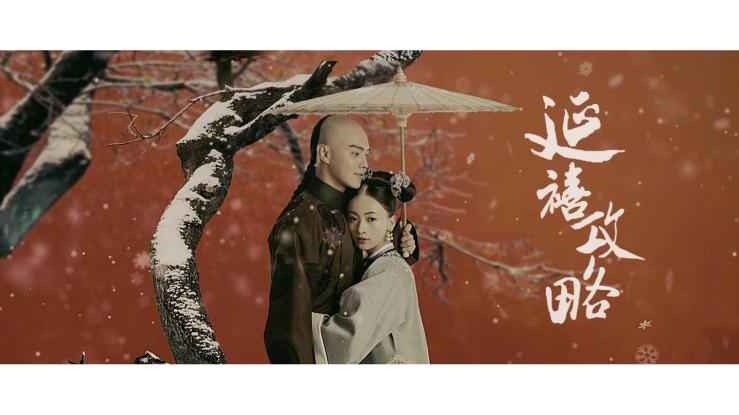
When you watched through the various scenes of the two Qing Dynasty based television series that was broadcast this year of 2018, in which set in the middle of the Qing Dynasty period of 如懿傳Ruyi’s Royal Love in the Palace- Qianlong Emperor (25 September 1711 – 7 February 1799) the fourth Qing Dynasty Emperor in which the fifth followed in the series of 延禧攻略Story of Yanxi Palace Yongzheng Emperor (13 December 1678 – 8 October 1735) in which are the most watched series in the Asian Communities globally….. in which both storylines carried onward respectively of each other..
Among both series, there was one continuous uses of a timeless wardrobe accessory among many that story tells the scene is the umbrella, in which is an Chinese invention in which was constantly used in everyday life also beyond today, in which was constantly used in rainy, snowing scenes in如懿傳Ruyi’s Royal Love in the Palace also 延禧攻略Story of Yanxi Palacewithin, and outside of the palaces of the Forbidden City, During those time periods of Qing Dynasty and before…….
Chinese Traditional umbrellas are made out from forest bamboo’s found exploring to find which trunk is the best to craft out from. In which finding that best bamboo to craft out from is an art form to which Master Silk Umbrella craftsman Song Zhiming has been making Silk Umbrella for more than a few decade now.. In which he uses the finest silk obtained from his Home city Hangzhou also the Embroidery aswell to transplant craft fully onto the Bamboo framed umbrella in which is crafted to open the ribs with steel wires to join the bamboo frames together..
Chinese Traditional silk Umbrellas comes in two parts the bamboo, also the silk, embroidery silk that forms the artwork canopy shade of the Umbrella. The Bamboo is sourced from it natural environment in which grade is best to use to crafted out from.. With the traditional tools that been used for many thousands of years ago with modern tools to hand craft the details.. The secondary part is the Silk or with fine silk or embroidery. In which is bound by glue, proxy onto the bamboo canopy rib frame works then its’ dried out, traditionally in which this case a dried hot iron does the work. But in traditional methods a small pot of amberic coal that forms the iron helps to dry out the glue, binding the silk to the bamboo frame stronger, with additional frame work to strengthen the canopy.. in which does the applications of protectively sheltering from the rain, sunshine.. In which is the designated function of an elegant hand carried artwork that accessorize your wardrobe..
Traditionally hand crafting the Silk Bamboo Umbrellas is the Master Silk Umbrella craftsman Song Zhiming has been making Silk Umbrella for more than a few decade now.. In which he uses the finest silk obtained from his Home city Hangzhou.. in which he’s also the representative inheritor of China’s intangible cultural heritage in which his art works in creating hand Crafting West lake Silk Bamboo Umbrellas founded him Song Zhiming’s Xihu Silk Umbrella Skills Master Studio, in developing a factory studio to hand craft to catering towards international and local domestic fashion.. With the traditional embroidery silk, or the non-traditional silk with the same craftsmanship to cater for a modest tier market in which will gather more sales due that the frabic is rain proof than the traditional one in which decorative to shade out from sunlight…. The ones that are traditional canopies ones are rainproof is made out from a mixture of oil layered lacquer hemp paper interwoven so it can be used in rain…