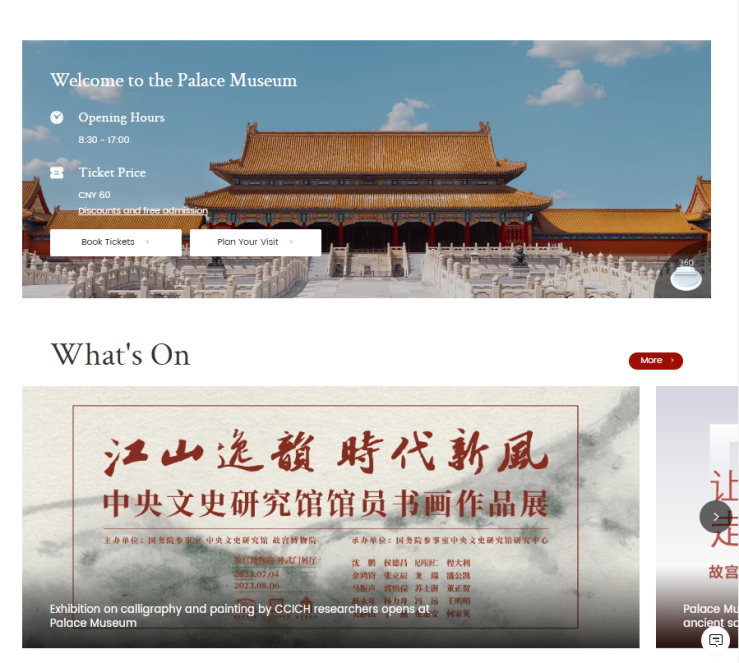
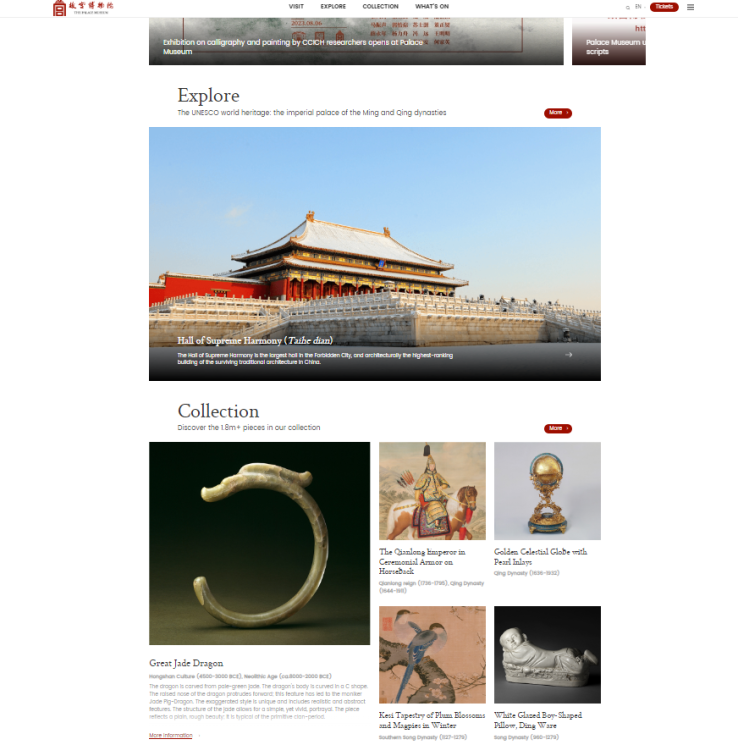
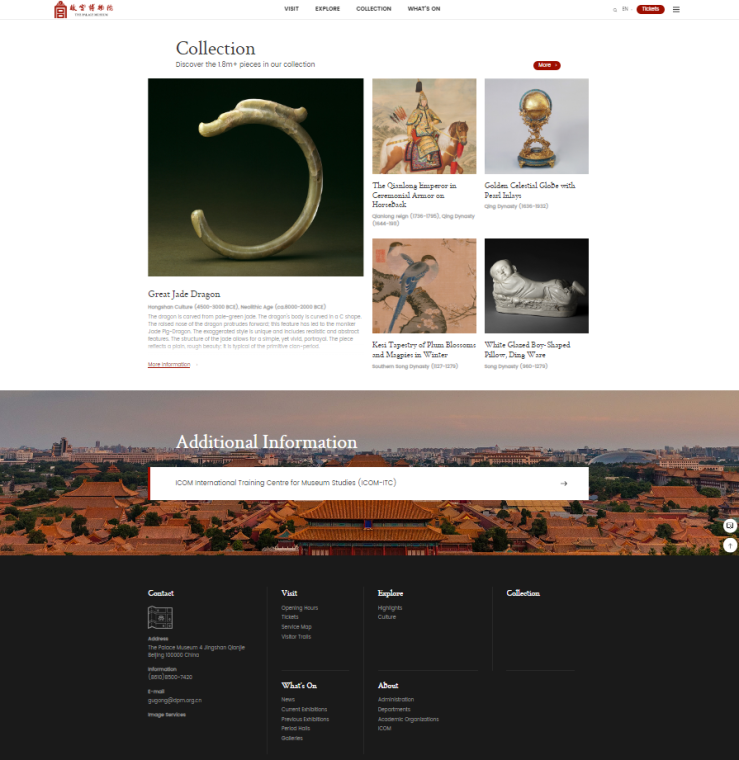
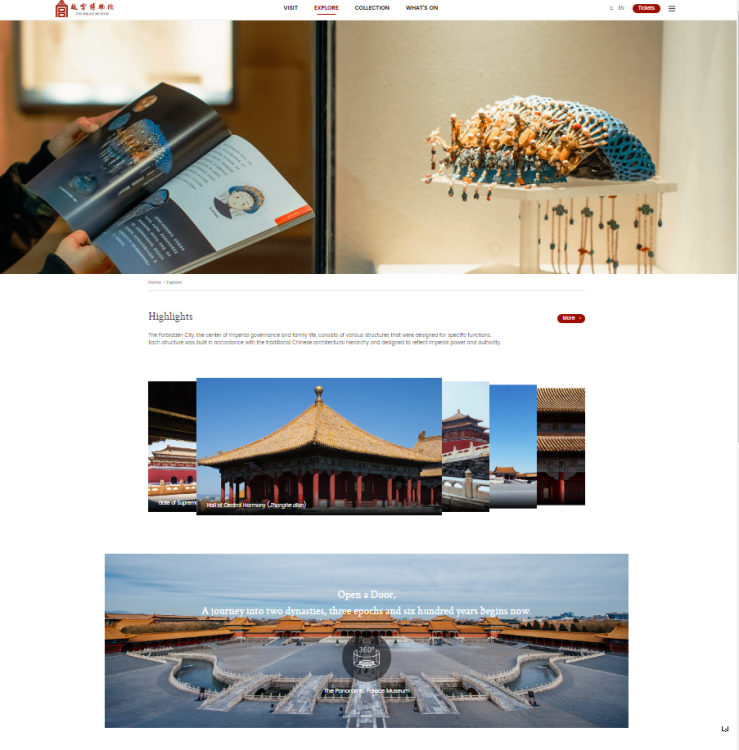
On July 19th 2023 , the multilingual website of the Forbidden City Palace Museum- Beijing, China, People’s Republic of Chinawas officially released at the Digital Cultural Tourism Development Forum of the 2023 China Internet Civilization Conference! The website covers five languages: English, French, Russian, Japanese, and Spanish, and will meet the needs of audiences with different languages.
The multilingual website of the Palace Museum is committed to establishing an international website that is concise, clear, easy to use for overseas audiences, and fits the construction of the modern civilization of the Chinese nation, including tour guides, information, panoramic tours, online exhibitions, collection appreciation, cultural topics, etc. Rich immersive content describing of the most detail collection that housed within the Forbidden city collection… .
“The sound of birds and the shadows of flowers attract people to live in”. The blossoms are pink and white, and the birds are singing, which is the most pleasant scene. The apricot ranking is ranked first, the spring breeze is proud, and there is joy and joy.
Today on the 8th October- 24th October 2023 is 寒露Cold Dew, the twilight is getting earlier and the dew is cold. It’s late autumn, remember to put on more clothes and keep warm 爱尊城……everyone.
The traditional Chinese calendar divides a year into 24 solar terms. Hánlù, Kanro, Hallo, or Hàn lộ is the 17th solar term. It begins when the Sun reaches the celestial longitude of 195° and ends when it reaches the longitude of 210°.
Interior view of the bridal chamber of Kunning Palace. In the bridal chamber, there is a floor-to-ceiling kang bed with a gourd and vine pattern of “囍” and dragon and phoenix, and a tent with a dragon and phoenix in auspicious “囍” pattern. A bedding is placed on the kang, and a plaque hangs “The sun rises and the moon stays forever.” There is a saying in the book of the emperor and empress of Tongzhi that “the two rituals of movement and coordination will make the husband smooth; the light will shine on the four sides, and the rising sun will praise the husband and the moon.” Therefore, the plaque contains the meaning of blessing. The vine gourd symbolizes the endless supply of melons, which corresponds to the couplet on the indoor wall: “The precious gourd lasts forever, the eight poles of mankind and heaven rejoice; the gold and yellow flowers flourish, the sun and moon shine brightly in the sky”.
Bamboo
“snow-covered sloping tips lean against the north wind”. The slim bamboo can also tower over the clouds and cling to the green mountains. Between the dense green and sparse shadows, the common sense of all things is revealed, showing the demeanor of a gentleman.
Qing Dynasty, silver and gold-plated account hook with the word “囍”. Chinese tent hooks have a long history. Bronze tent hooks were used as early as the Warring States Period, and they have been used continuously since then. In the Qing Dynasty, palace tent hooks were roughly divided into three categories: wedding celebrations, birthday celebrations, and auspiciousness. This is the wedding celebration category. There are small rings on the tent hooks for hanging, and the word “囍” is created in the middle and at the bottom of the semicircular hook, which can be described as meticulous.
“Beautiful flowers and pavilions leaning on the painted bridge”. Eating fresh food can relieve irritability, and observing postures can purify the mind. The round lotus sheds dew, the gentle breeze spreads the fragrance, and the summer scenery in the pond is overwhelming.
Qing Dynasty, red satin embroidered with a picture of a hundred children. This hundred-child picture account is the left half of the folded account. The account is embroidered with children with different expressions, which means more children and more blessings. Because Emperor Guangxu’s wedding took place in winter, this Baizi picture tent is a folder tent, which is warmer than a gauze tent. This account is made of exquisite materials and superb techniques. It is both practical and ornamental. It is a very exquisite piece of woven and embroidered art.
在palace中文 Look for the beauty of the country in the brocade, and enjoy the colourful colours in the courtyard. After seven days of fragrance-seeking journey, I hope the road ahead will be bright and worry-free, and the fragrance of flowers will always accompany you on a smooth journey!
Guangxu of the Qing Dynasty, bright red satin embroidered quilt with golden 囍 pattern for generations. The main color of the quilt is bright red, with gold “囍” patterns embroidered on it. There are also patterns such as pomegranates, bats, gourd vines, lotus round boxes, plums, orchids, bamboos and chrysanthemums, wishing the emperor and the queen a harmonious married life and future generations. This quilt is not only practical, but also has a beautiful meaning. But good intentions did not change the cruel reality. Emperors Tongzhi and Guangxu, who held wedding ceremonies in the Forbidden City, had no heirs, and the idea of five generations living under one roof became a fantasy.
From September 2 to November 30th 2023 , “Tea·World—Tea Culture Special Exhibition” will be on display at the Meridian Gate and East and West Yanchi Tower exhibition halls of the Forbidden City Beijing Palace Museum, China, people’s Republic of China . This exhibition is hosted by the Palace Museum and brings together representative collections from 30 archaeological and cultural institutions at home and abroad, with a total of 555 exhibits (groups). The exhibition is divided into four sections: Tea came from China, the tea ceremony is peaceful, the tea road is thousands of miles long, and the tea charm is long. With a distinctive theme and a grand scale, it three-dimensionally displays the Chinese tea civilization that transcends history, connects regions, and integrates nations. During the exhibition, a tea cultural and creative experience space was also opened in the Northeast Chonglou of Meridian Gate, allowing visitors to immerse themselves in the charm of tea culture. China Construction Bank serves as the joint promoter of the exhibition, and Longfor Group serves as the public welfare supporter of the exhibition to jointly support the exhibition activities. This exhibition is free to visit with Palace Museum tickets. Visitors must make a real-name reservation in advance through the “Forbidden City Museum” WeChat applet…
“The World of Tea: Special Exhibition on Tea Culture” opened at the Wu men (the Meridian Gate) Exhibition Hall of the Palace Museum on Friday in Beijing. From September 2 to November 30, 2023, the exhibition welcomes the public to explore a curated collection of tea-related artifacts. Presented by the Palace Museum, an array of tea-related treasures sourced from 30 esteemed cultural institutions and museums, both domestically and internationally, are on display at the exhibition. With an impressive assemblage of 555 cultural relics, encompassing individual pieces and intricate sets, this exhibition illuminates the fascinating journey of Chinese tea civilization. Furthermore, it provides insights into this cultural phenomenon’s origins, evolution, and remarkable achievements while emphasizing how tea has acted as a unifying thread connecting diverse regions and fostering the integration of various ethnic groups.
The exhibition’s opening ceremony was held on Friday at the Baoyun Lou (Hall for Accumulated Treasures) of the Palace Museum. Distinguished guests included Wang Xudong, a member of the Party Leadership Group of the Ministry of Culture and Tourism and director of the Palace Museum; Rao Quan, a member of the Party Leadership Group of the Ministry of Culture and Tourism and vice minister of culture and tourism; Guan Qiang, a member of the Party Leadership Group and deputy administrator of the National Cultural Heritage Administration; Shan Jixiang, president of the Chinese Society of Cultural Relics and former director of the Palace Museum; Liu Yuzhu, chairman of the China Foundation for Cultural Heritage Conservation; Liu Zhonghua, an academician with the Chinese Academy of Engineering and a professor at Hunan Agricultural University; Fung Ming Chu, former director of the Taipei Palace Museum; Lin Zhongyue, chairman of the Cross-Straits Tea Exchanges Association; and Cheng Pei-kai, former chairman of the Hong Kong Intangible Cultural Heritage Advisory Committee. Representatives from participating exhibitors, officials from cultural and museum departments in Beijing, representatives from societies, associations and foundations, experts and scholars, and leaders of the Palace Museum also attend the opening ceremony. Wang Xudong, director of the Palace Museum; Sergei Nilov, head of the Department of Russian Culture and History of the Russian State Hermitage Museum; Li Yun, executive vice president of China Construction Bank; and Song Yao, vice president of the Longfor Group and vice chairman of Longfor Foundation, all delivered speeches. Kang Hui, a well-known Chinese TV host, presided over the opening ceremony.
In November 2022, the United Nations Educational, Scientific, and Cultural Organization (UNESCO) acknowledged Chinese traditional tea processing techniques and their associated social practices in its intangible cultural heritage list. This noteworthy recognition marks a significant stride in promoting Chinese tea culture and facilitating deeper cross-cultural exchanges and mutual learning.
To further these objectives, the Palace Museum has organized “The World of Tea: Special Exhibition on Tea Culture.” This exhibition seeks to advance the systematic protection of intangible cultural heritage, stimulate innovative developments in China’s rich traditional culture, and fortify the bonds within the Chinese nation while showcasing the allure of Chinese culture on a global scale. Through the medium of this exhibition, the Palace Museum delves into the depths of tea history, explores the intricacies of the tea ceremony, and celebrates the diversity of tea-related activities. Using tea as a conduit, it elucidates the essence of Chinese tea culture, which greatly emphasizes the values of harmony and unity.
Tea originated in China and is popular worldwide. Legend has it that the Chinese were already aware of and making use of tea during the era of Shennong (who is considered the first Yan Emperor and an ancestor of the Chinese people). In Zhejiang Province, roots of artificially cultivated tea trees dating back about 6,000 years have been discovered. In Shandong Province, remains of boiled tea leaves dating back about 2,400 years were discovered in ancient tombs from the Warring States Period (476-221 BC), making it the oldest known evidence of tea drinking. Since the Han Dynasty (202 BC-220 AD), the tea preparation and drinking methods were diversified, including eating, frying, whisking, boiling, and steeping. Drinking tea has evolved into a cultural activity that sates an aesthetic thirst. The Chinese have combined their thoughts on life, the nation, nature, and the universe with daily practices, forming the essence of tea culture. The widespread embrace of tea within China has acted as a catalyst, promoting interactions among people from diverse regions and ethnic backgrounds who all share a deep affection for this cherished beverage. Furthermore, the global dissemination of tea has acted as a conduit for cultural fusion across the vast expanse of the Eurasian continent.
The exhibition delves into tea culture and fully presents the development of Chinese civilization and its interactions with other civilizations, all through the lens of tea as a medium. The exhibition comprises four sections, each illuminating a distinct facet of tea’s rich history and cultural significance.The first section explores the origins of tea in China, tracing its development over thousands of years and its pivotal role in politics, economics, and cultural exchanges. On display are cultural relics from the Qing Dynasty (1644-1911), including preserved tea leaves, export paintings, and combinations of various objects. The second section delves into the essence of the tea ceremony, featuring a collection of notable paintings and calligraphy from the Palace Museum, as well as ancient texts and excavated tea sets. In the third section, the exhibition traces the global spread of tea from China to various parts of the world, highlighting how different cultures adopted and adapted tea culture. Exhibits include exquisite tea sets from the UK, Japan, and Russia, unique tea sets used in the Qing Dynasty court, and foreign-style tea sets produced by the Imperial Workshop of the Qing Dynasty. The fourth and final section discusses the enduring appeal of tea culture, emphasizing its diverse and integral role in people’s daily lives across the globe. Rooted in tradition, it showcases tea culture’s ongoing development and prospects.
The exhibition spans from the Neolithic Age to the present day. It highlights the development and adoption of tea culture over thousands of years, as well as its embodiment of Chinese philosophical ideals such as unity of nature and man and universal harmony. The exhibits include ancient green-tea tree roots unearthed from the Tianluoshan site of the Hemudu culture (about 5000 BC to 4000 BC) in Yuyao, Zhejiang Province, pushing back the timeline of tea planting in China to about 6,000 years ago. Tea bowls and remains of boiled tea leaves were unearthed from a tomb of the Warring States Period in Zoucheng of Shandong Province, making it the oldest known evidence of tea drinking. The exhibition also features unearthed tea leaves from the Han and Song (960-1279) dynasties, along with over 40 pieces or sets of tribute tea (Gong Cha in Chinese) from the Qing Dynasty collected by the Palace Museum. Together, these cultural relics document China’s over 6,000-year history of tea cultivation and utilization. On display for the first time, a complete set of tea wares unearthed from a Tang Dynasty (618-907) tomb in Qujiangzhuang of Changzhi City, Shanxi Province, in 2022 is one of the most recent archaeological discoveries reflecting Tang Dynasty tea culture. The painting Spring Banquet illustrates a gathering of literati around a rectangular banquet table, with tea-related tools such as tea spoons and tea cups on it, offering a snapshot of how Song Dynasty literati enjoyed tea. A painted clay sculpture of the “Tea Sage” Lu Yu, originally displayed in the Emperor Qianlong’s tea room in Chengde Mountain Resort, is also featured. Accompanying this sculpture are tea sets and a statue from the Tang Dynasty unearthed in Gongyi, Henan Province. The statue is believed to be a representation of Lu Yu. From the Tang to the Qing Dynasty, the once-in-a-millennium meeting of two statues of Lu Yu is unprecedented in the history of tea culture.
This exhibition features a total of 555 pieces or sets of exhibits, including 227 from representative collections of 30 cultural institutions and museums both domestically and internationally. These collections are sourced from esteemed institutions such as the National Library of China, the National Museum of China, the China National Tea Museum, the Institute of Archaeology of the Chinese Academy of Social Sciences, the Museum of Ethnic Cultures of Minzu University of China, the Management Center of Ming Tombs in Beijing’s Changping District, the Shanghai Museum, the Tianjin Library, the Museum of Heilongjiang Province, the Hebei Provincial Institute of Cultural Relics and Archeology, the Xinjiang Uygur Autonomous Region Museum, the Shaanxi Academy of Archeology, the Famen Temple Museum, the Hanyangling Museum, the Gongyi Museum, the Shandong University Museum, the Changzhi City Cultural Relics Protection Research Center (Changzhi City Archaeological Research Institute), the Xiyang County Cultural Relics Institute (Xiyang County Museum), the Hunan Provincial Institute of Cultural Relics and Archeology, the Hunan Museum, the Nanjing Museum, the Guizhou Provincial Museum, the Zhejiang Provincial Institute of Cultural Relics and Archeology, the Guangdong Provincial Museum, the Shaowu Museum, the Opium War Museum, the Russian State Hermitage Museum, the British Victoria and Albert Museum, and the Tokyo National Museum and the Idemitsu Museum of Arts in Japan.
“The World of Tea: Special Exhibition on Tea Culture” comes with an exhibition catalog. Simultaneously, the Palace Museum’s official website will initiate online exhibition tours. Moreover, multiple channels and formats will be adopted to promote the exhibition, including the museum’s official accounts on Weibo, WeChat, and online video platforms. The Palace Museum will sequentially present a series of public academic lectures to facilitate visitors to understand the exhibition. Please stay tuned for lecture announcements on the “The Palace Museum Publicity and Education” official WeChat account.
During the exhibition, a tea-related cultural and creative products experience space is open to visitors at the Chonglou (the Lofty Pavilion) in the northeast of Wu men (the Meridian Gate). This unique space is a dedicated area for cultural and creative exploration, highlighting the essence of tea culture within the Forbidden City, with a theme centered around “thousands of feet of snow.” By seamlessly integrating elements such as white jade carving, meticulous mortise and tenon craftsmanship, and the iconic red wall color, visitors are invited to fully immerse themselves in the captivating allure of traditional Chinese culture while indulging in a profound tea culture experience.
China Construction Bank, as the joint promoter of the exhibition, and Longfor Group, as the public welfare supporter, have collaborated to support the exhibition activities. During the exhibition, the Palace Museum and China Construction Bank will launch the fifth round of new precious metal cultural and creative products – the “Divine Animals of the Forbidden City.”
Admission to this exhibition is free with a Palace Museum ticket, and visitors can make real-name reservations through the “Palace Museum” WeChat mini-program.
On July 19th 2023 , the multilingual website of the Forbidden City Palace Museum- Beijing, China, People’s Republic of Chinawas officially released at the Digital Cultural Tourism Development Forum of the 2023 China Internet Civilization Conference! The website covers five languages: English, French, Russian, Japanese, and Spanish, and will meet the needs of audiences with different languages.
The multilingual website of the Palace Museum is committed to establishing an international website that is concise, clear, easy to use for overseas audiences, and fits the construction of the modern civilization of the Chinese nation, including tour guides, information, panoramic tours, online exhibitions, collection appreciation, cultural topics, etc. Rich immersive content describing of the most detail collection that housed within the Forbidden city collection… .
During the Months of late July towards early August 2023 it has been serve Rainstorms in Beijing in which the 603 year old Forbidden city Drainage has been designed very well in countering those intense weather conditions….
去我们一起来读计划 In the Guangxu period of the Qing Dynasty, a red silk embroidered gold Xi word butterfly pattern single cloak. Cloaks, shirts, waistcoats, etc. are all casual clothes worn by concubines in the Qing Dynasty, and they are also gorgeous and colorful parts of court costumes. According to Guangxu’s “Great Wedding Ceremony Red Documents”, the items prepared by Emperor Guangxu for the queen’s wedding include: a total of 236 pieces of casual clothes such as shirts, cloaks, tights, ragged coats, and mandarin jackets of various materials. Forty-four pieces of clothing, eighty sets of various inner garments, eighty pairs of various shoes and socks, etc. “Red Archives of Tongzhi Wedding Ceremony in the Qing Dynasty” also has records of the colors, textures, patterns and craftsmanship of the various garments in the queen’s dowry. This cloak should be the summer casual clothes of Emperor Guangxu, Empress Xiao Dingjing. The whole body is covered with red silk, mainly with gold thread, and the Chinese character “囍” is embroidered with hundreds of butterflies. Butterflies are a symbol of happiness and love, and the word “囍” in Baidie means a happy marriage for a hundred years….
去我们一起来读计划 In the Guangxu period of the Qing Dynasty, a single cloak with bright yellow silk embroidered with peony circles and longevity patterns. This cloak is the concubine’s summer casual dress, with bright yellow plain silk as the ground, embroidered with lake-colored, white, and light-green silk threads to embroider peony flowers with folded branches, and decorated with flat gold embroidered group “Shou” in between. The neckline, sleeves and hem are all traditional auspicious patterns, woven with gold dancing butterfly tapestry and Yuanqing satin flat gold “Shou” peony border, the color matching is very coordinated, and the embroidery is exquisite, highlighting the imperial royal clothing .
去我们一起来读计划 Qing and Ming yellow silk 囍 word mink fur coat. The Palace Museum has a wide variety of ready-made garments for empresses and concubines of the Qing Dynasty, available in all seasons and in various textures. Manchu people who originally lived in the cold region of Northeast China, their love for fur products has not diminished in the slightest after entering the customs. Wool products such as winter clothing and crown hats occupied an important position in the ceremonial clothing of the Qing Dynasty. What grade and type of fur people of different status levels wore was also determined in the system…..
[The Forbidden City opened a new exhibition in Xinjiang! 】On July 28 2023, “Glory of the Flourishing Age-Exhibition of Qing Dynasty Palace Jade Collected by the Palace Museum” opened in the “Forbidden City Hall” of the Xinjiang Uygur Autonomous Region Museum. This exhibition is also the first appearance of the “Forbidden City Hall” of the museum. For thousands of years, the excellent cultures of various ethnic groups have converged and jointly created a brilliant Chinese civilization. Among them, jades in the Qing Dynasty used a large number of unique Xinjiang jade materials, with excellent materials, regular shapes, and designs .
去我们一起来读计划 Guangxu in the Qing Dynasty, a small waistcoat with pink and gold 囍 word butterfly pattern on the front. This vest is the queen’s daily casual dress, also known as tight-fitting, round neck, double-breasted, sleeveless, with open skirts on both sides and back. The pink ground on the front and back and the back, as well as the stone-blue garment hem, are woven with the word “囍”, interspersed with a pair of colorful butterflies dancing together, implying happy reunion. The rich and colorful dowry costumes of the empress not only reflect the noble status of the empress and the exquisiteness of the wedding in the emperor’s home, but also show the exquisite craftsmanship of our country’s weaving and embroidery.
Qing, Qing Kuan, etc., the queen’s dowry picture of the big wedding picture. This is the end of the dowry procession in “The Queen’s Dowry Picture”. The scene depicted is the dowry procession walking outside the Donghua Gate, carrying some red sandalwood carved boxes and a pair of red sandalwood carved cabinets as the final push. So far, the queen The 200 dowries carried into the palace were all carried into the palace, and the two-day dowry delivery event came to an end. During the entire process of the dowry entering the palace, in order to protect the safety of the dowry all the way, the troop carrying the dowry is composed of the school lieutenant Luan Yiwei and various personnel from the Ministry of Internal Affairs. , the Ministry of Internal Affairs, etc. will be taken care of along the way.
There is a time to see the end of the day when the clouds are cleared. When the wind stops and the rain stops, enjoy the beautiful sunlight and the fragrance of golden stamens together. Hello August….!
去我们一起来读计划 Qing, Qingkuan, etc., set up a welcome picture (partial) in the album of big wedding pictures. In the evening before the big wedding, the emperor of the Qing Dynasty held a grand canonization ceremony at the queen’s mansion first, and then welcomed the queen into the palace when she was a child. Although registration and welcome are two consecutive etiquettes, they are actually completed over two days. The sixth volume of Emperor Guangxu’s “Big Marriage Picture” “Collecting the Picture of Ingratiation” depicts the process of these two pre-wedding ceremonies, including 16 pages of images and 6 pages of illustrations. The following set of pictures are all taken from this volume. This is part of the page of “Picture of Salutation at the Palace of Compassion and Peace” The wedding ceremony of Emperor Guangxu was scheduled to be held on the twenty-seventh day of the first lunar month in the fifteenth year (1889). On the twenty-sixth day of the first lunar month, before the welcoming procession set off, Emperor Guangxu went to the Cining Palace to salute Empress Dowager Cixi and announce that he was about to become a queen. The eight pieces of gold in the empress dowager’s ceremonial car are located in Ciningmen Square. On the east side are the gold furnace, gold incense box, gold spit pot, and gold bottle; , Jinping, and the golden chair in the south.
去我们一起来读计划 Qing, Qingkuan, etc., set up a welcome picture in the album of big wedding pictures. These two pages show spectacular scenes, collectively known as “Pictures of Reception and Reception in the Palace of Imperial Harmony”. After Emperor Guangxu saluted the Empress Dowager in the Palace of Compassion and Ning, he was led by officials from the Ministry of Rites to the Hall of Supreme Harmony, where he first received the congratulations from the ministers, and then appointed envoys. In the picture, the senior scholar stands under the east eaves of the Hall of Supreme Harmony, the cabinet officials, publicity officials, and officials of the Ministry of Rituals stand behind the senior scholar, the envoys, deputy envoys, and saluting princes and ministers kneel on Majesty Dan, and His Majesty Dan is more Saluting civil and military officials ranked according to the grade level according to the grade mountain mark, waiting for the emperor to come…..
去我们一起来读计划Qing , Qingkuan, etc., the album of the big wedding picture sets up a welcome picture (partial); the interior view of the Hall of Supreme Harmony. This is a part of the “Picture of the Welcome Ceremony in the Book of the Palace of Imperial Harmony”. On the screen, there is a festival table in the middle of the Hall of Supreme Harmony, with a red lacquer festival frame on the table. There are book cases and treasure cases on the left and right, and a gold box on the top, which is used to hold the gold book and the queen’s treasure. Under the eaves of the Hall of Supreme Harmony, there are eight pieces of gold from the Emperor’s Fajia brine book, namely, two gold furnaces, two gold vases, two gold incense boxes, one gold spit pot, and one gold washbasin. Under the east and west eaves of the Hall of Supreme Harmony, there are Zhonghe Shaoyue chime bells, chime chimes and other musical instruments.
去我们一起来读计划Qing , Qingkuan, etc., the album of the big wedding picture sets up a welcome picture (partial); the interior view of the Hall of Supreme Harmony. This is a part of the “Picture of the Welcome Ceremony in the Book of the Palace of Imperial Harmony”. On the screen, there is a festival table in the middle of the Hall of Supreme Harmony, with a red lacquer festival frame on the table. There are book cases and treasure cases on the left and right, and a gold box on the top, which is used to hold the gold book and the queen’s treasure. Under the eaves of the Hall of Supreme Harmony, there are eight pieces of gold from the Emperor’s Fajia brine book, namely, two gold furnaces, two gold vases, two gold incense boxes, one gold spit pot, and one gold washbasin. Under the east and west eaves of the Hall of Supreme Harmony, there are Zhonghe Shaoyue chime bells, chime chimes and other musical instruments.
The umbrella cover (replica) in the emperor’s brine book. The umbrella covers in the emperor’s law driving brine book include: curved nine-dragon cover, emerald green cover, purple sesame cover, straight handle nine-dragon cover, five-color flower cover, five-color dragon cover and red and purple two-color square umbrellas. The picture shows the five-color flower cap with straight handle.
The fan (replica) in the emperor’s brine book. The fans in the emperor’s law driving brine book include longevity fans, double dragon fans, single dragon fans, peacock fans, pheasant tail fans, and phoenix fans. They are square and round in different shapes, and red, yellow, and green. The four pieces shown in the middle are fans, the one on the right is a battle-axe, and the one on the left is a leopard-tailed gun used by the leopard-tailed squad.
去我们一起来读计划 Qing, Qingkuan, etc., set up a welcome picture (partial) in the album of big wedding pictures. This is a part of the “Picture of the Welcome Ceremony in the Book of the Palace of Imperial Harmony”. It depicts princes and ministers, civil and military officials, and chief and deputy envoys standing in sequence, waiting for the emperor to preside over the ceremony in person, and appointing envoys to go to the queen’s residence for registration and welcome ceremony. The details in the picture can be seen in various fans, buildings, flags, banners, Jing, flags, weapons, etc. in the ceremonial guard of the halogen book, and the musical instruments of Danbi Dale are placed under the eaves on both sides of the Taihe Gate.
On July 19th 2023 , the multilingual website of the Forbidden City Palace Museum- Beijing, China, People’s Republic of Chinawas officially released at the Digital Cultural Tourism Development Forum of the 2023 China Internet Civilization Conference! The website covers five languages: English, French, Russian, Japanese, and Spanish, and will meet the needs of audiences with different languages.
The multilingual website of the Palace Museum is committed to establishing an international website that is concise, clear, easy to use for overseas audiences, and fits the construction of the modern civilization of the Chinese nation, including tour guides, information, panoramic tours, online exhibitions, collection appreciation, cultural topics, etc. Rich immersive content describing of the most detail collection that housed within the Forbidden city collection… .
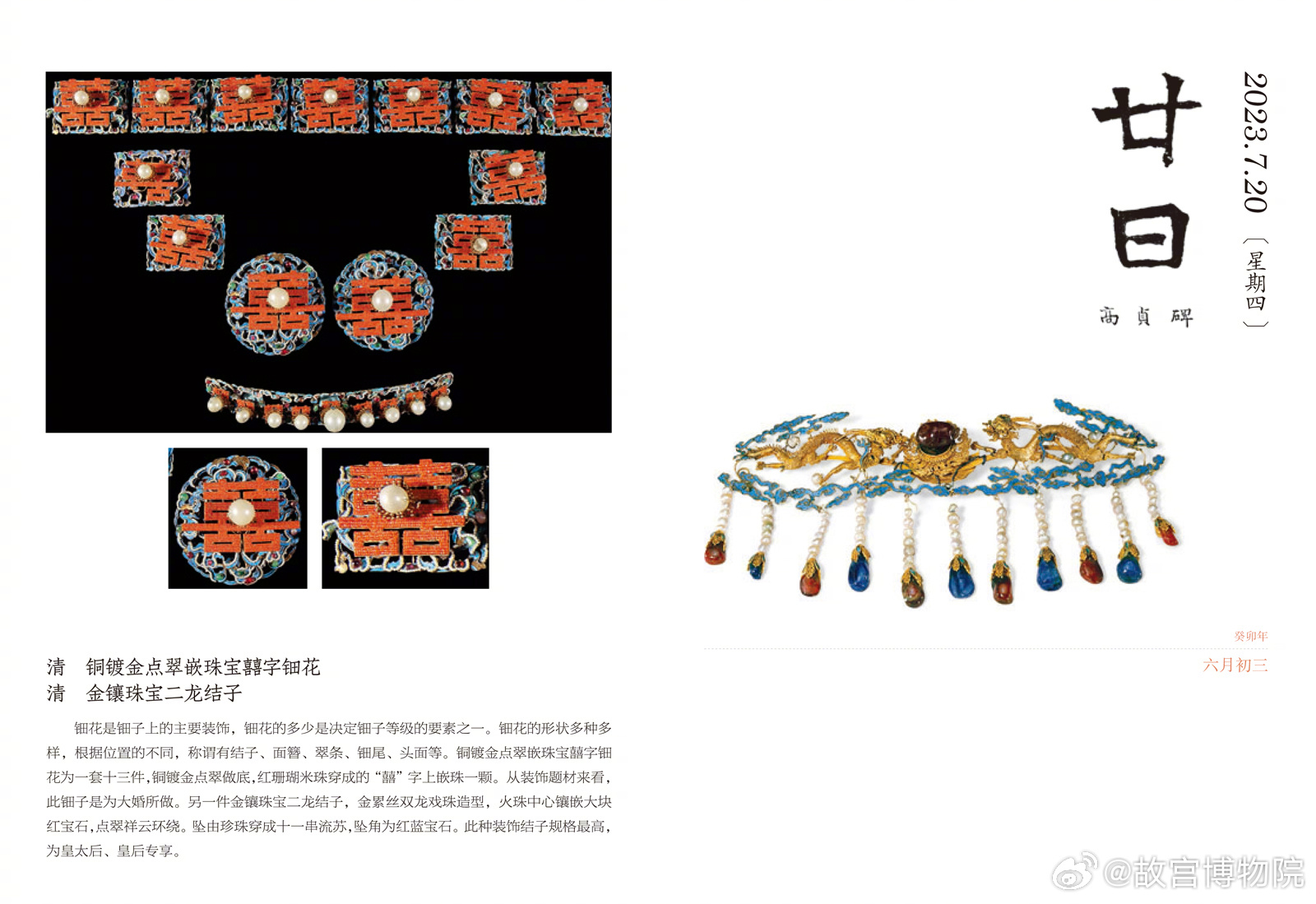
In the Qing Dynasty, gold-plated copper dots emerald inlaid with jewelry and the word Tianhua; in Qing Dynasty, gold-plated jewelry with two dragon knots. Tin flowers are the main decoration on the tin, and the number of tin flowers is one of the factors that determine the grade of the tin. Tin flowers come in a variety of shapes, and depending on their location, they are called knots, face hairpins, green strips, tin tails, head faces, etc. Gold-plated copper dot emerald jewels inlaid with the word “囍” is a set of thirteen pieces, with gold-plated copper dot emerald as the base, and a bead embedded in the character “囍” made of red coral rice beads. Judging from the decorative theme, this tin is made for a big wedding. Another piece of gold inlaid jewelry is a two-dragon knot, in the shape of two dragons playing with gold silk. The center of the fire bead is inlaid with a large ruby, surrounded by green and auspicious clouds. The pendant is made of pearls threaded into eleven strings of tassels, and the corners of the pendant are red sapphires. This kind of decorative knot has the highest standard and is exclusively used by empress dowagers and empresses.
Qing Daoguang, silver-plated hairpin with gold-plated emerald dots inlaid with gemstones, and Tongzhi in Qing Dynasty, silver-plated hairpin with gold-plated gemstones and fake beads and phoenix pattern. In the jewelry of concubines, there are a large number of hairpins of various types, and although they have different themes, they all have auspicious meanings. The number of pearls and the types of gemstones on these jewelry reflect the rank and status of the jewelry owner. Three pieces of silver – plated emerald “囍” character hairpins, with pearls inlaid on the center “囍” character, “囍” character above and below…
In the Qing Dynasty, the golden chiseled word butterfly pattern is flat and square. Bianfang is a unique headdress for Manchu noblewomen in the Qing Dynasty, and it is also a bracket used for dressing up the “two heads”. It has a similar function to the long hairpin used by Han women. This flat square is made of gold, chiseled with sesame seeds as the ground, with a circle of flowers and grass patterns chiseled on the frame, six dancing butterflies and five “囍” characters chiseled inside the frame, and a bat chiseled on the head, implying the double arrival of happiness and happiness. It is a special decoration for the queen’s wedding…
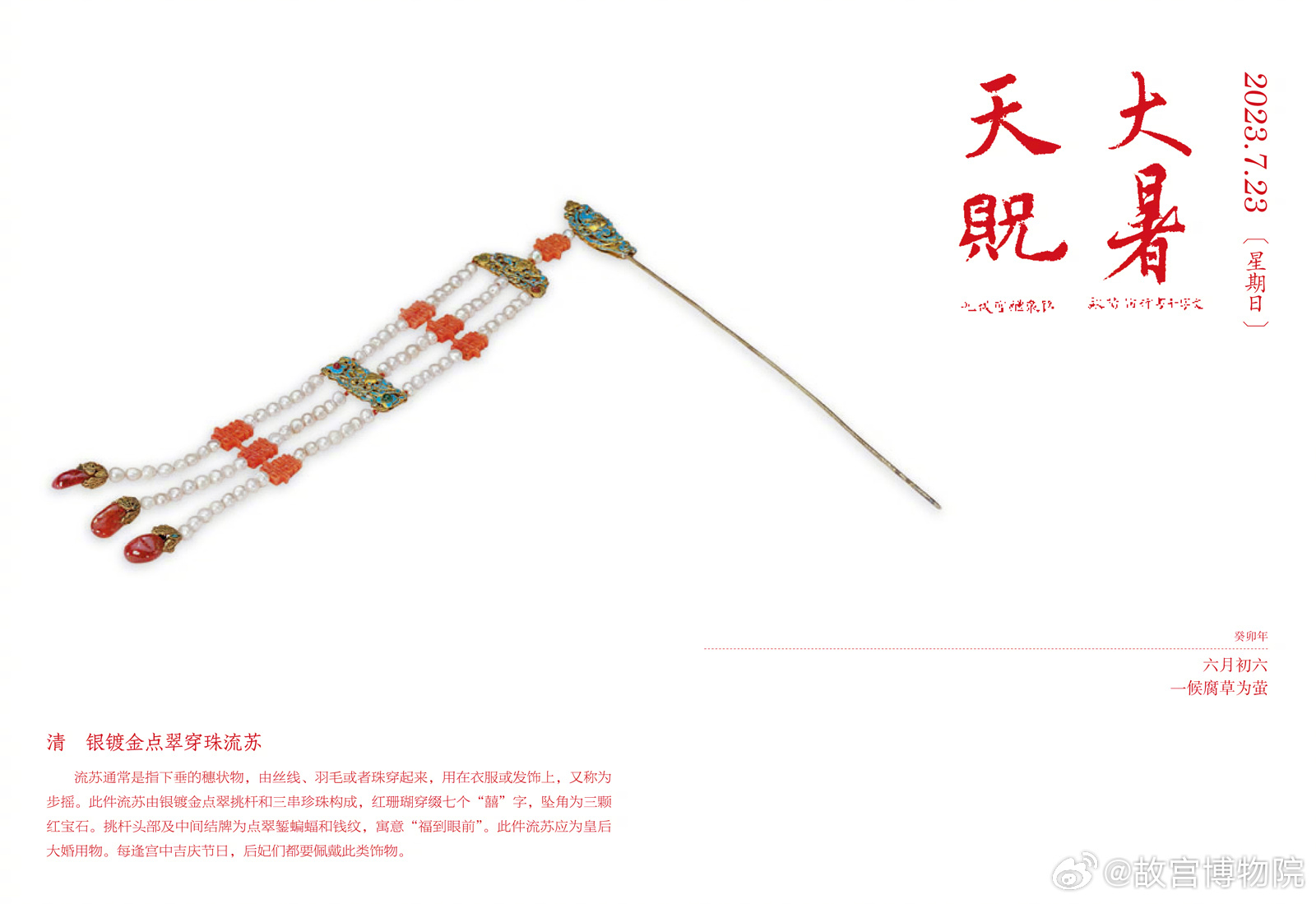
Clear, silver-plated dots emerald beads tassels. Tassels usually refer to drooping tassels, threaded by silk threads, feathers or beads, used on clothes or hair ornaments, also known as step shakes. This tassel is composed of silver-plated dot emerald poles and three strings of pearls. The red coral is embellished with seven “囍” characters, and the pendant corners are three rubies. The head of the pole and the knot in the middle are dotted emerald chiseled bats and money patterns, which means “blessings come to you”. This tassel should be used for the queen’s wedding. Every auspicious festival in the palace, concubines have to wear such ornaments.
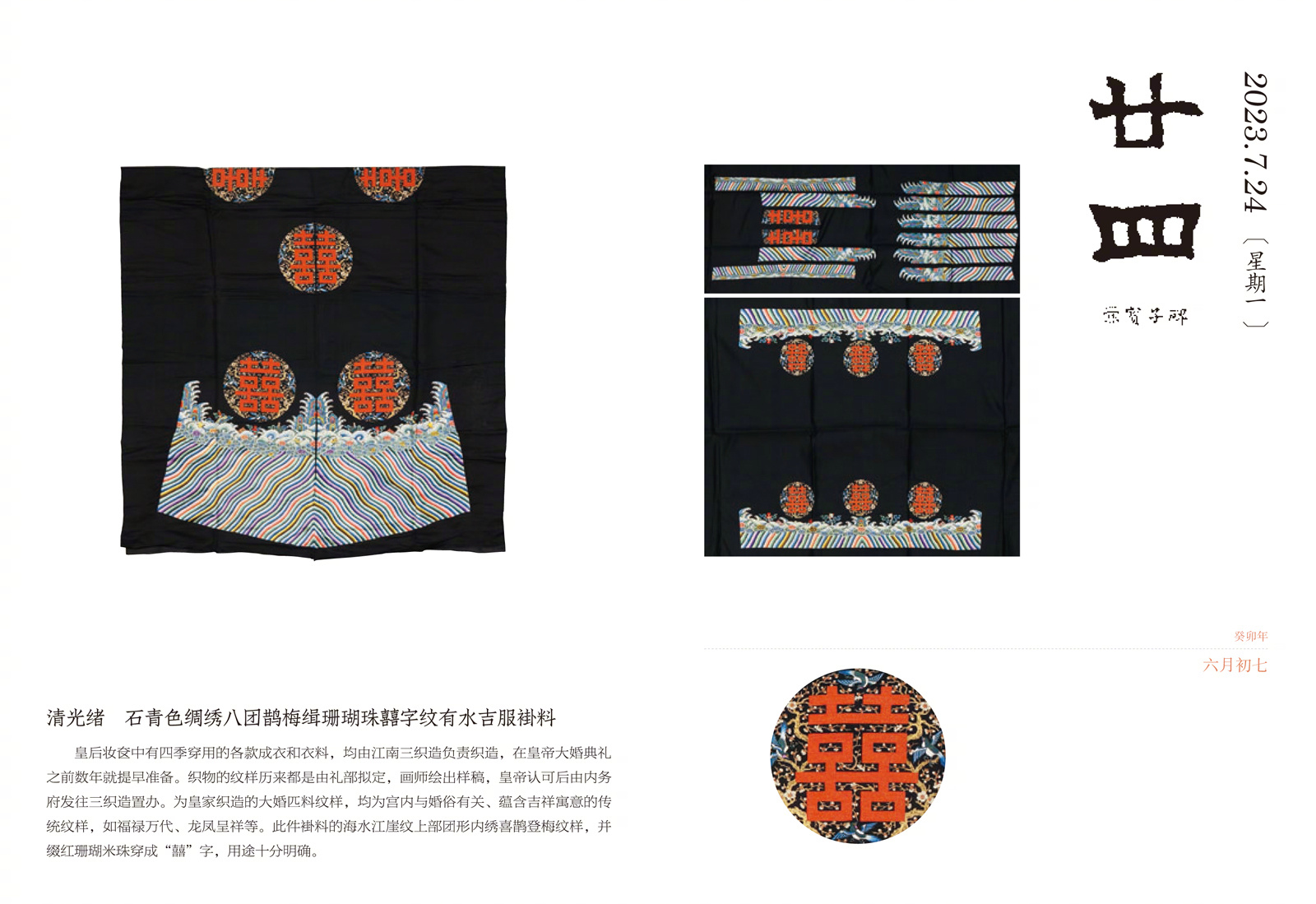
Qing Guangxu, stone blue silk embroidered with eight groups of magpies, plums, coral beads and Chinese characters, with water and auspicious clothing materials. The queen’s dowry includes all kinds of ready-made clothes and materials for the four seasons, all of which are woven by Jiangnan Sanzhi, which is prepared in advance several years before the emperor’s wedding ceremony. The pattern of the fabric has always been drawn up by the Ministry of Rites, and the artist draws a sample draft. After the emperor approves, the Ministry of Internal Affairs sends it to Sanzhizao for purchase. The wedding patterns woven for the royal family are all traditional patterns that are related to marriage customs in the palace and contain auspicious meanings, such as Fulu Bandai, Dragon and Phoenix Bringing Good Fortune, etc. The seawater river cliff pattern of this gown is embroidered with a magpie and a plum pattern on the upper part, and decorated with red coral and rice beads to form the character “囍”. The purpose is very clear.
Qing Guangxu, bright yellow silk embroidered with eight groups of magpies, plums, coral beads and 囍 characters, with Shui Jifu gowns. This gown is embroidered with bright yellow silk, with eight embroidered plum blossoms in full bloom, four magpies jumping on the branches, and red coral rice beads in the middle to form the character “囍”, with distinct layers and echoing up and down. Bright yellow is the imperial color exclusively used by the royal family. The magpie and plum blossoms imply happy brows, and the word “囍” pressed on the top implies happiness on top of happiness, highlighting the joy and peace of the emperor’s wedding. Plum blossoms have strong cold resistance, and they can brave the severe cold and bloom alone in the middle of winter when all the flowers are withered. Emperor Guangxu’s wedding coincided with the midwinter when plum blossoms were in full bloom, and such patterns added a festive atmosphere to the wedding..
On July 19th 2023 , the multilingual website of the Forbidden City Palace Museum- Beijing, China, People’s Republic of Chinawas officially released at the Digital Cultural Tourism Development Forum of the 2023 China Internet Civilization Conference! The website covers five languages: English, French, Russian, Japanese, and Spanish, and will meet the needs of audiences with different languages. The multilingual website of the Palace Museum is committed to establishing an international website that is concise, clear, easy to use for overseas audiences, and fits the construction of the modern civilization of the Chinese nation, including tour guides, information, panoramic tours, online exhibitions, collection appreciation, cultural topics, etc. Rich immersive content.