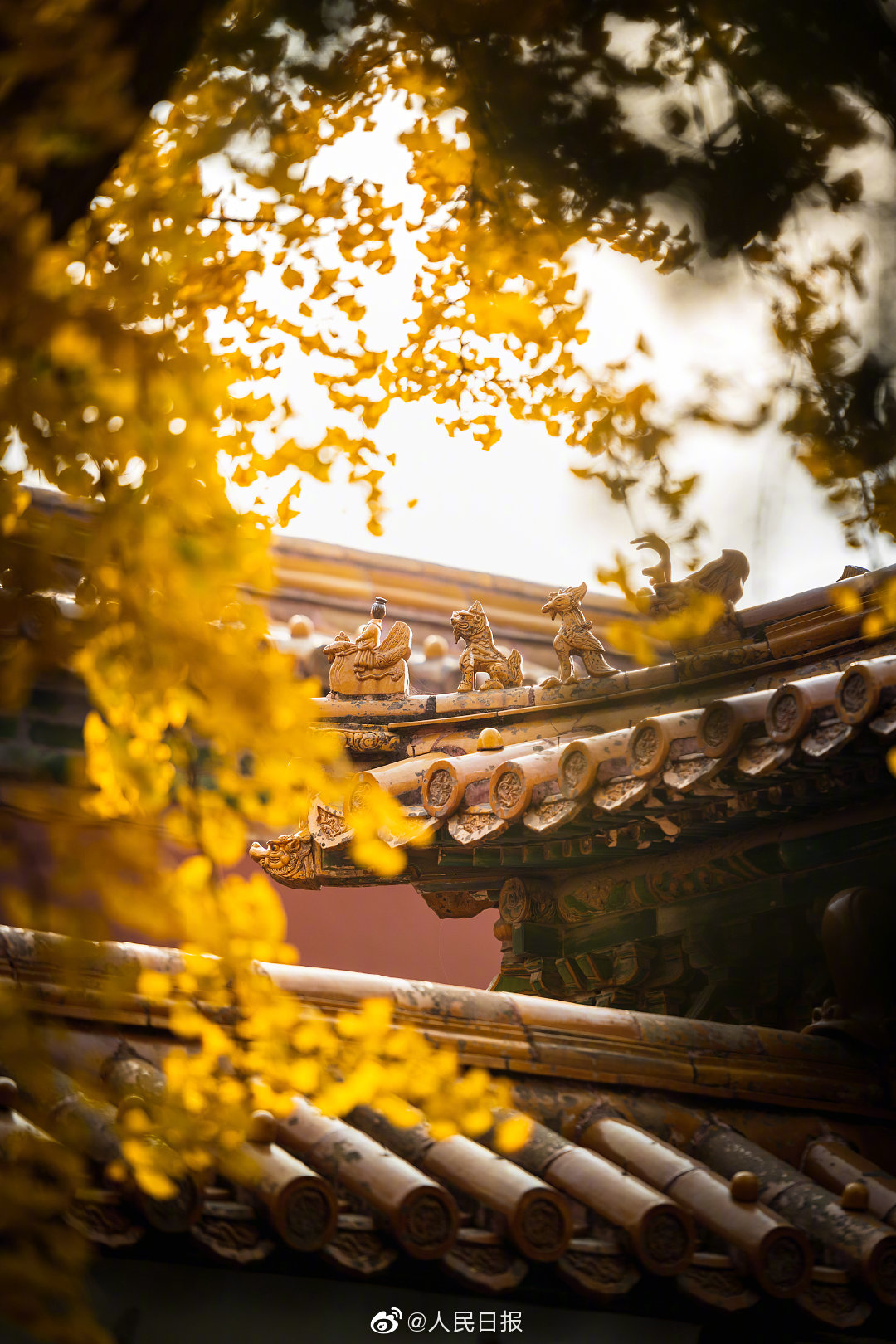
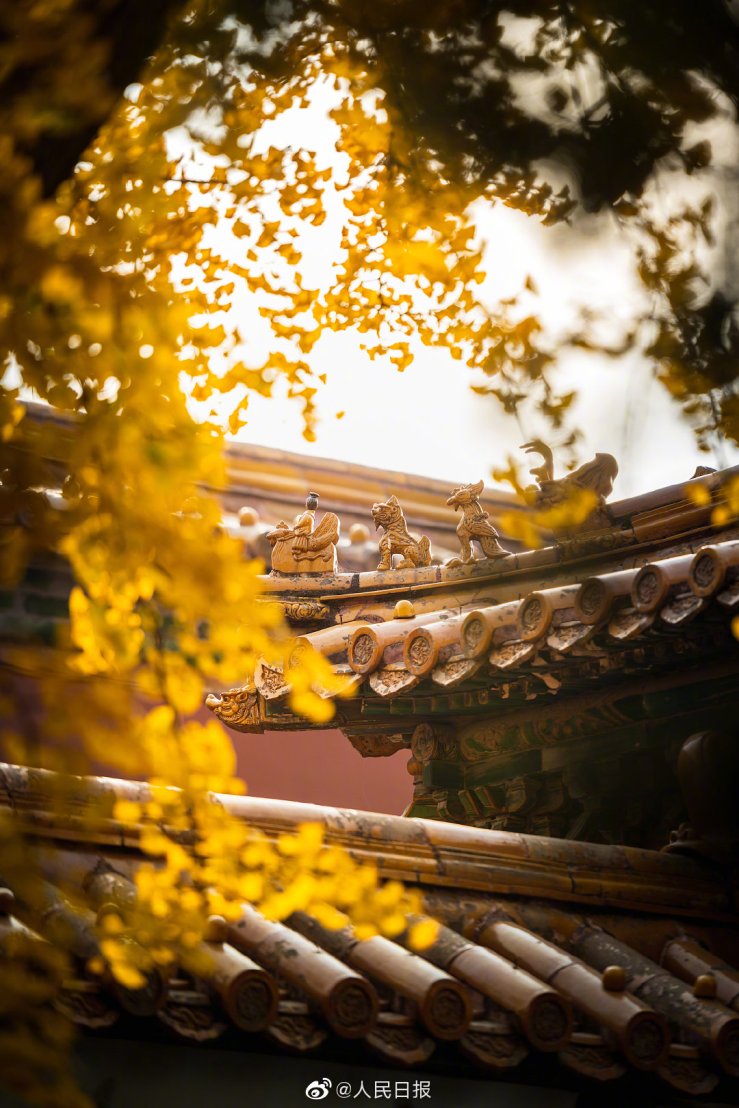
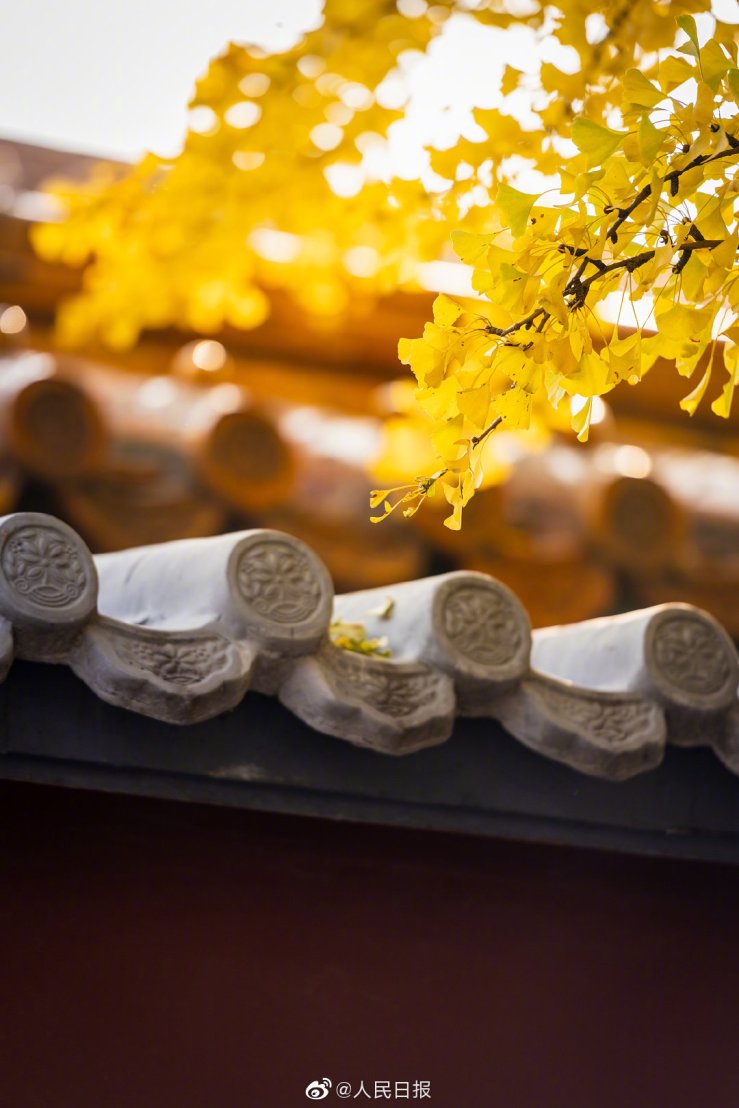
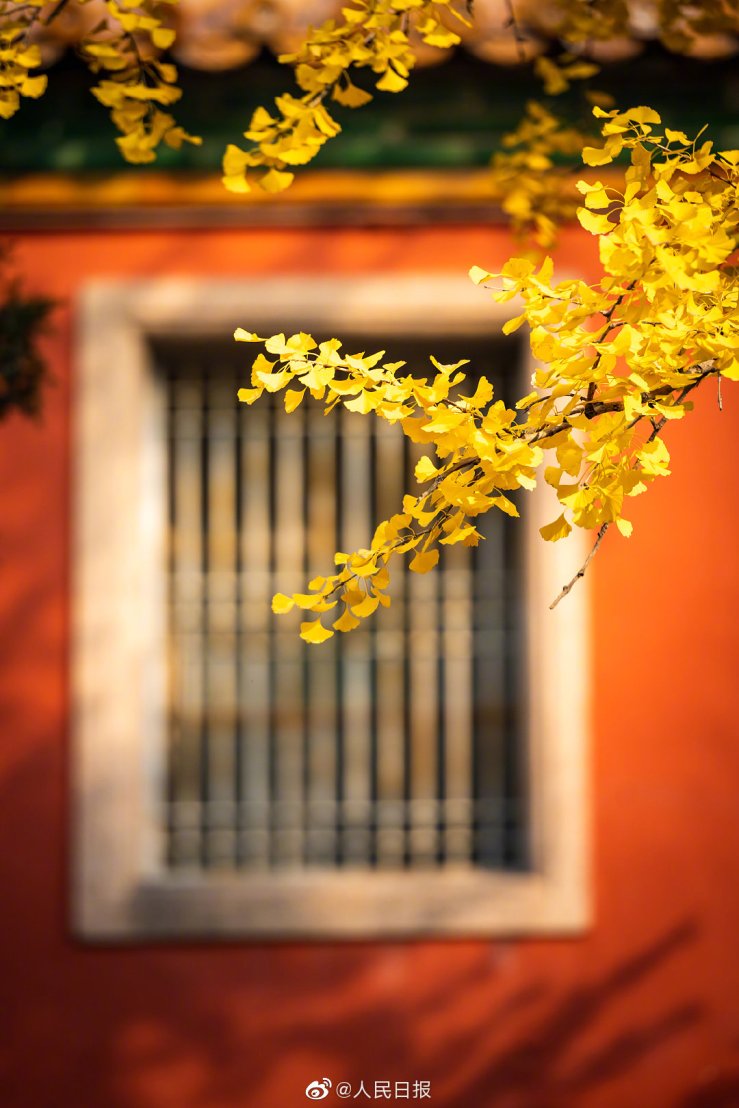
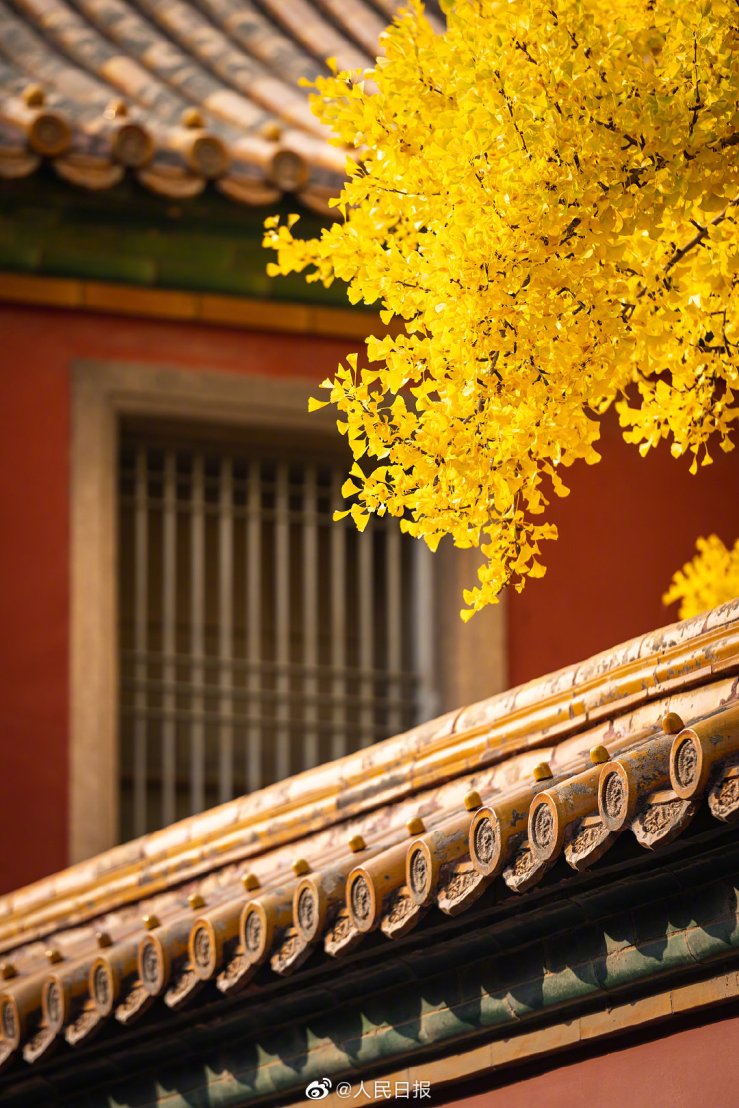
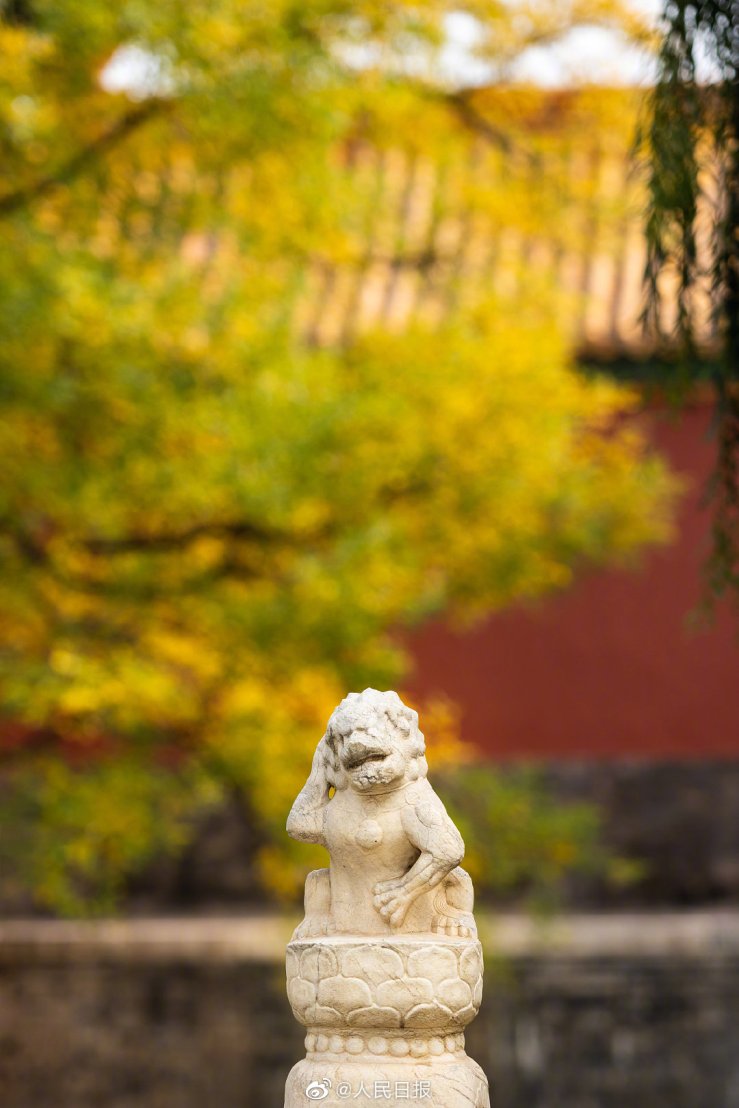
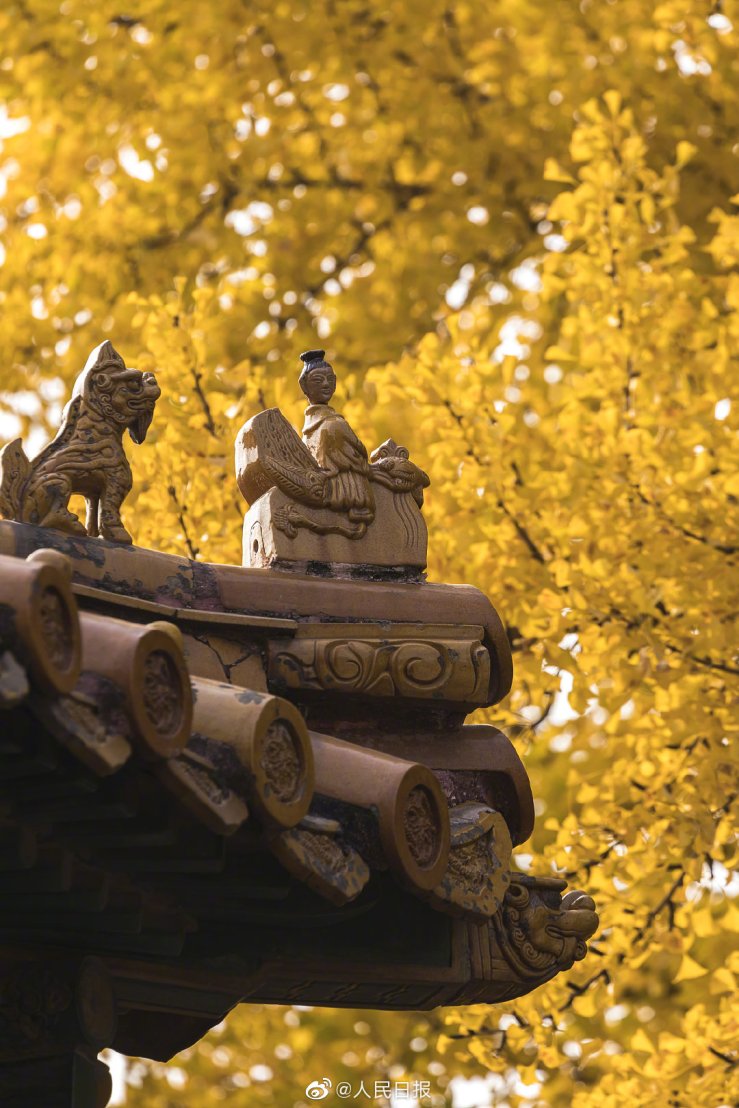
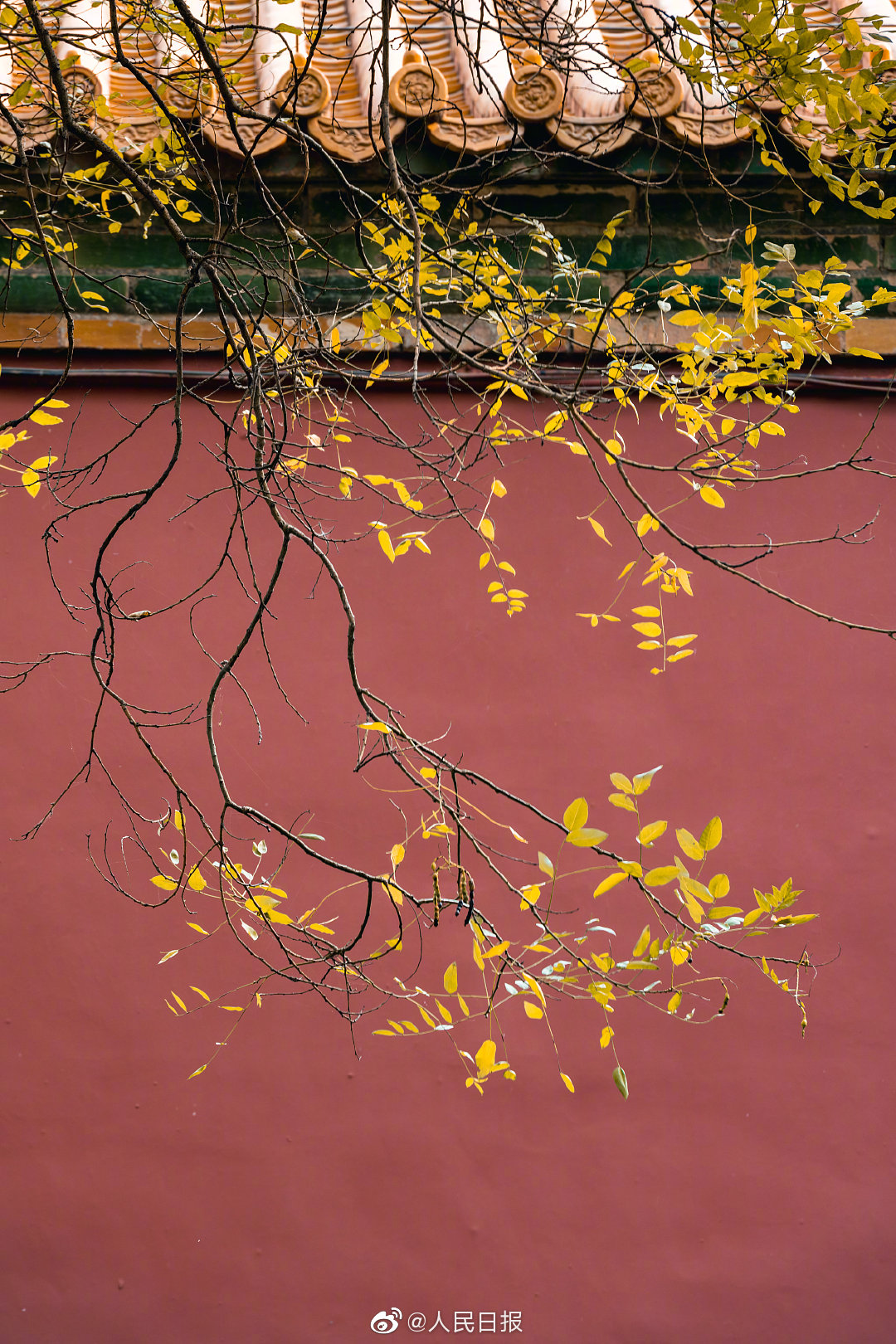
On the 31st October 2021 Sunday week it’s Autumn in the Forbidden City palace – Beijing –China- People’s Republic of China, in which it has been with beautiful blue skies with Chinese Painting white Clouds storytelling Beijing Ancient postmodern megatroplis city scape… along the 601 year old Forbidden city is looking from inside of the Forbidden city in which it’s trees glow in the Autumn Sunlight … in which photographer on 31st October 2021 OneDayFoto旅行摄影 have brilliant captured the Autumn sunlight amberically glowing the Ginkgo trees of the Grounds of the Forbidden city on the grounds of the gate of the Yanxi Palace in which has a strong rich history..
The Hall of Prolonging Happiness (Yanxi gong) was destroyed by fire during the Daoguang reign (1821-1850). In 1931, a few years after the Palace Museum was founded, three two-storied warehouses were built for storing artifacts. In 2005, the museum installed the Research Center for Traditional Calligraphy and Paintings in the east warehouse, the Research Center for Ceramics in the west warehouse, and a Ceramics Laboratory in the central warehouse.
It used to be the residence of consorts and concubines during the Ming and the Qing dynasties. After the destruction, it remained in ruin. In 1909, the Qing government initiated the construction of a western-style “Hall of water” in a pool. The hall is built on a white marble base, with iron cast and glass walls and floors. By its completion, water would be filled into the poll surrounding the hall, so that people inside the pavilion could view the swimming fish through the transparent glass walls. It is popularly known as the “crystal palace”. However, not long after the project was launched it stopped due to the tight budget. Now, the marble carvings and the iron cast are only for visitors to imagine.
……the second decade from the turn of the century in Beijing the Capital of China also the People’s Republic of China, in which is also the year of the rat, marking its six hundred years anniversary of the Forbidden city that marks the transitional point of in between the middle of the Ming Dynasty (1368- 1644) transitionally from Nanjing to Beijing towards the Qing Dynasty (1636-1644-1911) …. The Imperial Palace seen so many countless seasonally transitional equinoxes but further its six hundred years is iconic, but it’s five hundred ninety nine years it marks it Autumn Equinox…. In which it only took twelve years to build the same of the Daming Palace of The Tang Dynasty Xian Imperial Capital only it was least twenty times larger……
On the 31st October 2021 Sunday week it’s Autumn in the Forbidden City palace – Beijing –China- People’s Republic of China, in which it has been with beautiful blue skies with Chinese Painting white Clouds storytelling Beijing Ancient postmodern megatroplis city scape… along the 601 year old Forbidden city is looking from inside of the Forbidden city in which it’s trees glow in the Autumn Sunlight …
……the second decade from the turn of the century in Beijing the Capital of China also the People’s Republic of China, in which is also the year of the rat, marking its six hundred years anniversary of the Forbidden city that marks the transitional point of in between the middle of the Ming Dynasty (1368- 1644) transitionally from Nanjing to Beijing towards the Qing Dynasty (1636-1644-1911) …. The Imperial Palace seen so many countless seasonally transitional equinoxes but further its six hundred years is iconic, but it’s five hundred ninety nine years it marks it Autumn Equinox…. In which it only took twelve years to build the same of the Daming Palace of The Tang Dynasty Xian Imperial Capital only it was least twenty times larger……
In this year’s 2021, the second decade from the turn of the century in Beijing the Capital of China also the People’s Republic of China, in which is also the year of the OX, marking its six hundred and one year’s anniversary of the Forbidden city that marks the transitional point of in between the middle of the Ming Dynasty (1368- 1644) transitionally from Nanjing to Beijing towards the Qing Dynasty (1636-1644-1911) …. The Imperial Palace seen so many countless seasonally transitional equinoxes but further its six hundred years is iconic, but it’s five hundred ninety nine years it marks it Autumn Equinox…. In which it only took twelve years to build the same of the Daming Palace of The Tang Dynasty Xian Imperial Capital only it was least twenty times larger..
In which during the time of the Ming Dynasty Ming Dynasty (1368- 1644) transitionally from Nanjing to Beijing there’s are many variations of the Forbidden City complexes each have similarities in architectural Design Heritages in all cases the share the same philosophy of havening the central axis in which the city is fixed towards the Northern Pole Star BeiDou – Polaris in which helps to find North as the compass points as the remaining Beijing Forbidden City designed out with all the astronomical compass points …
How many “forbidden cities” are there in China? There are Several. And their similarities and differences are shedding light on ancient mysteries as excavations uncover them…..For centuries, the Forbidden City, officially known as the Palace Museum today, has stood in the heart of Beijing and witnessed the rise and fall of dynastic power and the nation’s ongoing rejuvenation….. in a which the several sites have the same average characteristics of This roughly 720,000-square-meter compound that served as the imperial palace from 1420 to 1911 is also the world’s largest surviving palatial complex…… But the prequel to this architectural splendour, hidden about 1,000 kilometers away in Fengyang county, Anhui province, is much lesser known worldwide, although it was inscribed on the list of key heritage sites under national-level protection as early as 1982.
The Ming Dynasty (1368-1644) Zhongdu (literally, the central capital) site could be thought of as “the Forbidden City mark one the first one” the second one in Beijing Forbidden City complex is Mark two.. The 840,000-square-meter imperial city in Zhongdu is slightly bigger than its younger cousin in Beijing. Its construction began in 1369, one year after the Ming Dynasty’s founding.
Soon after Zhu Yuanzhang, who was once a poor peasant toppled the ethnic Mongolian Yuan Dynasty (1271-1368) in China and built up his own empire, he decided to make his hometown the national capital.
An ambitious urban-infrastructure project began, and the emperor later bestowed the auspicious name Fengyang (literally, a rising sun like a flying phoenix) upon his home county. The Zhongdu Forbidden city archaeologist from the Palace Museum in charge of the excavation says a much larger outer city was then planned around the palatial section.
Archaeological investigation shows the city could cover 50 square kilometers, including military facilities, temples, mausoleums and nobles’ residential areas in addition to the palatial compound…. Among the investigations have covered most areas within the Zhongdu Forbidden City, and we know the layouts of its major buildings, roads and waterways……
More other similarities among the palace compounds in Zhongdu and Beijing may become apparent as excavations of the greater area around Zhongdu proceed.
. The perspective of Zhengyangmen Wengcheng.
For instance, there’s a hill to the north of the palatial city of Zhongdu. Likewise, Jingshan Hill is just across the road from the northern exit of the Palace Museum today. Jingshan Hill was created from earth piled up while digging the moats surrounding the Forbidden City.
2. View from Tiananmen Square.
The Zhongdu site hosts counterparts of Beijing’s Forbidden City’s major outer city gates-the Eastern Prosperity Gate, the Western Prosperity Gate, the Meridian Gate and others.
3. Jingshan perspective.
And an area by the southern entrance of Zhongdu’s imperial city was cleaned up in 2018, unveiling Chengtianmen (the Gate of Accepting the Heavenly Mandate)…. There’s a similar structure in Beijing, which was renamed Tian’anmen (the Gate of Heavenly Peace) in 1651….Some local legends say there were “five dragon bridges” underground in the area, but Wu’s team found seven.The bridges also have famous counterparts in front of Tian’anmen, known as Jinshuiqiao.
4. Hongwumen, the capital of the Ming Dynasty.
Though information about Zhongdu’s city gates is clearly recorded in history, detailed information about its inner palaces is vague….. archaeological team has dug deeply in the core of the palatial city to further scrutinize connections between Zhongdu and Beijing’s Forbidden City.
5.Daming Gate in the middle of the Ming Dynasty.
The ongoing excavation is on the ruins of Zhongdu’s “Number One Palace”. Although no hints have been found to its specific historical name, its location is presumably on par with the “three great halls” in its Beijing counterpart.
6.The ancient city of the Emperor of the Ming Dynasty.
The so-called “three great halls “on the axis of the Forbidden City’s outer section include the Hall of Supreme Harmony, the Hall of Central Harmony and the Hall of Preserving Harmony. The first hall is the highest-status structure in the Forbidden City. It was only used for the most important ceremonies during the imperial era.
7. The reconstruction of the Daming Gate area of the Forbidden City in Nanjing.
“We’ve figured out the basic H-shaped layout of (Zhongdu’s) palace grounds, which is similar to the Forbidden City,”
8. Modeling and restoration of Chengtian Gate of the Forbidden City in Nanjing.
A firewall stands at the same location in the Forbidden City, but Wu explains that the wall was added during the Qing Dynasty (1644-1911), and the original layout during Ming Dynasty matched this new finding in Zhongdu.
However, there doesn’t seem to be a Forbidden City equivalent to a wall with three gates 20 meters north of Zhongdu’s “No 1 Palace”.
And even more confusing is that no structure similar to the Hall of Central Harmony has been discovered in Zhongdu.
Nanjing, which is today’s capital of Jiangsu province, became the emperor’s alternative as the national capital.
Zhu Yuanzhang ordered builders to prioritize stability instead of luxury in his “Forbidden City 2.0” there. His son, Zhu Di, the third Ming emperor, inherited that principle. Zhu Di, who previously resided in Beijing as a prince, won a civil war in 1402 and moved the national capital to his home city.
9. Modeling and restoration of the Palace City of the Forbidden City in Nanjing.
After massive construction starting from 1417 and lasting for three years, the “Forbidden City Mark Three” in Beijing was finished, and the city became the Ming capital a year later.
However, its predecessors, including the abandoned one in Fengyang and the completed one in Nanjing, both crumbled in the following centuries, as continuous wars and social upheavals destroyed most aboveground structures…..
A summary of the three capitals of the Forbidden City in Beijing, the Forbidden City in Nanjing and the imperial city of the Ming Dynasty in the Ming Dynasty.
The reconstruction of the Nanjing Forbidden City is for reference only. It is estimated based on the actual Wuchao Gate, East and West Hua Gate and the remains of the three major halls. In order to prevent the impact on the surrounding sensitive areas, the background of the Forbidden City in Nanjing is blurred here.
1. The perspective of Zhengyangmen Wengcheng.
2. View from Tiananmen Square.
3. Jingshan perspective.
4. Hongwumen, the capital of the Ming Dynasty.
5.Daming Gate in the middle of the Ming Dynasty.
6.The ancient city of the Emperor of the Ming Dynasty.
7. The reconstruction of the Daming Gate area of the Forbidden City in Nanjing.
8. Modeling and restoration of Chengtian Gate of the Forbidden City in Nanjing.
9. Modeling and restoration of the Palace City of the Forbidden City in Nanjing.
The Three Palaces in the Ming Dynasty had a great influence on the space of the city, but due to historical reasons, only the Forbidden City in Beijing has survived, and the Forbidden City in Nanjing and Fengyang have been greatly damaged, and it is even difficult to explore many forms of organization. Here is a comparison of the Sannomiya. I hope everyone will pay more attention to the cultural heritage of Fengyang and Nanjing. It is very difficult for some sites to survive. I hope you will visit more.
On the of Day of 1st October 2021Friday, on 0611 Hong Kong SAR – Beijing Time to celebrate the China’s founding of the People’s Republic of China.. In which there was multiple flag raising though out the Chinese Civilisation continent in which one prominent held in front of the Forbidden City Tian’anmen Fortress gate holding the traditionally Sunrise Daily Tian’anmen Square held a flag-raising ceremony to mark the 72nd anniversary of the founding of the People’s Republic of China at Tian’anmen Square in Beijing on Friday. Local residents and tourists from all walks of life from across China witnessed the event….. Greetingly also with The Macao Special Administrative Region government on Friday held a flag-raising ceremony at Golden Lotus Square to celebrate the 72nd anniversary of the founding of the People’s Republic of China….. Also too The Hong Kong Special Administrative Region (HKSAR) government held a ceremony at Golden Bauhinia Square on Friday morning to celebrate the 72nd anniversary of the founding of the People’s Republic of China. The national flag and the flag of the HKSAR were raised, in the presence of government officials and other representatives….
The hardest spine, the broadest shoulders, the brightest smile, and the warmest gaze….. The greatest pride and the most sincere love, dedicated to the great motherland China – People’s Republic of China in saying to Hello, October! Forbidden City in love with # drying out your side of the Chinese Red….
In this year’s 2020, the second decade from the turn of the century in Beijing the Capital of China also the People’s Republic of China, in which is also the year of the rat, marking its six hundred years anniversary of the Forbidden city that marks the transitional point of in between the middle of the Ming Dynasty (1368- 1644) transitionally from Nanjing to Beijing towards the Qing Dynasty (1636-1644-1911) …. The Imperial Palace seen so many countless seasonally transitional equinoxes but further its six hundred years is iconic, but it’s five hundred ninety nine years it marks it Autumn Equinox…. In which it only took twelve years to build the same of the Daming Palace of The Tang Dynasty Xian Imperial Capital only it was least twenty times larger..
On the Evening Night Day of 21st September 2021Tuesday, it was the One of the many Festive holidays in the Asian Chinese Communities throughout the world in which dates back to the Shang Dynasty 1600-1046 BC also Western Zhou Dynasty 1046- 771 BC.. on that previously day in which on the Mid-Autumn Festival : 中秋節, also known as Moon Festival or Mooncake Festival, is a traditional Chinese festival celebrated by many East and Southeast Asian countries and regions. It is the second-most important holiday after Chinese New Year with a history dating back over 3,000 years, when the Emperor of China worshipped the moon for bountiful harvests….
On the that21st September 2021Tuesday Evening Night there was massive crowds of people whom gathered around the moat areas of the Forbidden City- Beijing- China- People’s Republic of China.. in which people gathering in witness the full moon that over hanging over Forbidden City fortress walls in which with picturesque moments as the moon illuminated as an ancient golden amberically Chinese Lantern illuminating the Beijing Ancient Post Modern Ultra Megatroplis city landscape .. previously to the day it was the launch of the Chang Zheng – Long March seven Carrier Rocket daytime launching of Tianzhou three cargo module towards CNSA BRI CMS CSS –China National Space Administration- China Manned Space China Space Station in for the Shenzhou 13 preparations in the October Month from Wenchang Spacecraft launch centre – Hainan province…..
The festival is held on the 15th day of the 8th month of the Chinese lunisolar calendar with a full moon at night, corresponding to mid-September to early October of the Gregorian calendar. On this day, the Chinese believe that the moon is at its brightest and fullest size, coinciding with harvest time in the middle of autumn….
In the ancient past, there was a hero named Hou Yi who was excellent at archery. His wife was Chang’e. One year, the ten suns rose in the sky together, causing great disaster to the people. Yi shot down nine of the suns and left only one to provide light. An immortal admired Yi and sent him the elixir of immortality. Yi did not want to leave Chang’e and be immortal without her, so he let Chang’e keep the elixir. However, Peng Meng, one of his apprentices, knew this secret. So, on the fifteenth of August in the Chinese lunisolar calendar, when Yi went hunting, Peng Meng broke into Yi’s house and forced Chang’e to give the elixir to him. Chang’e refused to do so. Instead, she swallowed it and flew into the sky. Since she loved her husband and hoped to live nearby, she chose the moon for her residence. When Yi came back and learned what had happened, he felt so sad that he displayed the fruits and cakes Chang’e liked in the yard and gave sacrifices to his wife. People soon learned about these activities, and since they also were sympathetic to Chang’e they participated in these sacrifices with Yi.
After the hero Houyi shot down nine of the ten suns, he was pronounced king by the thankful people. However, he soon became a conceited and tyrannical ruler. In order to live long without death, he asked for the elixir from Xiwangmu. But his wife, Chang’e, stole it on the fifteenth of August because she did not want the cruel king to live long and hurt more people. She took the magic potion to prevent her husband from becoming immortal. Houyi was so angry when discovered that Chang’e took the elixir, he shot at his wife as she flew toward the moon, though he missed. Chang’e fled to the moon and became the spirit of the moon. Houyi died soon because he was overcome with great anger. Thereafter, people offer a sacrifice to Chang’e on every fifteenth day of eighth month to commemorate Chang’e’s action.