The Forbidden City Book Store which in the grounds of the Forbidden City Complex Forbidden City Hundred Excellent Books Public welfare reading activities! ” Forbidden City Hundred Excellent Books “The Way of Architecture of the Forbidden City “ Public Reading Activity Why is the Meridian Gate a perfect embodiment of the integration of gates and walls in ancient Chinese architecture? The book “Building the Forbidden City” wrote: The Meridian Gate was built in the eighteenth year of Yongle in the Ming Dynasty (1420), and rebuilt in the eighth year of Shunzhi (1651) and the sixth year of Jiaqing (1801) in the Qing Dynasty. The plane is concave, the pier is 12 meters high, there are 3 doors in the middle, and there is an east-west tuck door on each side, which is in the shape of “light, three, dark and five”.
A gate tower is built in the middle of the pier, with a width of 9 rooms totalling 60.05 meters, and a depth of 5 rooms totalling 25 meters. From the city wall to the ground, it is 37.95 meters high from the face to the right kiss. There are bell and drum pavilions on the left and right sides of the main building, each with 3 pavilions, and 13 corridors on each of the two wings. Quemen forms a square of more than 9,900 square meters to the south, with Jialiang on the left and a sundial on the right on the imperial road in front of the gate. There are horse roads on the inside of each of the four gate piers to the top of the city platform, and there are roads connected to facilitate defense communication. Meridian Gate is not only the highest, largest and most magnificent gate in the Forbidden City, but also a perfect embodiment of the gate-queue form of ancient Chinese architecture.
The Forbidden City Book Store which in the grounds of the Forbidden City Complex Forbidden City Hundred Excellent Books Public welfare reading activities! ” Forbidden City Hundred Excellent Books “The Way of Architecture of the Forbidden City” with this in mind explanation of the Detailed explanation of the five-door and three-dynasty system of the Forbidden City Palace Complex is the palace system of the Zhou Dynasty, representing orthodoxy, and it is the highest palace building level in ancient China, which has been almost inherited by all dynasties. Emperor Yongle of the Ming Dynasty transformed the city of Beijing, built the Forbidden City, and determined a new axis. However, he still followed the ancestral system and planned the Forbidden City in Beijing according to the Forbidden City in Nanjing.
Five gates and three dynasties were set up on the axis according to the “Rituals of Zhou”. During the Wanli period, the five gates were Daming Gate, Chengtian Gate, Duan Gate, Meridian Gate, and Huangji Gate, namely Fengtian Gate. The three dynasties were Huangji Hall (Fengtian Hall), Zhongji Hall (Huagai Hall), and Jianji Hall (Jinshen Hall). . When the Ming Dynasty brought chaos to order in the Yuan Dynasty, it simply razed the Yuan Dynasty to the ground, and set up five gates and three dynasties according to the orthodox thought of “Zhou Li”, indicating that the Ming Dynasty inherited the great power.
Now there is no Daming Gate, and the remaining four gates are Tiananmen, Duanmen, Meridian Gate, Taihemen, Taihe Hall, Zhonghe Hall, and Baohe Hall.
Why did the central axis of the Forbidden City move east? Where is the center of heaven and earth in the Forbidden City? What are the mysteries of the civil and military layout of Beijing City, the layout of the rear court of the Forbidden City, and the architectural methods of Emperor Qianlong that we are familiar with? With a book in hand, all doubts are solved
The Forbidden City Book Store which in the grounds of the Forbidden City Complex Forbidden City Hundred Excellent Books Public welfare reading activities! “The Way of the Forbidden City Architecture” is the work of Wang Zilin, an expert from the Palace Museum, to study the construction of the Forbidden City. The Forbidden City has a rich architectural language that emphasizes the principles of order, proportion and symmetry. The central axis is the backbone of the building and the pivot that supports the entire palace. The Forbidden City is upright, symmetrical and orderly, and is a “model student” of ancient Chinese official architecture. The architectural complex of the Forbidden City has a unique shape and cultural connotation rich in traditional charm.
For example, the frame structure of the Forbidden City—five gates and three dynasties, the front court and the back bed, the east and west six palaces, comes from the “Zhou Li”. The Qiankun hexagram in “Book of Changes” makes the combination of buildings have a metaphysical height and a solid foundation. For example, the plane structure of the east and west six palaces presents the three-painted hexagram, which symbolizes the Kun hexagram, while the Qianqing Palace, The names of Kunning Palace and Jiaotai Hall are directly derived from Qian Gua, Kun Gua and Tai Gua, which make the Forbidden City have the logical law of the positioning of heaven and earth and the intersection of heaven and earth. The red walls and yellow tiles constitute the color tone of the Forbidden City architecture. In traditional cognition, yellow symbolizes earth, red symbolizes fire, and earth is located in the center. Therefore, the three halls are built on earth-shaped platforms. The color is yellow, so the central emperor is called the Yellow Emperor.” According to the principle of the five elements, fire can generate soil, so the red wall symbolizes fire, and the yellow tile symbolizes soil. The building roofs in the Forbidden City include almost all the forms of ancient Chinese building roofs, such as hard hills, hanging hills, Xieshan, Hudian, Zanjian, cross ridges, double eaves, rolling tents, scorpion tops, etc. They have strict grades. The difference reflects the etiquette characteristics of that era.
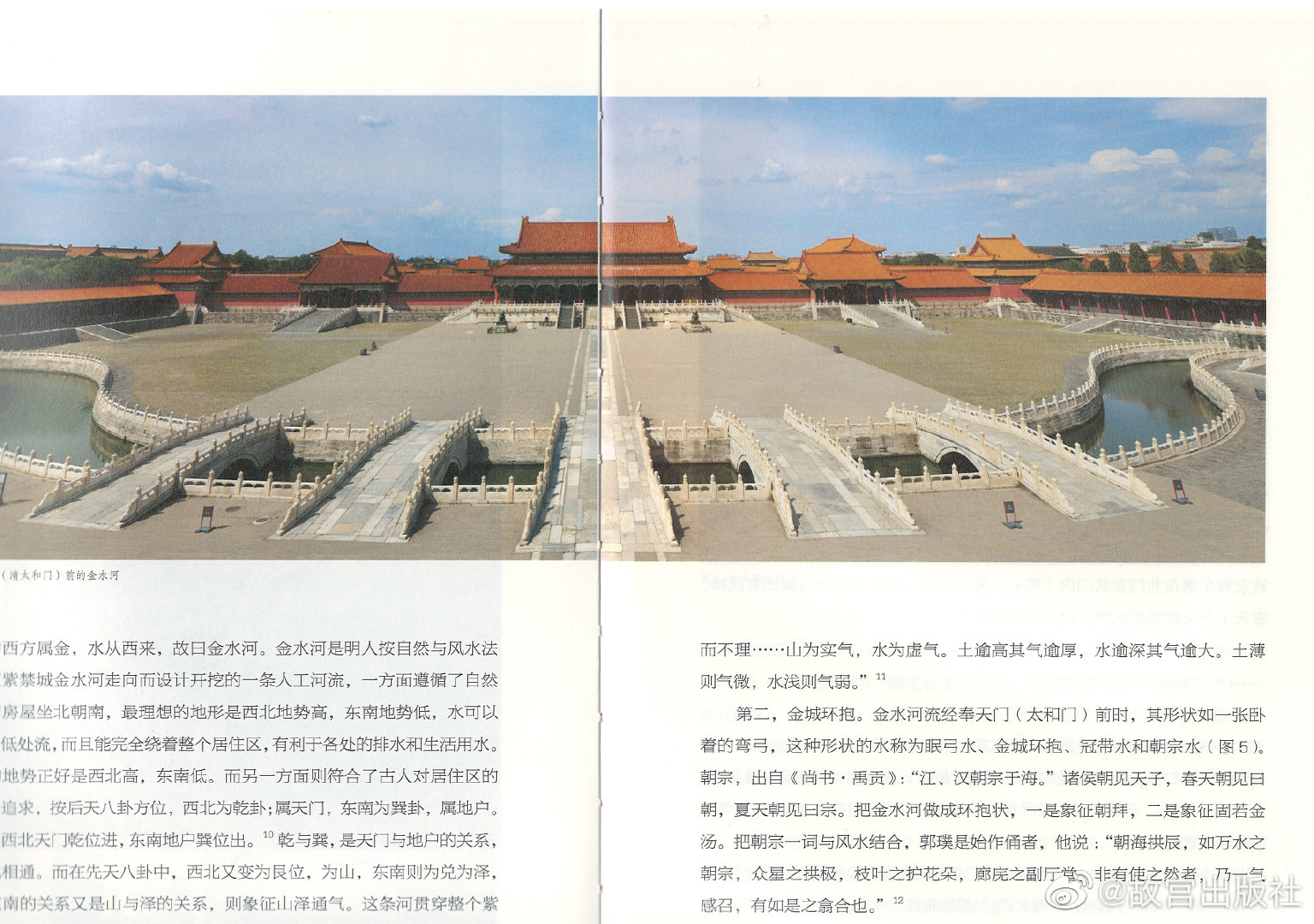
In addition to deciphering the architectural language from the architecture itself, when the landscape and architecture are integrated and are no longer isolated natural landscapes, they also become part of the architectural language and shoulder the heavy responsibility of interpreting architectural ideals. The Jinshui River and Wansui Mountain in the Forbidden City are no longer natural mountains and waters in a pure sense, but have an inseparable relationship with architecture. Wansui Mountain is the backing of the Forbidden City. Without this mountain, the Forbidden City will lose its strongest barrier and become an isolated city. The Jinshui River also has this function. It not only provides water for the entire Miyagi city and ensures the water and drainage of the palace city, but also plays the role of connecting the northwest trunk with the southeast Sunda, making the Jinshui River an image of a trunk. The river of gold enables the communication between heaven and earth and the connection between mountains and lakes….
徐可意Shirky is a well-known Science Blogger from Chinese University of Hong Kong – Hong Kong SAR – China – People’s Republic of China she resides in Beijing the Capital in which she’s passionate in in which Her works international Known for Nature Photographer, Main photography of scenery/starry sky/wildlife also she is of Winners of the first annual wildlife video competition in China|Works published in “China National Geographic”, National Geo Traveller|Global Traveller….
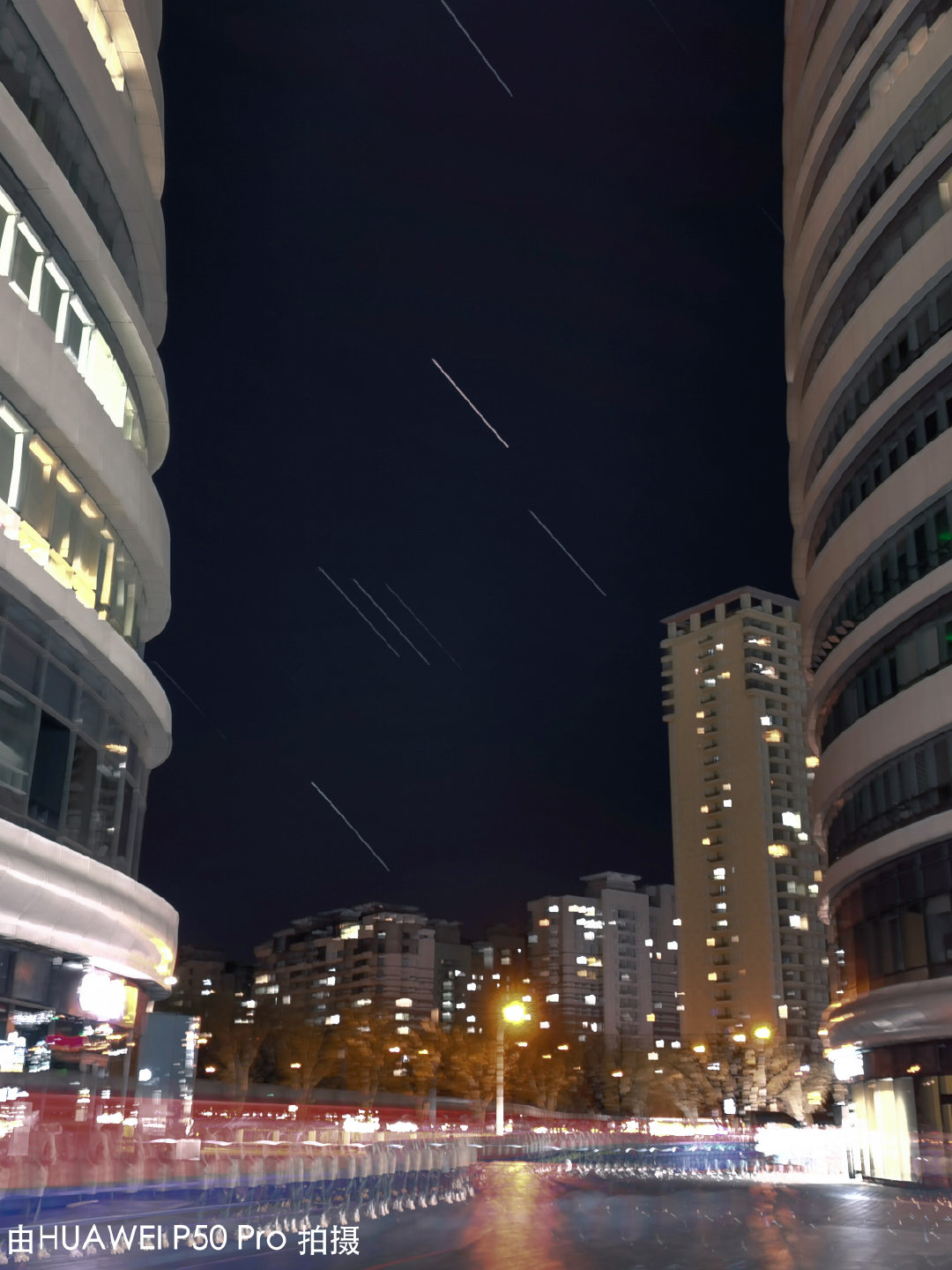
徐可意Shirky Demonstrates use Huawei P50 Pro to demonstrate how to use a mobile phone to take pictures of the starry sky in the city Astrophotographying in one of the many Ultra Mega Malls of Ancient Postmodern Beijing City in the center of Galaxy Soho business center, shopping mall and residences in Beijing in which is located Chaoyangmen district Beijing, Dongcheng, Xiaopaifang Hu Tong, 小牌坊胡同甲7号 邮政编码: 100010 …..Architectural project by Zaha Hadid only built in three years between 2009 -2012 in which Internationally Iconically Know for Iconic curvy commercial center building with offices, shops & restaurants with incredible spatial open spaces….
Come see the stars with us! Can you take pictures of stars in your city How beautiful is the city starry sky captured by mobile phones…..
In The Little Prince, it is said that if a person falls in love with a unique flower among the vast stars, then the person will feel extremely happy when looking up at the stars. The beautiful starry sky can also be seen in the city. I often enjoy every bit of excitement and emotion brought by astronomical observation, and of course, the rare spiritual relaxation in the silent night.
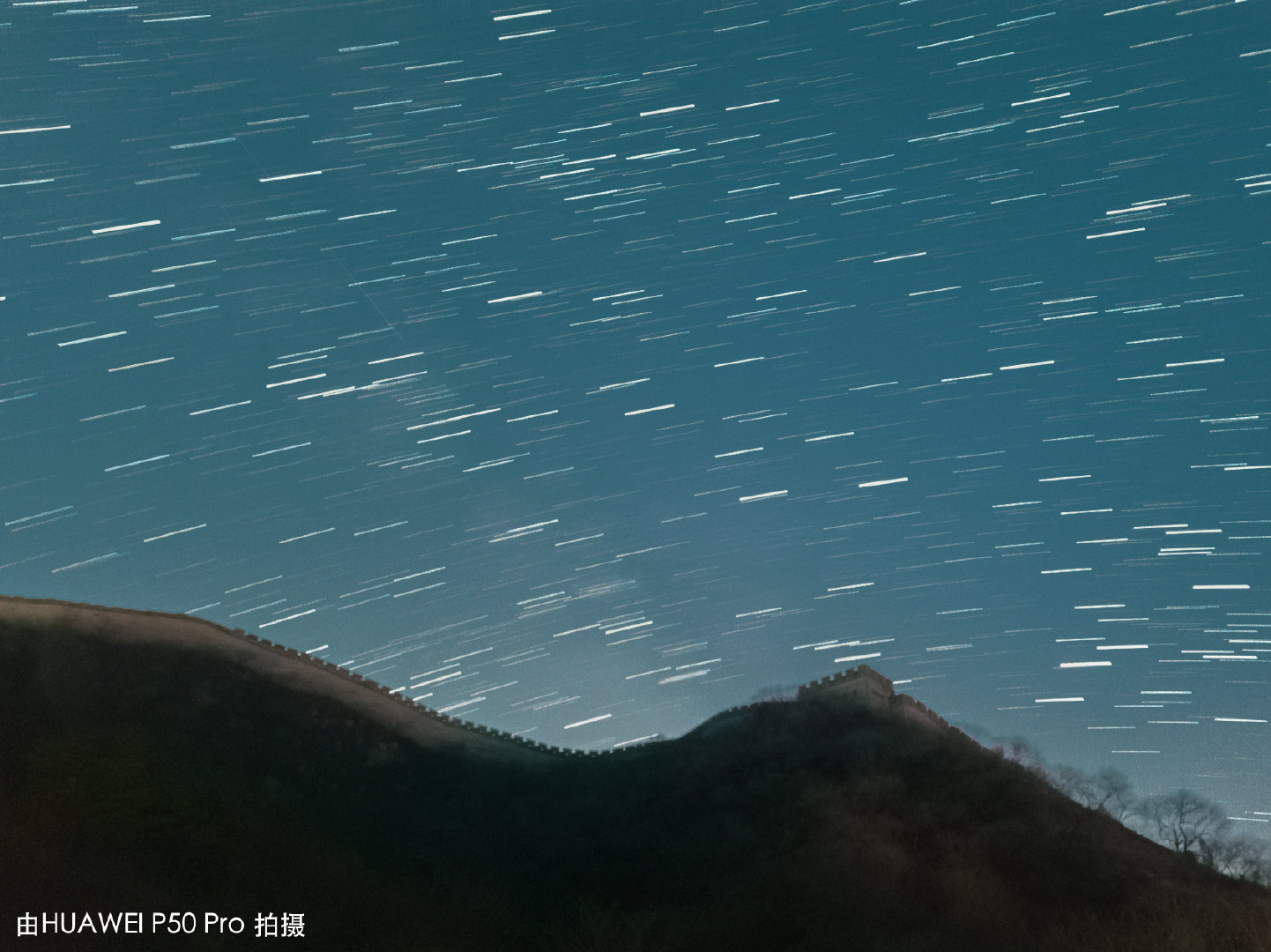
Humans were originally born on a star, and temporarily lived on this star called the Earth. There is a famous line in “The Wandering Earth”, “Beijing, you can’t see the stars at all.” As the capital and political center of China, in this metropolis, as long as you wait for the sunny environment and wait patiently, even if you only have a mobile phone, you can still record the starry sky around you. In this tutorial, I use Huawei P50 Pro to demonstrate how to use a mobile phone to take pictures of the starry sky in the city.
Images and visuals are from their respectives 徐可意Shirky
In this year’s 2021, the second decade from the turn of the century in Beijing the Capital of China also the People’s Republic of China, in which is also the year of the OX, marking its six hundred and one year’s anniversary of the Forbidden city that marks the transitional point of in between the middle of the Ming Dynasty (1368- 1644) transitionally from Nanjing to Beijing towards the Qing Dynasty (1636-1644-1911) …. The Imperial Palace seen so many countless seasonally transitional equinoxes but further its six hundred years is iconic, but it’s five hundred ninety nine years it marks it Autumn Equinox…. In which it only took twelve years to build the same of the Daming Palace of The Tang Dynasty Xian Imperial Capital only it was least twenty times larger..
In which during the time of the Ming Dynasty Ming Dynasty (1368- 1644) transitionally from Nanjing to Beijing there’s are many variations of the Forbidden City complexes each have similarities in architectural Design Heritages in all cases the share the same philosophy of havening the central axis in which the city is fixed towards the Northern Pole Star BeiDou – Polaris in which helps to find North as the compass points as the remaining Beijing Forbidden City designed out with all the astronomical compass points …
How many “forbidden cities” are there in China? There are Several. And their similarities and differences are shedding light on ancient mysteries as excavations uncover them…..For centuries, the Forbidden City, officially known as the Palace Museum today, has stood in the heart of Beijing and witnessed the rise and fall of dynastic power and the nation’s ongoing rejuvenation….. in a which the several sites have the same average characteristics of This roughly 720,000-square-meter compound that served as the imperial palace from 1420 to 1911 is also the world’s largest surviving palatial complex…… But the prequel to this architectural splendour, hidden about 1,000 kilometers away in Fengyang county, Anhui province, is much lesser known worldwide, although it was inscribed on the list of key heritage sites under national-level protection as early as 1982.
The Ming Dynasty (1368-1644) Zhongdu (literally, the central capital) site could be thought of as “the Forbidden City mark one the first one” the second one in Beijing Forbidden City complex is Mark two.. The 840,000-square-meter imperial city in Zhongdu is slightly bigger than its younger cousin in Beijing. Its construction began in 1369, one year after the Ming Dynasty’s founding.
Soon after Zhu Yuanzhang, who was once a poor peasant toppled the ethnic Mongolian Yuan Dynasty (1271-1368) in China and built up his own empire, he decided to make his hometown the national capital.
An ambitious urban-infrastructure project began, and the emperor later bestowed the auspicious name Fengyang (literally, a rising sun like a flying phoenix) upon his home county. The Zhongdu Forbidden city archaeologist from the Palace Museum in charge of the excavation says a much larger outer city was then planned around the palatial section.
Archaeological investigation shows the city could cover 50 square kilometers, including military facilities, temples, mausoleums and nobles’ residential areas in addition to the palatial compound…. Among the investigations have covered most areas within the Zhongdu Forbidden City, and we know the layouts of its major buildings, roads and waterways……
More other similarities among the palace compounds in Zhongdu and Beijing may become apparent as excavations of the greater area around Zhongdu proceed.
. The perspective of Zhengyangmen Wengcheng.
For instance, there’s a hill to the north of the palatial city of Zhongdu. Likewise, Jingshan Hill is just across the road from the northern exit of the Palace Museum today. Jingshan Hill was created from earth piled up while digging the moats surrounding the Forbidden City.
2. View from Tiananmen Square.
The Zhongdu site hosts counterparts of Beijing’s Forbidden City’s major outer city gates-the Eastern Prosperity Gate, the Western Prosperity Gate, the Meridian Gate and others.
3. Jingshan perspective.
And an area by the southern entrance of Zhongdu’s imperial city was cleaned up in 2018, unveiling Chengtianmen (the Gate of Accepting the Heavenly Mandate)…. There’s a similar structure in Beijing, which was renamed Tian’anmen (the Gate of Heavenly Peace) in 1651….Some local legends say there were “five dragon bridges” underground in the area, but Wu’s team found seven.The bridges also have famous counterparts in front of Tian’anmen, known as Jinshuiqiao.
4. Hongwumen, the capital of the Ming Dynasty.
Though information about Zhongdu’s city gates is clearly recorded in history, detailed information about its inner palaces is vague….. archaeological team has dug deeply in the core of the palatial city to further scrutinize connections between Zhongdu and Beijing’s Forbidden City.
5.Daming Gate in the middle of the Ming Dynasty.
The ongoing excavation is on the ruins of Zhongdu’s “Number One Palace”. Although no hints have been found to its specific historical name, its location is presumably on par with the “three great halls” in its Beijing counterpart.
6.The ancient city of the Emperor of the Ming Dynasty.
The so-called “three great halls “on the axis of the Forbidden City’s outer section include the Hall of Supreme Harmony, the Hall of Central Harmony and the Hall of Preserving Harmony. The first hall is the highest-status structure in the Forbidden City. It was only used for the most important ceremonies during the imperial era.
7. The reconstruction of the Daming Gate area of the Forbidden City in Nanjing.
“We’ve figured out the basic H-shaped layout of (Zhongdu’s) palace grounds, which is similar to the Forbidden City,”
8. Modeling and restoration of Chengtian Gate of the Forbidden City in Nanjing.
A firewall stands at the same location in the Forbidden City, but Wu explains that the wall was added during the Qing Dynasty (1644-1911), and the original layout during Ming Dynasty matched this new finding in Zhongdu.
However, there doesn’t seem to be a Forbidden City equivalent to a wall with three gates 20 meters north of Zhongdu’s “No 1 Palace”.
And even more confusing is that no structure similar to the Hall of Central Harmony has been discovered in Zhongdu.
Nanjing, which is today’s capital of Jiangsu province, became the emperor’s alternative as the national capital.
Zhu Yuanzhang ordered builders to prioritize stability instead of luxury in his “Forbidden City 2.0” there. His son, Zhu Di, the third Ming emperor, inherited that principle. Zhu Di, who previously resided in Beijing as a prince, won a civil war in 1402 and moved the national capital to his home city.
9. Modeling and restoration of the Palace City of the Forbidden City in Nanjing.
After massive construction starting from 1417 and lasting for three years, the “Forbidden City Mark Three” in Beijing was finished, and the city became the Ming capital a year later.
However, its predecessors, including the abandoned one in Fengyang and the completed one in Nanjing, both crumbled in the following centuries, as continuous wars and social upheavals destroyed most aboveground structures…..
A summary of the three capitals of the Forbidden City in Beijing, the Forbidden City in Nanjing and the imperial city of the Ming Dynasty in the Ming Dynasty.
The reconstruction of the Nanjing Forbidden City is for reference only. It is estimated based on the actual Wuchao Gate, East and West Hua Gate and the remains of the three major halls. In order to prevent the impact on the surrounding sensitive areas, the background of the Forbidden City in Nanjing is blurred here.
1. The perspective of Zhengyangmen Wengcheng.
2. View from Tiananmen Square.
3. Jingshan perspective.
4. Hongwumen, the capital of the Ming Dynasty.
5.Daming Gate in the middle of the Ming Dynasty.
6.The ancient city of the Emperor of the Ming Dynasty.
7. The reconstruction of the Daming Gate area of the Forbidden City in Nanjing.
8. Modeling and restoration of Chengtian Gate of the Forbidden City in Nanjing.
9. Modeling and restoration of the Palace City of the Forbidden City in Nanjing.
The Three Palaces in the Ming Dynasty had a great influence on the space of the city, but due to historical reasons, only the Forbidden City in Beijing has survived, and the Forbidden City in Nanjing and Fengyang have been greatly damaged, and it is even difficult to explore many forms of organization. Here is a comparison of the Sannomiya. I hope everyone will pay more attention to the cultural heritage of Fengyang and Nanjing. It is very difficult for some sites to survive. I hope you will visit more.