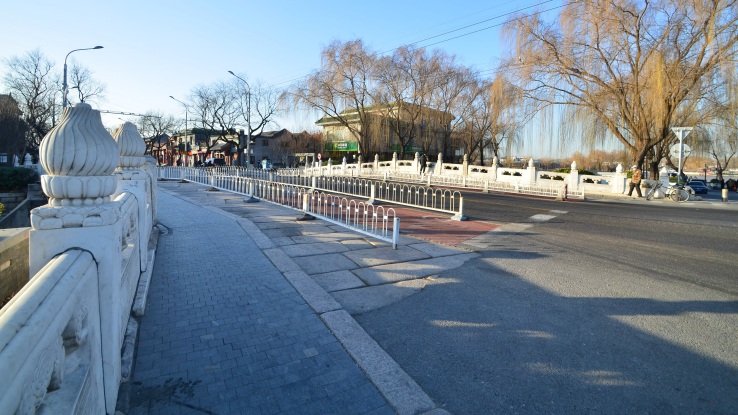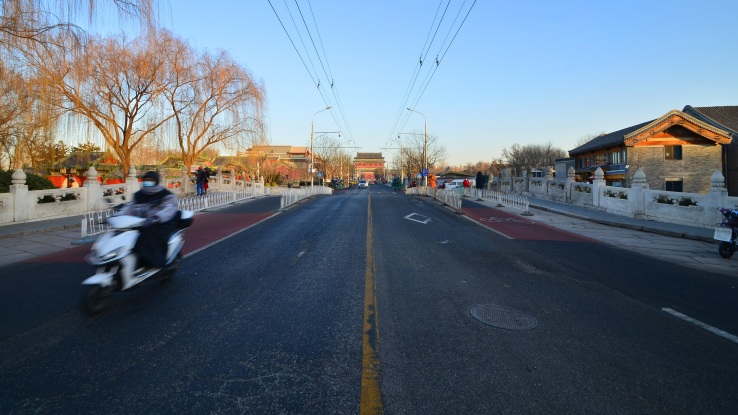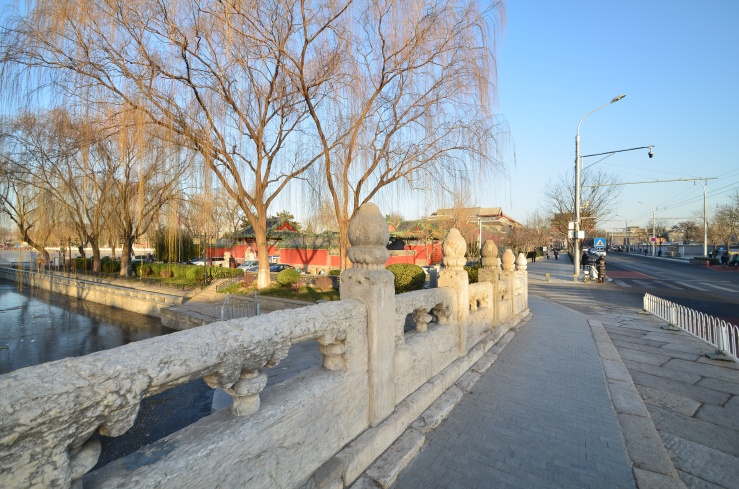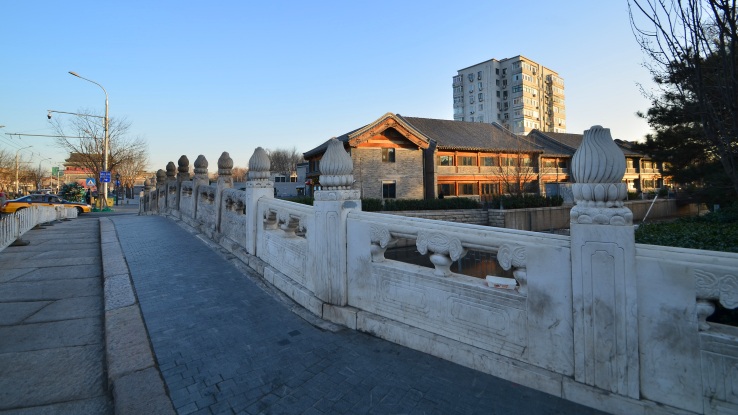
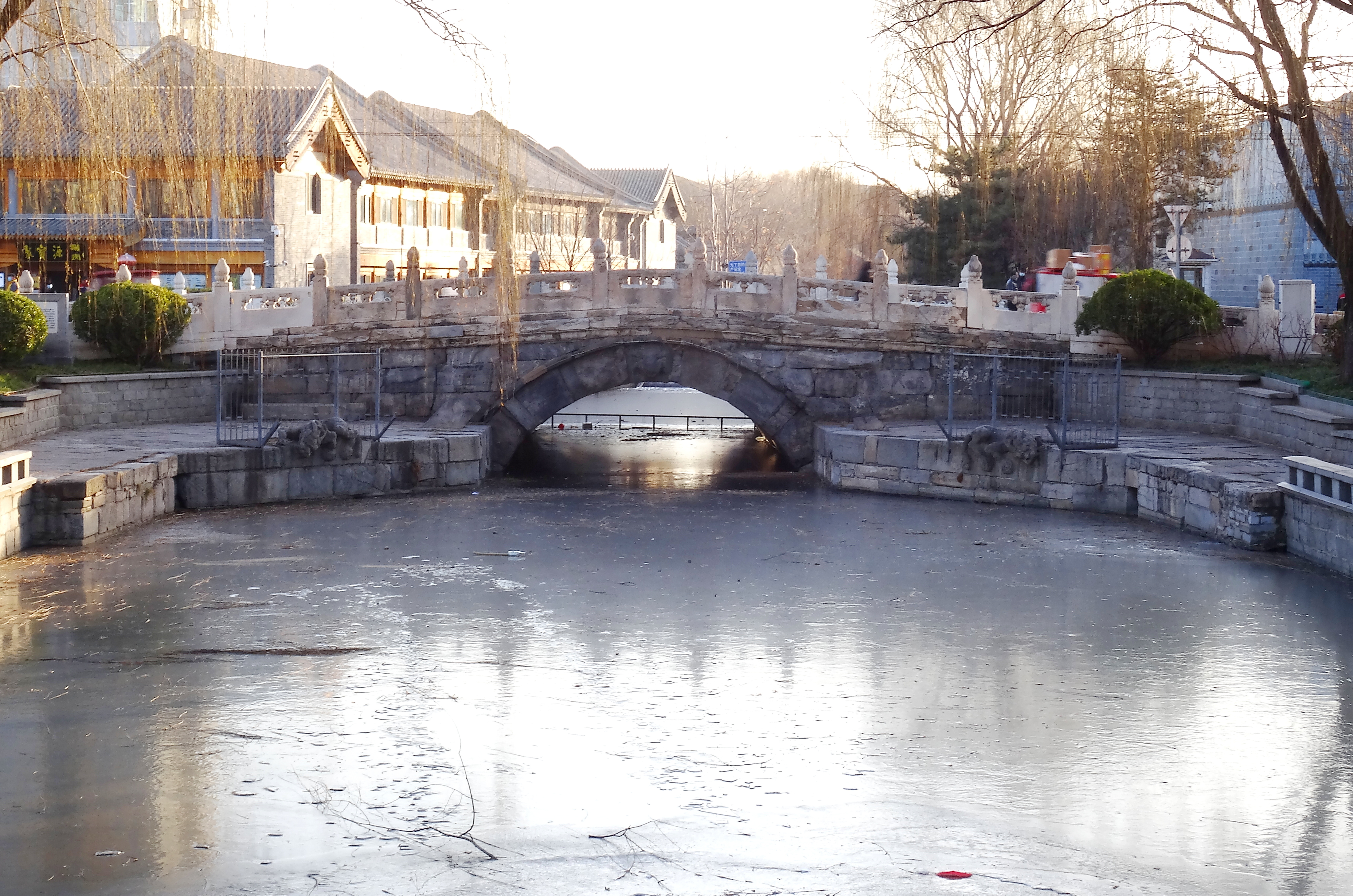
#北京。 #中國 #China #Beijing | #紫禁城 #ForbiddenCity #December 2021 | #北京卫视上新了故宫 The Forbidden City on Beijing Satellite TV| December gorgeous sunset #YuanDynasty   #后门桥#WannignBrigde of the #GrandCanal on the Winter Solstice   ….

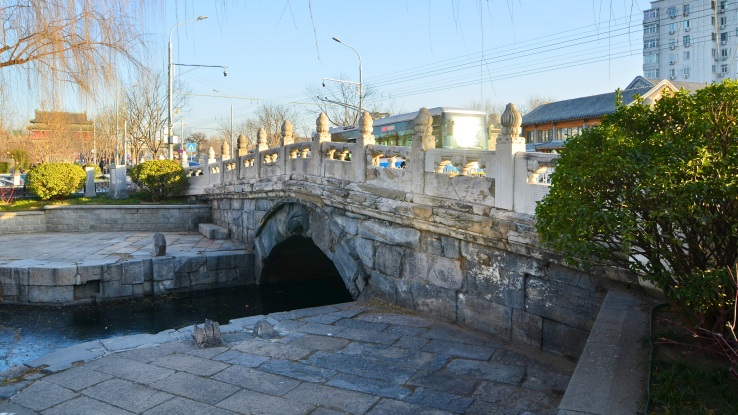
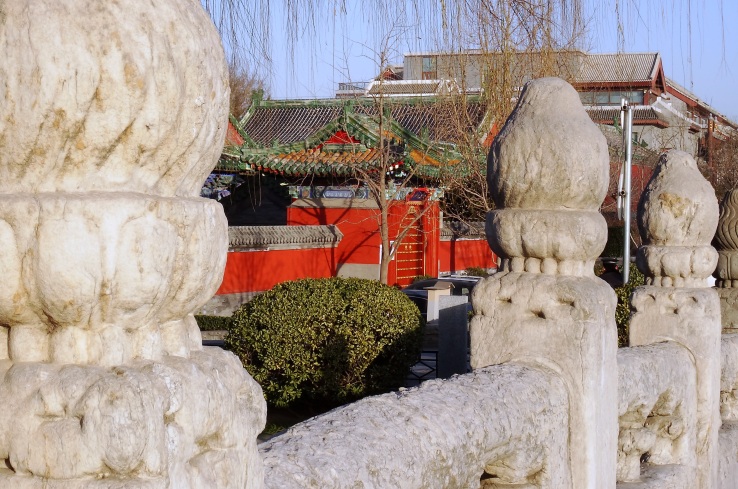
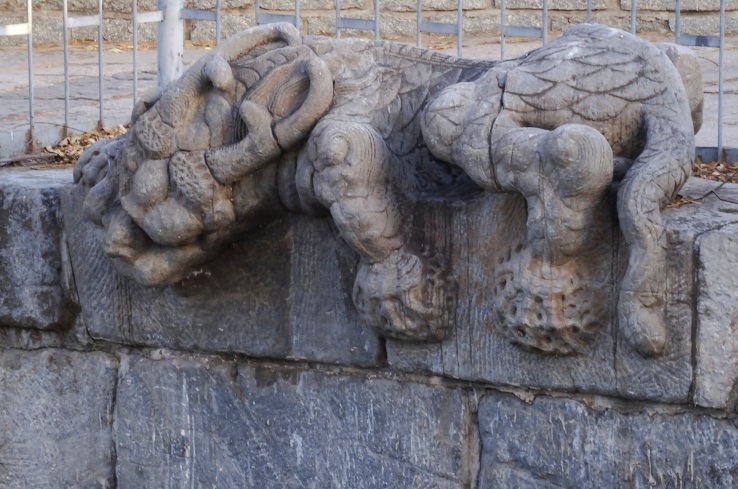
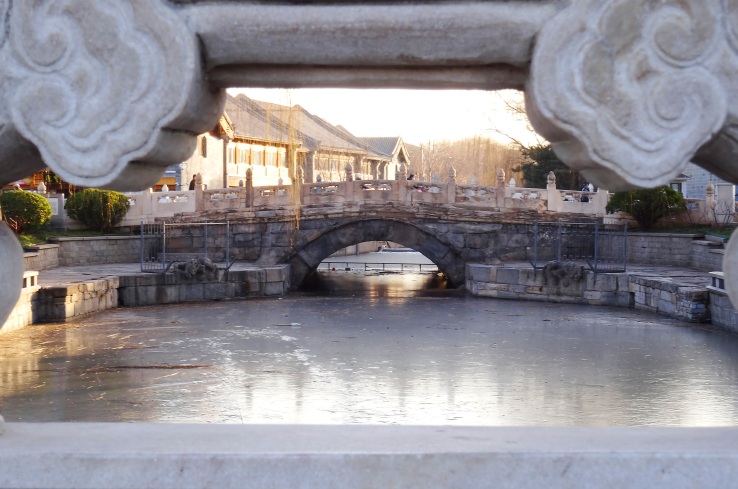
On  the 21st December 2021  it was the Winter Solstice 2021 in which during the Beijing – China – People’s Republic of China  was a clear blue skies with  Located in Di’anmenwai Ave, 什刹海 Xicheng District, Beijing, China, 100009 the 736 year old Yuan Dynasty Bridge named the后门桥 Wanning Bridge or known as the Houmen Bridge .. located near Shichahai, was built in 1285. A sluice is installed under the bridge, and the sluice is lifted and released to stop the water from passing the boat. This “high-tech” stone bridge was the starting point for grain transportation on the Grand Canal in the Yuan Dynasty, and all grain ships entering the imperial city of Beijing would pass here. There are dragon-shaped water-separating beasts on all four sides of the bridge, which have the meaning of blessing the safety of water transport. This century-old bridge is still in use today!

后门桥 Wanning Bridge, also known as the Bridge , the Bridge , is located in Beijing Tiananmen Square , the Shichahai near, a bridge located in Beijing’s central axis. It was built in the 22nd year of Yuan Shizu to Yuan Dynasty (1285), originally named Wanning Bridge. Because the bridge is to the north of Di’anmen, Di’anmen is the back gate of the imperial city, so it is called the Houmen Bridge. Municipal cultural relics protection unit.

Located in Di’anmenwai Street, Xicheng District. It was built in the twenty-second year of Yuan Zhi Yuan (1285). Originally a wooden bridge, it was changed to a stone arch bridge in the Yuan Dynasty, named Wanning Bridge. Also known as Haizi Bridge and Houmen Bridge…….. was built from the Yuan Dynasty to the 22nd of the Yuan Dynasty. It was called Wanning Bridge at that time. It was the most prosperous period of the Yuan Dynasty under Kublai Khan’s rule. The Wanning Bridge at that time was a wooden bridge. At that time, its “little name” was not called “Houmen Bridge”. Historical materials record Wanning Bridge in Yuan Dynasty, also known as “Sky Bridge”. In the Yuan Dynasty, Kublai Khan repaired the end of the Beijing-Hangzhou Grand Canal to today’s Jishuitan, and this Wanning Bridge is the northernmost gate of the Beijing-Hangzhou Grand Canal . The water transport ships entering the Imperial City of Beijing must pass here. The “Tonghui River” in the Beijing section was not only built by Kublai Khan’s decree, but the Tonghui River was also named by Kublai Khan on the Wanning Bridge, and it is also a bridge that Kublai Khan must walk in and out of Beijing. That’s why its nickname is qualified to be called “Tianqiao”.
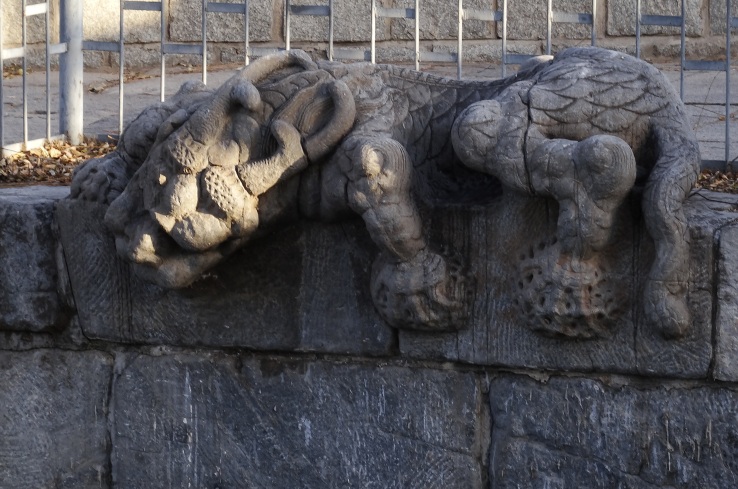
Wanning Bridge is a “bridge gate” with dual functions: it can be used as a bridge to pass through, and it can also be used as a gate to control water. Guo Shoujing dug a canal, used Jishuitan as a reservoir, and set up ten locks and dams along the Tonghui River for control. There are boats to release the water from the Fangti locks, but they are usually closed. It seems to be energy efficient. Set up under the Wanning Bridge is the Qingcheng sluice, also known as the Haizi sluice. It is the first checkpoint for the water flow in Jishuitan (formerly known as Haizi). At the same time, it serves as the terminal of the Grand Canal. The sail passes through the tunnel of the Wanning Bridge and enters a safe haven for anchoring and unloading.

Imagines credits are of the Forbidden City –Imperial Palace –Beijing – China- People’s Republic of China also from the Series Weibo北京卫视上新了故宫 Treasures in the Forbidden City…

#北京。 #中國 #China #Beijing | #紫禁城 #ForbiddenCity #December 2021 | #北京卫视上新了故宫 The Forbidden City on Beijing Satellite TV| December gorgeous sunset and crescent moon of the #SummerPalace nights of #BeihaiPark ….

During the Month of December 2021, in which current Beijing – China – People’s Republic of China the Beijing the three thousand more ancient postmodern ultra-metropolis mega city in which the evening of 12  December 2021  there was in the evening of Beihai Park, the afterglow of the setting sun is sprinkled on Yong’an Bridge, and the gorgeous sunset glows on the lake, and the white pagoda is reflected in each other, like a fairy mountain and Qiongyu, making the night of Beihai beautiful

Beihai Park 北海公園; 北海公园is a public park and former imperial garden located in the north-western part of the Imperial City, Beijing. First built in the 11th century, it is among the largest of all Chinese gardens and contains numerous historically important structures, palaces, and temples. Since 1925, the place has been open to the public as a park. It is also connected at its northern end to the Shichahai.

The park has an area of more than 69 hectares (171 acres), with a lake that covers more than half of the entire park. At the center of the park is an island called Jade Flower Island (瓊華島; 琼华岛; whose highest point is 32 meters.

Beihai literally means “Northern Sea”. There are also corresponding Central (Zhonghai) and Southern (Nanhai) “Seas” elsewhere. These latter two are joined inside a complex of buildings known after them as Zhongnanhai; it is the home of China’s paramount leaders.

The Beihai Park, as with many of Chinese imperial gardens, was built to imitate renowned scenic spots and architecture from various regions of China such as Lake Tai, the elaborate pavilions and canals of Hangzhou and Yangzhou, the delicate garden structures in Suzhou and others all served as inspirations for the design of the numerous sites in this imperial garden. The structures and scenes in the Beihai Park are described as masterpieces of gardening technique that reflects the style and the superb architectural skill and richness of traditional Chinese garden art….

On previously on 11th December 2021 on the night of the Summer Palace in the winter is charming with crescent moon waxing towards the full moon from the first quarter in winter romantically walks of romance mystery walks.

Imagines credits are of the Forbidden City –Imperial Palace –Beijing – China- People’s Republic of China also from the Series Weibo北京卫视上新了故宫 Treasures in the Forbidden City…

#北京。 #中國 #China #Beijing | #紫禁城 #ForbiddenCity #北京服装学院  #October2021 | #北京卫视上新了故宫 Treasures in the Forbidden City #Autumn the Fortress wall turret stands ready for the incoming season.

On the 4th October 2021 week it’s Autumn in Beijing –China- People’s Republic of China, in which it has been with beautiful blue skies with Chinese Painting white Clouds storytelling Beijing Ancient postmodern megatroplis city scape…  along the 601 year old Forbidden city is looking from the Qianhai Lake and it’s Island  .

古宫角楼北海白塔交相辉映# The sky is high in autumn in Beijing. The turret of the Forbidden City stands quietly, facing the White Tower in Beihai Park. The blue sky, white clouds, red walls and blue waves make people feel more comfortable and cosy. 找老舍心中北京的秋# Let’s slow down together and feel the breath of autumn…..

Imagines visuals credit are from the Forbidden city –Imperial Palace –Beijing – China- People’s Republic of China…  also from their respectives from the Series Weibo北京卫视上新了故宫 Treasures in the Forbidden City…

#北京。 #中國 #China #Beijing | #紫禁城 #ForbiddenCity #DonghuaUniversity #BeijingInstituteOfFashionTechnology #北京服装学院 #November2020 | #北京卫视上新了故宫 Treasures in the Forbidden City #Season3 #FashionLookBook creating a collection inspired by the famous ChinesePainting of #ChibiTu of the Gardens of #EmperorQianlong also of the #SongDynasty works of #SuShi #SuDongpo …

On 7th November 2020 Beijing Television -iQyi Streaming of the 北京卫视上新了故宫 Treasures in the Forbidden City in which it stream the third season of A Guzheng- Guqin plays the legacy of the great sage of the Tang Dynasty in which recreates a scene of a jug of wine creates the mood of Emperor Qianlong’s Lanting Pavilion; a stream of clouds interprets the spirit of Suzi throughout ancient and modern times. In which airing streaming  on 7th November 2020  on 20:30 Hong Kong – Beijing Time北京卫视 , 爱奇艺#上新了皇宫…. The third season, follow the new product developer 邓伦, 聂远, 李沁, 千古风流人物——Su Shi from the Palace Museum The theme painting and calligraphy special exhibition, feel the open-minded life of Su Dongpo….. In which featured….. In which it has been finally restored after it has been viewed for more than two hundred years…. In which during the Television segment of each episode there’s a design challenge in which design students are task with creating inspirational products that each three host of the episodes explores within the Forbidden City  in which are in form of two designing teams in which under take producing a very timeless unique product  for the Forbidden City Museum Store..

This time, the creative work for the Shanghai’s Donghua University in designing for “The Third Season of the New Palace Museum” the collection is called “Lotte Echoes” In the design of the suit, we have evolved the shape of the “curved stream” to form the curve of the coat neckline and coat pocket cover. At the same time, the suit collar is designed as a traditional Chinese collar; the coat has more streamers. Functionally, it can be connected to the body through a hidden buckle, which can be removed to form a waistband, or a streamer can be tied up to adjust the waist, reflecting Su Shi’s free-spirited outlook on life.

In the Suits, sweaters …..The color matching of lotus root pink and khaki is also being perfected… In the design of the sweater, we extracted the water ripples of “Red Cliff Picture” and hand-embroidered the pattern on the sweater, which intuitively reflects the characteristics of the Forbidden City……

上新了旧宫 During this episode ….   Of Cultural Creation is a “Jiang Yue Yi Su” clothing series designed by students of Beijing Institute of Fashion Technology. The color matching of the earth tone of the clothing is taken from the famous painting “Chibi Tu”. At the same time, the Jiangtao pattern in the painting is extracted, embroidered on the outer layer of the coat, and attached to the inner layer of the coat to form an internal and external echo; borrowing from the beauty of the “Curved Water Flowing Vessel” of the Pavilion, Applying its sense of fluency to the coat layout, as the clothes swing, it is flexible and elegant, revealing a sense of open-mindedness. People who wear the “Jiang Yue Yi Su” coat will take the most optimistic and confident steps and embark on the brightest and most open road.

The student designers have deconstructed the Jiang Tao pattern in the “Red Cliff Picture” on the inner and outer layers of the coat in response to each other, and blended the lines of the “curved water flow” in the Qianlong Garden into the tailoring of the coat, revealing every detail A sense of open-mindedness [Heart] I hope that anyone who wears the “Jiang Yue Yi Su” clothing series of this issue of cultural and creative industries can take the most optimistic and confident steps like this cat and embark on the brightest and most open road…

Imagines credits are of the Forbidden city –Imperial Palace –Beijing – China- People’s Republic of China also from the Series Weibo北京卫视上新了故宫 Treasures in the Forbidden City…

#北京。 #中國 #China #Beijing | #紫禁城 #ForbiddenCity #November2020 | #北京卫视上新了故宫The new Series of Treasures in the Forbidden City on #BeijingSatelliteTV #BeijingTV for the season three # 李沁 #LiQin #邓伦 #聂远… #ForbiddenCityMuseum New #Recycling #ZeroWasteInitiative #CaringForTheEnvironment

On 7th November 2020 Beijing Television -iQyi Streaming of the 北京卫视上新了故宫 Treasures in the Forbidden City in which it stream the third season of A Guzheng- Guqin plays the legacy of the great sage of the Tang Dynasty in which recreates a scene of a jug of wine creates the mood of Emperor Qianlong’s Lanting Pavilion; a stream of clouds interprets the spirit of Suzi throughout ancient and modern times. In which airing streaming  on 7th November 2020  on 20:30 Hong Kong – Beijing Time @北京卫视@爱奇艺#上新了皇宫# The third season, follow the new product developer 邓伦, 聂远, 李沁, 千古风流人物——Su Shi from the Palace Museum The theme painting and calligraphy special exhibition, feel the open-minded life of Su Dongpo….. In which featured.. In which it has been finally restored after it has been viewed for more than two hundred years

In which during the episode they also featuring a well known join effort campaign Zero Waste also Caring for the environment and protecting cultural relics is very importantly too of also to in which the team of Forbidden city also from the Beijing TV –北京卫视上新了故宫 Treasures in the Forbidden City in which During 2020, The Forbidden City – The Palace Museum has responded to the Beijing Municipal Government’s call to actively carry out the classification of household waste. How to sort the common garbage during the visit? Check with the staff of the Open Management Office of the Palace Museum. Has your hometown started to sort waste? Do you have any tips for reducing garbage?  In which the Forbidden city Management Office is interested how to recycle in which will be implement into how the Palace Museum waste management operate in which there’s a four bins in which are dedicated for plastic, glass, organic waste also paper- cardboard waste

In this year’s 2020, the second decade from the turn of the century in Beijing the Capital of China also the People’s Republic of China, in which is also the year of the rat, marking its six hundred years anniversary of the Forbidden city that marks the transitional point of in between the middle of the Ming Dynasty (1368- 1644) transitionally from Nanjing to Beijing towards the Qing Dynasty (1636-1644-1911) …. The Imperial Palace seen so many countless seasonally transitional equinoxes but further its six hundred years is iconic, but it’s five hundred ninety nine years it marks it Autumn Equinox…. In which it only took twelve years to build the same of the Daming Palace of The Tang Dynasty Xian Imperial Capital only it was least twenty times larger…

Imagines credits are of the Forbidden city –Imperial Palace –Beijing – China- People’s Republic of China also from the Series Weibo北京卫视上新了故宫 Treasures in the Forbidden City…China – People’s Republic of China