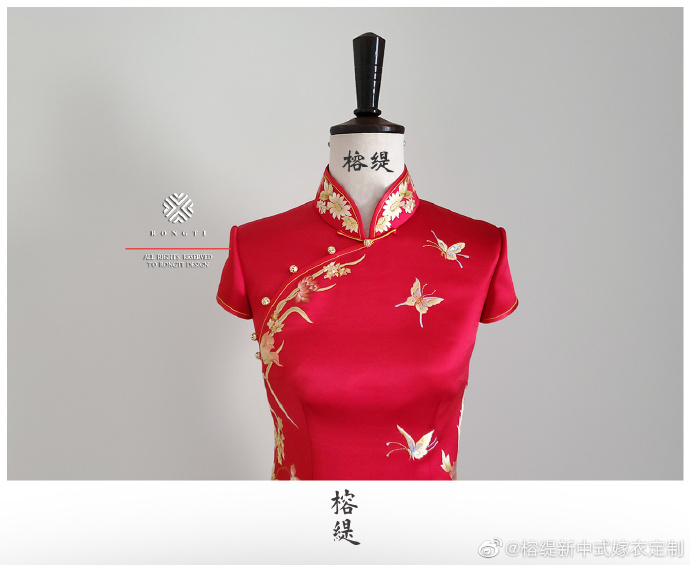
Dressed in Imperial auspiciousness classically timeless innovatively Modern Red Qipao on Chinese hand crafted embroidery youthfully cheongsam Qipao ….with beautifully dressed in Beautiful Chinese Painting embroidery of Oriental women’s uniquebeautiful and imperial Femininity is the ultimate expression of condensed femininity…….. Feminine traits are often hidden in the body lines, followed by looks, but they are more important than looks………embroidery Luxury accumulated with time Rong Ti plate gold embroidered cheongsam on the red silk and satin, heavy gold embroidered, thousands of needles, and golden phoenix.
Hand woven with sewn implies happiness and auspiciousness, and a happy and harmonious love……The wishes for the new couple are woven into the cheongsam through the embroidered Craftsmanship and luxury accumulated over time create a new Chinese cheongsam with oriental cultural heritage……
….…… In which timeless gorgeous hand crafted embroidery youthfully cheongsam Qipao Chinese Qipao –Cheongsam makes a most treasured embroidery art center piece on you and after on a mannequin as your fashion art piece memorable…….
QIPAO 旗袍 Cheongsam …. In which from historically Shenyang is the birth place of the Qing Dynasty 1636-1912plus …. In which Qipao is termed for Qing Dynasty Clothing that the Manchu ethnic adoptively wore…… in which the Shenyang Palace Museum was an imperial palace towards two Qing Dynasty emperors. Previously two years ago during the event it which was an eight day forums, with exhibitions also related workshops illustrating the birth place of the Old Capital of Cheongsam where the Qing Dynasty- Qipao was inspired from…
Before that Shanghai 1930’s Qipao-Cheongsam revolution, the Manchurian Cheongsam was the fashion of choice of the Qing Dynasty (1636-1912) throughout as it standardised that style during the dynasty… Replacing the previous clothing standard Han Fu – Han Dynasty clothing style, in which also is form fitting towards the women’s silhouette but with a higher degree of freedom of flare of personal, individual style…
Qipao-Cheongsam is uniquely hand crafted tailored Chinese dress to the customer’s various measurements… in which you can still have them brought of the rack in which is accustomed to the standard measurements… in which you can tell which is western influenced with the back zipped in which the Eastern traditional Chinese Tailors would have the side zipped of the Qipao dress due it interrupts the flow of the pattern work at the back of the dress.. Also it creates a continuous seamless back look… after as the measurements are translated drafted onto the silk or the customer desired accustomed fabric of choice, from the measurements book with the associated look of the design elements with additional accessories the sexiness of Qipao lies subtlety.. Measuring, patterning, cutting, and button making are crucial, in where passion and art comes together in tailoring
In which traditionally Qipao- Cheongsam dresses are worn for from straight forwardly every day towards after work evening wear in without having to change to another set of wardrobe dressing only to accessories for the required occasion… … in which the Qipao dress pattern silhouette is design for the lady’s figure in which accentuating the silhouette without giving away too much of what’s underneath in retaining…. its timeless classic silhouettes in which are designed to be worn every day, from work, evening, casually towards to the weekend… with sleek simple, elegant, sexy intelligent sophistication in which are easy to be accessorised with any pieces of clothing in your current or upcoming wardrobe…
Dressed in Imperial auspiciousness classically timeless innovatively Modern pastel pink Qipao on Chinese hand crafted embroidery youthfully cheongsam Qipao ….with beautifully dressed in Beautiful Chinese Painting embroidery of Oriental women’s uniquebeautiful and imperial Femininity is the ultimate expression of condensed femininity…….. Feminine traits are often hidden in the body lines, followed by looks, but they are more important than looks……… with a hand Sewn Pink with a high-end sense, charming but enchanting Fresh and elegant ambience is created by the smooth-color embroidery with pink and white gradients. The embroidery pattern uses peony, peach blossom, lily of the valley, and curly grass patterns to form a Chinese symmetrical aesthetics. The stitches are smooth and smooth, and it blends with the silk fabric as one, and highlights The advanced skills of hand embroidery…
The embroidery composition of the flower pattern is also quite exquisite. The delicate flowers like fine brushwork are arranged from top to bottom with rhythm and layers, and the flowers are romantically pouring down, which is the finishing touch to outline the curve of the upper body.
The embroidery composition of the flower pattern is also quite exquisite. The delicate flowers like fine brushwork are arranged from top to bottom with rhythm and layers, and the flowers are romantically pouring down, which is the finishing touch to outline the curve of the upper body… embroidery with prosperous flowers are filled with strong blessings, a happy melody with no rest.
….…… In which timeless gorgeous hand crafted embroidery youthfully cheongsam Qipao Chinese Qipao –Cheongsam makes a most treasured embroidery art center piece on you and after on a mannequin as your fashion art piece memorable…….
QIPAO 旗袍 Cheongsam …. In which from historically Shenyang is the birth place of the Qing Dynasty 1636-1912plus …. In which Qipao is termed for Qing Dynasty Clothing that the Manchu ethnic adoptively wore…… in which the Shenyang Palace Museum was an imperial palace towards two Qing Dynasty emperors. Previously two years ago during the event it which was an eight day forums, with exhibitions also related workshops illustrating the birth place of the Old Capital of Cheongsam where the Qing Dynasty- Qipao was inspired from…
Before that Shanghai 1930’s Qipao-Cheongsam revolution, the Manchurian Cheongsam was the fashion of choice of the Qing Dynasty (1636-1912) throughout as it standardised that style during the dynasty… Replacing the previous clothing standard Han Fu – Han Dynasty clothing style, in which also is form fitting towards the women’s silhouette but with a higher degree of freedom of flare of personal, individual style…
Qipao-Cheongsam is uniquely hand crafted tailored Chinese dress to the customer’s various measurements… in which you can still have them brought of the rack in which is accustomed to the standard measurements… in which you can tell which is western influenced with the back zipped in which the Eastern traditional Chinese Tailors would have the side zipped of the Qipao dress due it interrupts the flow of the pattern work at the back of the dress.. Also it creates a continuous seamless back look… after as the measurements are translated drafted onto the silk or the customer desired accustomed fabric of choice, from the measurements book with the associated look of the design elements with additional accessories the sexiness of Qipao lies subtlety.. Measuring, patterning, cutting, and button making are crucial, in where passion and art comes together in tailoring
In which traditionally Qipao- Cheongsam dresses are worn for from straight forwardly every day towards after work evening wear in without having to change to another set of wardrobe dressing only to accessories for the required occasion… … in which the Qipao dress pattern silhouette is design for the lady’s figure in which accentuating the silhouette without giving away too much of what’s underneath in retaining…. its timeless classic silhouettes in which are designed to be worn every day, from work, evening, casually towards to the weekend… with sleek simple, elegant, sexy intelligent sophistication in which are easy to be accessorised with any pieces of clothing in your current or upcoming wardrobe… Images and visuals are from Weibo also from 榕缇新中式嫁衣定制 Rongti Design – Beijing Rongti Fashion Design Co., Ltd…. Phone 5801269327 Store public number: Rongti_China ….Store address: Hairun International Plaza, No. 2, Jiangtai Road, Chaoyang District, Beijing…China – People’s Republic of China
Currently running an exhibition is the Co-hosted by the Palace Museum and China Post Group Co., Ltd., and undertaken by China Philatelic Co., Ltd. and Beijing Youlaiyou Network Technology Co., Ltd., the “National Business Card Forbidden Treasure-Forbidden City Stamp Exhibition” will be held in the Forbidden City from May 18th. The Zhai Palace exhibition hall of the museum is open to the public. This exhibition is an important measure to implement General Secretary Xi Jinping’s “strengthening cultural self-confidence and building a cultural power”
The Newly , New Exhibition of the Forbidden City! The “National Business Card Forbidden Treasure-Special Exhibition of Forbidden City Stamps”, co-sponsored by the Palace Museum and China Post Group Co., Ltd., will open today in Zhai Palace. This special exhibition exhibited a total of 56 sets of 1732 stamps and 54 precious exhibits such as stamp manuscripts. It also exhibited jade, enamel, bronze, porcelain, furniture and other cultural relics of the Palace Museum, realizing the first time for the Palace Museum theme stamps and cultural relics. “Same frame”. Through the small stamps, you can explore the Forbidden City and feel the cultural beauty of Fangcun art. This exhibition implements appointment by appointment, and an appointment is made to receive 3,000 spectators every day, until the quota is full. You can go to the “Forbidden City Museum Online Ticketing Website”) or WeChat public account “Forbidden City Museum Audience Service” real-name appointment.
Co-hosted by the Palace Museum and China Post Group Co., Ltd., and undertaken by China Philatelic Co., Ltd. and Beijing Youlaiyou Network Technology Co., Ltd., the “National Business Card Forbidden Treasure-Forbidden City Stamp Exhibition” will be held in the Forbidden City from May 18th. The Zhai Palace exhibition hall of the museum is open to the public. This exhibition is an important measure to implement General Secretary Xi Jinping’s “strengthening cultural self-confidence and building a cultural power”. Through the combination of the Forbidden City-themed stamps issued by the People’s Republic of China and the corresponding Forbidden City cultural relics, it reflects the party leadership’s achievements in cultural heritage protection and cultural propaganda. , A gift for the centuries of founding the party. This is the first time that the Palace Museum has jointly organized a cultural theme exhibition with China Post.
On May 17, the opening ceremony of the exhibition was held in Zhai Palace. Huang Mengfu, Vice Chairman of the Tenth and Eleventh CPPCC National Committee, Lou Wei, Executive Vice President of the Palace Museum, Kang Ning, Deputy General Manager of China Post Group Co., Ltd., relevant leaders of China Post and the Palace Museum, as well as many artists, cultural scholars, and stamp designers of the Palace Museum Guests from all walks of life including philatelists and philatelists attended the opening ceremony.
The Forbidden City theme loved by stamp designers
Although the stamp is only a square inch in size, it can reflect the characteristics of a country’s history, technology, economy, culture, customs, and natural features. It is a “national business card” that represents the image of the country. The Palace Museum, which has gone through nearly a hundred springs and autumns, is based on the Forbidden City, the imperial palace of the Ming and Qing dynasties. It not only has the largest wooden palace complex in the world, but also has a collection of more than 1.86 million pieces representing the diligence and wisdom of the Chinese nation. Of exquisite artifacts. Therefore, the ancient buildings and cultural relics of the Forbidden City, which reflect the glorious achievements of Chinese civilization, appear on stamps time and time again, playing a role in spreading the excellent traditional Chinese culture.
The stamp has a deep connection with the Forbidden City. In 1953, the turret of the Forbidden City, which embodies the superb skills and outstanding talents of ancient Chinese craftsmen, appeared on a stamp for the first time. In 1982, the fan paintings of the Ming and Qing Dynasties became the cultural relics of the Forbidden City to appear on stamps for the first time. Since then, more and more ancient buildings and collections of the Forbidden City have become the favorite design themes of stamp designers. In 1998, the Hall of Supreme Harmony in the Palace Museum and the Louvre Museum in France boarded the special stamps jointly issued by China and France, opening a new chapter in the exhibition and spread of Chinese culture in the Palace Museum on the international stage. In 2003, the Forbidden City Post Office officially opened in the Forbidden City. The Palace Museum and China Post have maintained a long-term friendly and cooperative relationship, and jointly contribute to the promotion of the country’s image.
The Forbidden City-themed stamps are framed with cultural relics for the first time
The biggest highlight of this exhibition is “Stamps and cultural relics are in the same frame, history and times reflect each other.” For the first time, the Forbidden City-themed stamps issued by the People’s Republic of China and the corresponding Forbidden City cultural relics are presented together. It can strengthen the interaction, see the micro-knowledge and let the visitors experience the feeling of “cultural relics come alive, stamps come alive” to promote Chinese culture and strengthen cultural confidence.
At the exhibition site, a total of 56 sets of 1732 stamps (including 52 sets of 1590 pieces of the Forbidden City theme stamps), 54 pieces of precious exhibits such as stamp manuscripts, and 13 first day covers are jointly issued; 25 pieces of Forbidden City cultural relics on display in conjunction with the stamps, including paintings, calligraphy and jade , Enamelware, bronze ware, porcelain, furniture and other categories are displayed in comparison with stamps of the same theme, and complement each other. The content of the exhibition is divided into four units: “The Country is Beautiful”, “Beautiful”, “Great Existence”, and “Ten Thousand Miles of Mail”. The first unit “Jiangshan Du Jiao” selects the symbolic and magnificent mountains and rivers themed stamps “Yangtze River”, “Great Wall”, “Huangshan” and “Yellow River” to show the great rivers and mountains of the motherland, corresponding to the cultural relics of the Palace Museum “Four Scenic Landscapes” and “Five Mountains” The images of “A Thousand Miles of Rivers and Mountains” show the vitality and continuity of the motherland; the second unit “Beautiful” shows the main buildings of the Forbidden City, supplemented by stamp design manuscripts, sculptures, and images of ancient buildings to reproduce the architectural charm of the Forbidden City; The third unit “Great Existing Collection”, through the comparison of cultural relics and stamps, especially the newly issued “Five Bulls” stamps, embodies the entire process from cultural relics to stamp design, engraving, and printing, and shows the technological level of stamp printing. . The fourth unit “Postal Transmission” takes the theme of the Forbidden City in the stamps jointly issued by China and foreign countries as the main line, showing the cultural dissemination role of the Forbidden City cultural relics and Chinese stamps in party-state diplomacy, cultural exchanges and other activities, reflecting the integration of Chinese civilization The store will last forever.
The exhibition also developed related philatelic products and cultural and creative products. There will be no sales at the exhibition site. Interested members of the public can purchase your favourite products by paying attention to the China Philatelic Subscription Number, China Philatelic Corporation Jingdong Flagship Store and the “Forbidden City Theme Post Office” online mall to learn more about the exhibition and special cultural and creative products .
Exhibition reservation visit reminder
1. “The Palace Museum Online Ticketing Website” and the Wechat public account “The Palace Museum Audience Service” are the only official ways to reserve tickets for the Palace Museum. Real-name reservations are implemented. My valid ID is the only admission certificate, and you must enter the hospital with a valid certificate.
2. “National Business Card Forbidden Treasure-Special Exhibition of Forbidden City Theme Stamps”, the exhibition period is from May 18, 2021 to July 18, 2021. Tickets will not be sold separately. According to the requirements of epidemic prevention and control, and in accordance with the principles of appointment, current limitation, and peak shifting, the exhibition will be admitted by appointment, and an appointment will be made to receive 3,000 spectators every day until full. 3. Visitors can use the second-generation ID card or passport information to make an appointment to visit the exhibition in the “Forbidden City Museum Online Ticketing Website” or the WeChat service account “Forbidden City Museum Audience Service”. You can also scan the QR code at the entrance of the exhibition hall to make an on-site appointment. When checking at the entrance of the exhibition hall, you must hold an ID certificate that matches the ID number reserved at the time of booking.
Currently running an exhibition is the Temple Ritual-Special Exhibition of Figure Paintings of Past Dynasties Collected in the Palace Museum (Phase1 )” opening on May 1st, Wenhua Hall opening for two months till 30th 2021 in which is situated exhibiting at on display at the Wenhua Hall Painting and Calligraphy Gallery….. The exhibition involves in with its collection of 55 pieces/sets of figure paintings with both artistic and historical value will meet you in Wenhua Hall. There are an emperor who founded a nation and administers a benevolent government, as well as civil servants and military generals who have made great achievements and awe-inspiring achievements, and there are also great women who have made contributions to the country. In the Forbidden City ..
Figure Painting: One of the traditional Chinese painting department
Figure painting is one of the traditional Chinese painting subjects that describe figures and activities. It is subdivided into various subjects such as historical figures, religious figures, customs, ladies and so on. According to techniques, there is a distinction between fine brushwork and freehand brushwork. Since ancient times, figure painting has been valued by people because of its social function of admonishing and enlightening and its representation of real life. Its emergence and maturity were not only earlier than landscape painting and flower-and-bird painting, but also figure painters such as Gu Kaizhi in the Eastern Jin Dynasty, Lu Tanwei in the Southern Dynasty, Yan Liben and Wu Daozi in the Tang Dynasty.
The development of figure painting reached its peak in the Five Dynasties and the Song Dynasty, and a number of masterpieces with a high degree of artistic expression appeared, such as the famous Northern Song Dynasty Zhang Zeduan’s “Surfing the River on Qingming Festival”. The figure paintings of this period were not only rich in subject matter and diverse techniques, but also paid more attention to the expression of inner spiritual emotion and the setting atmosphere of the character in the portrayal of the characters, reflecting the highest level of vividness in ancient Chinese figure portraits. Since the Yuan Dynasty, although most literati painters seldom participated in the creation of figure paintings, the documentary and educational functions of figure paintings continued to develop vigorously in the Ming and Qing court painting academies, and excellent works appeared one after another. At the same time, a large number of works that express the life of literati and elegant, and records the production and life of ordinary people are even more beautiful and wonderful, such as Baihuizhengyan, which is not inferior to the previous generations in the number of works and artistic standards, and has become our understanding and exploration. The vivid and vivid historical data of the thoughts, interest, and living conditions of the ancients.
Exploring historical and cultural values and enhancing national cohesion . The creation of figure paintings has received special attention in the past, and a large number of excellent works have been passed down to this day. In order to carry forward the excellent traditional Chinese culture and promote the research of figure painting, the Palace Museum specially organized the “Temple Ceremony-Special Exhibition of Figure Paintings of Past Dynasties Collected in the Palace Museum (Phase 1)”. From the figure paintings in the courtyard collection, 55 pieces/sets of precious paintings with both artistic and historical value are selected and displayed in accordance with the identity of the characters on the screen and the order of the times. Among them, there are not only the emperors who founded the country and established a state and exercised benevolent governance, including Yao, Shunyu in ancient times to Kangxi and Qianlong in the Qing Dynasty; there are also literati and generals with great achievements and great festivals, such as Su Wu, Zhuge Liang, Yue Fei, Wen Tianxiang, etc.; also There are women who have contributed to their homeland, including Wang Zhaojun, Cai Wenji, Mulan and other great women who are familiar with them. These characters and their deeds shine through the annals of history and are in the hearts of the people. To evaluate a figure painting, we must not only pay attention to its artistic level, but also explore the historical and cultural value behind it. Exhibiting his image and publicizing his deeds will not only play the role of “adult education and help others”, but will also help strengthen national cohesion. The Palace Museum insists on continuous innovation while maintaining integrity, deeply explores the connotation of the times, humanistic spirit and aesthetic value contained in cultural relics, uses cultural relics as media to tell Chinese s
Publication: “Patterns of the Past-A Special Exhibition of Figure Paintings of Past Dynasties Collected in the Palace Museum”
The published “Patterns of the Past-Special Exhibition of Figure Paintings of Past Dynasties” in the Palace Museum contains nearly a hundred pieces of figure paintings of the past dynasties collected in the Palace Museum, including the earliest handed down book of “Lie Nu Tu” and “Lie Nu Zhi Ren Tu” “Volume”, representing the superb artistic level of the paintings of the Northern Song Dynasty painting academy’s “Ting Qin Tu” axis, one of the “Four Great Masters of the Southern Song Dynasty” Li Tang’s figure painting masterpiece “Picking Wei Tu” volume and other famous paintings in history, including ” The first high-definition paintings are published in the book “Character Story Atlas”, “Sun Deng Changxiao Tu” axis, and “Yang Fei’s Bathing Picture” axis. There are many types of figure paintings selected in this book and each has its own characteristics, so that readers can not only further understand the development context of Chinese figure paintings, be familiar with the characteristics of various types of figure paintings, but also see the costumes, furnishings and lifestyles of various periods in ancient my country. . In the next stage, as the “Special Exhibition of Figure Paintings of Past Dynasties Collected in the Palace Museum” will be exhibited in different periods and themes, the Palace Publishing House will continue to release corresponding catalogs with the exhibition.
Tips for booking visits to the Palace of Wenhua Temple Etiquette-Special Exhibition of Figure Paintings Collected in the Palace Museum (Phase 1) will be held from May 1, 2021 to June 30, 2021 in Wenhua Hall of the Palace Museum. Tickets are not sold separately. According to the current situation of epidemic prevention and control, and in accordance with the principle of appointment, current limitation, and peak shifting, the exhibition will be admitted by appointment, and appointments will be started 10 days in advance. The whole day will be divided into morning and afternoon sessions (2000 in the morning and 1000 in the afternoon). .
Visitors can use the online ticketing website of the Palace Museum and Wechat Palace Museum audience service number, and use the second-generation ID card or passport information to make real-name reservations. For admission to the hospital, you need to check your health code, measure your body temperature, and swipe your reserved ID card (you must have an ID card that matches the ID number reserved at the time of booking).
Promotion of key exhibits (9 pieces): 1. Yuan Chenji’s “Bianqiaohui League Map” volume, ink on paper , Tang Taizong Li Shimin (598-649), the second emperor of the Tang Dynasty. During his reign, he made great efforts to govern and his national strength was strong. This volume depicts the story of the Turkic invaders in the 9th year of Wude (626), and Li Shimin turned danger into an alliance with Anqi. The characters’ clothing patterns are drawn with “iron lines”, fine and accurate, and belong to the Li Gonglin school of the Northern Song Dynasty. The trees and stones are similar to Guo Xi’s painting methods, with the charm of Yuan people’s brushwork. Chen Jizhi, Zhupo, Yuan Dynasty painter.
2. Ming Liu Jun’s “Snowy Night Interview with Putu” axis , ink and color on silk. Song Taizu Zhao Kuangyin (927-976), the founding emperor of the Northern Song Dynasty. He ended the long-term separatism and advocated the rule of culture. Zhao Kuangyin suddenly visited Prime Minister Zhao Pu, discussing important conquests together, praising the emperor’s knowledge and good use. The clothes patterns of the characters are drawn with “blue leaves”, the square is rounded, and the characters are vividly portrayed, and each person’s identity and expression are appropriate. Liu Jun, dedicated to the inner court in the early fifteenth century.
3. Ming Qiuying’s “Lin Xiao Zhao Zhongxing Ruiying Picture” volume, ink and color on silk Song Gaozong Zhao Gou (1107-1187), the founding emperor of the Southern Song Dynasty. Xiao Zhao’s “Zhongxing Ruiying Picture” depicts the legendary deeds of Zhao Gou from his birth to his appointment as the emperor. This is a copy of Qiu Ying, and it has four sections: shooting the rabbit, Ji Meng, crossing the river, and divination. The pen is meticulous and meticulous, the color is calm and bright, and the characters have a stylized tendency to open their faces. Qiu Ying (approximately 1502-1552), a native of Suzhou, Jiangsu, one of the “Four Ming schools”.
4. Ming Wu Wei’s “Wing Jin Tu” volume. Ink and ink on paper Kongqiu (551-479), the pioneer of Confucianism. The story comes from “The Analects”, which shows Confucius’ attitude towards life that does not evade reality. The clothing patterns of the characters in the scroll are drawn with “blue leaves”, soft and strong, and the characters are simple and elegant. It is one of Wu Wei’s masterpieces of figure paintings. Wu Wei (1459-1508), a native of Jiangxia (now Wuchang, Hubei), a master of the “Zhe School” in the Ming Dynasty, was good at landscape and line drawing. 5. Ming Zhu Zhanji’s “Wu Hou Gao Lying Picture” volume Zhuge Liang (181-234) in ink and brush on paper ,
written by Kong Ming, the prime minister of the Shu Han Dynasty during the Three Kingdoms period, an outstanding politician and military strategist, was named “Marquis of Wuxiang” during his lifetime After death, the posthumous call him “Wuhou” In the volume, Kong Ming is lying in the bamboo forest, with a chic attitude. The clothes pattern is drawn by Ma Yuan, and the pen is simple and expressive, with literary interest. Zhu Zhanji (1399-1435), namely Xuanzong of the Ming Dynasty, likes literature and art, especially painting. This is a reward for the hero Ping Jiangbo Chen Xuan.
6. The axis of “The Statue of Yue Fei” by Ming Dynasty. Colored on silk, Yue Fei (1103-1142), a famous anti-jin general in the early Southern Song Dynasty, has been admired for his loyalty and service to the country. The picture shows Yue Fei wearing a four-banded scarf on his head, wearing a woven golden python robe, with a Yunlong jade belt around his waist, and sitting on the top chair with books in his hand. The portrayal of characters is less restrained and slightly freehand. Ministers wearing python robes were a phenomenon unique to the Ming Dynasty. It can be seen that this image was created by the painter based on the Ming Dynasty system.
7. Gu Kaizhi (Biography) of the Eastern Jin Dynasty, “Lie Nutu ” volume, ink and color on silk The Western Han Dynasty minister Liu Xiang took the famous women from the past dynasties and compiled them into seven “Biography of Women”. The famous painter Gu Kaizhi (about 348-409) of the Eastern Jin Dynasty drew and circulated the pictures accordingly. This volume is a copy of Song Dynasty. The characters are drawn with “iron lines”, and the clothes patterns are “compounded brushwork” to express folds and dancing, which is very characteristic. Yufu artifacts retain the system of the Han Dynasty and have precious historical value. 8. Gu Kaizhi (Biography) of the Eastern Jin Dynasty “Nu Shi Zhen Tu” volume The book “Nu Shi Zhen” by Zhang Hua, the minister of the Western Jin Dynasty in ink and brush , lists the models of court women in history and expresses the worries about the harem’s political intervention at that time. Gu Kaizhi interprets it into twelve stories. This volume is a white tracing copy of the Song Dynasty, with the beginning and the end intact. The proportions of the figures and the scenery retain the characteristics of the figure paintings of the Middle Ages. The clothes patterns are drawn with “high ancient hair silk”, and the brushwork is smooth. The copy is from Li Gonglin’s school.
9. The Book of Female Filial Piety, a volume of Song Dynasty People’s “Sutra of Female Filial Piety”, with color on silk . This volume describes the contents of the first nine chapters of the “Book of Filial Piety”. After each chapter, there is a regular script recorded text. The clothes patterns of the characters are drawn with “iron lines”, which are meticulously portrayed and the colors are quaint. The figures are beautiful, graceful, and exquisite. They are the masterpieces of figure paintings in the Southern Song Dynasty.
Dressed in Imperial auspiciousness classically timeless innovatively Modern Red Qipao on Chinese hand crafted embroidery youthfully cheongsam Qipao ….with beautifully dressed in Beautiful Chinese Painting embroidery of Oriental women’s uniquebeautiful and imperial Femininity is the ultimate expression of condensed femininity…….. Feminine traits are often hidden in the body lines, followed by looks, but they are more important than looks……… with hand sewn Luanfeng Heming ·Combination of Classical and Classical Cheongsam is the best embodiment of classical elements, probably embroidered…. This is a typical Chinese element and a typical oriental beauty…. Zhenghong is undoubtedly the standard color for Chinese weddings, with a strong oriental color, fiery and mysterious. As the first choice for wedding dresses, how to use “red” with both traditional and modern and fashionable meaning is consider the key to wedding dress design.
Rong Ti wedding dresses are all exclusively dyed “Rong Ti Red”. The silk satin has a little pearly light in the light and shade difference, and the carefully laid out hand-embroidered pattern is a veritable “icing on the cake.”
As for embroidery patterns, they follow the classical Chinese aesthetics and symbolic charm, and use the fineness and exquisiteness of Suzhou embroidery to make the best wishes of prosperity and prosperity, full of gold and jade, and blooming flowers….. A collection once, a classic forever.
Hand-embroidered aura is unparalleled. The cheongsam itself is very spiritual and agile. The hand-made gold embroidered phoenix embroidered the phoenix let the woman most hope to show the beautiful side to the fullest… in which the Red fabric, blue teeth embellished with red and blue collision….
Rongti cheongsam is customized. The exquisite body measurer reshapes the body’s lines with the lines of the cheongsam between the tightness and the retracted square inches, magnifying the original advantages of the figure, and using ingenuity to modify your anxiety, and the panorama shows your goddess temperament…….
….…… In which timeless gorgeous hand crafted embroidery youthfully cheongsam Qipao Chinese Qipao –Cheongsam makes a most treasured embroidery art center piece on you and after on a mannequin as your fashion art piece memorable…….
QIPAO 旗袍 Cheongsam …. In which from historically Shenyang is the birth place of the Qing Dynasty 1636-1912plus …. In which Qipao is termed for Qing Dynasty Clothing that the Manchu ethnic adoptively wore…… in which the Shenyang Palace Museum was an imperial palace towards two Qing Dynasty emperors. Previously two years ago during the event it which was an eight day forums, with exhibitions also related workshops illustrating the birth place of the Old Capital of Cheongsam where the Qing Dynasty- Qipao was inspired from…
Before that Shanghai 1930’s Qipao-Cheongsam revolution, the Manchurian Cheongsam was the fashion of choice of the Qing Dynasty (1636-1912) throughout as it standardised that style during the dynasty… Replacing the previous clothing standard Han Fu – Han Dynasty clothing style, in which also is form fitting towards the women’s silhouette but with a higher degree of freedom of flare of personal, individual style…
Qipao-Cheongsam is uniquely hand crafted tailored Chinese dress to the customer’s various measurements… in which you can still have them brought of the rack in which is accustomed to the standard measurements… in which you can tell which is western influenced with the back zipped in which the Eastern traditional Chinese Tailors would have the side zipped of the Qipao dress due it interrupts the flow of the pattern work at the back of the dress.. Also it creates a continuous seamless back look… after as the measurements are translated drafted onto the silk or the customer desired accustomed fabric of choice, from the measurements book with the associated look of the design elements with additional accessories the sexiness of Qipao lies subtlety.. Measuring, patterning, cutting, and button making are crucial, in where passion and art comes together in tailoring
In which traditionally Qipao- Cheongsam dresses are worn for from straight forwardly every day towards after work evening wear in without having to change to another set of wardrobe dressing only to accessories for the required occasion… … in which the Qipao dress pattern silhouette is design for the lady’s figure in which accentuating the silhouette without giving away too much of what’s underneath in retaining…. its timeless classic silhouettes in which are designed to be worn every day, from work, evening, casually towards to the weekend… with sleek simple, elegant, sexy intelligent sophistication in which are easy to be accessorised with any pieces of clothing in your current or upcoming wardrobe…