#北京 #中國 #China #Beijing | #紫禁城 #ForbiddenCity #October2023 | #ForbiddenCityDairies -The Palace Museum #ForbiddenCity Collections of Chinese intangible cultural heritage.  Collection  26th September 2023- 4th October  2023….

On July 19th 2023 , the multilingual website of the Forbidden City Palace Museum- Beijing, China, People’s Republic of Chinawas officially released at the Digital Cultural Tourism Development Forum of the 2023 China Internet Civilization Conference! The website covers five languages: English, French, Russian, Japanese, and Spanish, and will meet the needs of audiences with different languages.

 The multilingual website of the Palace Museum is committed to establishing an international website that is concise, clear, easy to use for overseas audiences, and fits the construction of the modern civilization of the Chinese nation, including tour guides, information, panoramic tours, online exhibitions, collection appreciation, cultural topics, etc. Rich immersive content describing of the most detail collection that housed within the Forbidden city collection… . 

Qing, Fei Yigeng, Zhang Xiong, Meiyue Chang’e picture fan page. This picture is a joint work of Shanghai-style famous artists. Fei Yigeng was the eldest son of Fei Danxu. He inherited his family’s painting skills and was good at painting ladies and flowers. Zhang Xiong, also known as Zixiang, also known as Yuanhu Waishi, specializes in poetry and rhythm. He likes to collect epigraphy, calligraphy and painting, and is good at flowers, birds, figures, and landscapes. His paintings are gorgeous but not vulgar. Together with Ren Xiong and Zhu Xiong, he is known as “Shanghai” “Shang Sanxiong”. It can be seen from the title “Yu Bo Fei used farming to paint Chang’e, Zixiang Zhang Xiong painted plum blossoms” that Fei and Zhang used their respective talents to express the popular folk theme of Chang’e flying to the moon. The moon has a mysterious veil due to its distance. Painters often create images related to the moon, such as the Jade Rabbit, Osmanthus Tree, Chang’e, and Wu Gang, to bring it into the homes of ordinary people.

During the Tongzhi period of the Qing Dynasty, men’s single court robes were made of sapphire blue silk embroidered with three blue clouds, bats and dragon patterns. The twelve chapters used on the emperor’s court uniform represent the twelve talents and virtues of the monarch. The “moon” and “sun” in the twelve chapters are arranged on both shoulders, which is a metaphor for the emperor’s power being like the light of the sun and the moon, shining in all directions. The moon is often painted with a toad or a white rabbit, which is based on the myth of Chang’e flying to the moon. This blue court robe is embroidered with twelve chapters, in which a jade rabbit is embroidered in the moon, holding a blue pestle stick and carefully pounding medicine. The appearance is very cute…

October wallpaper is now online. Admire the clouds and springs in the wild valleys, and enjoy the beauty of flowers. Feel the tranquillity and coolness of autumn in the beautiful scenery and beautiful utensils. Go to the official website to download high-definition wallpapers in various formats and sizes, suitable for various terminals…

 Qing, Anonymous, Mid-Autumn Festival Jiarui Picture Scroll (Part). This scroll is themed to celebrate the Mid-Autumn Festival, and there are many rabbit images related to the Mid-Autumn Festival and the moon. This picture shows a statue of a Jade Rabbit pounding medicine. Making statues out of clay, oil soil or wax has a long history in our country. In the late Qing Dynasty, there were also clay figurine Zhangs who specialized in statues. The rabbits in the picture are lifelike. They are not only dolls in the hands of children, but also rare handicrafts.

中秋节- Mid Autumn Festival Appreciating the bright moon together brings the reunion of thousands of families.

Sponsored by the State Administration of Cultural Heritage and hosted by the Palace Museum, the China Cultural Relics Exchange Center, and the China Cultural Relics Protection Foundation, the ” 五肖四海 – ‘One Belt, One Road’ Cultural Relics and Archaeological Cooperation Exhibition” will be held at the Shenwumen Exhibition Hall of the Palace Museum on September 29. Open to the public.
This exhibition brings together 84 exquisite cultural relics from 4 cultural and museum institutions in Uzbekistan, Kazakhstan, and the United Arab Emirates, as well as 13 museums in 10 provinces, autonomous regions, and municipalities in China. Many of these cultural relics are shown to the public for the first time. These exhibits materialize the invisible exchanges of civilizations along the Silk Road, reveal the historical trajectory of exchanges and mutual learning among civilizations along the Silk Road, and inject sustainable power into promoting exchanges and mutual learning among different civilizations and promoting mutual understanding and understanding between peoples. This exhibition will be on view until January 5, 2024. Please make a reservation in advance through the “Forbidden City Museum” applet to visit.

The osmanthus is bright, the flowers are full, and the moon is full. Happy Mid-Autumn Festival to everyone !

Qing Dynasty, Mu Guanghan Palace is at the end of the puzzle. This object is a mosaic (prop) used to simply set the scene and create an atmosphere during opera performances in the palace. The craftsmen strive for excellence in production and use layer-by-layer carving techniques to create a distant and near spatial relationship between the rabbit, the sweet-scented osmanthus tree, and the Guanghan Palace in a limited plane composition. Not only that, the magnificent Guanghan Palace was also carved with splendor and splendor, and even the white jade rabbit that made medicine in the Moon Palace was decorated with gold powder, showing its aura of wealth and nobility…

Crab, also known as “Huang Jia”, often appears on items with the meaning of “passing the imperial examination” because it plays the role of “A” in “Er Jia Chuanlu”.
The crabs in autumn make their debut based on their strength. With the plump crabs accumulated for a year, they become the well-deserved protagonists on the Mid-Autumn Festival table. The ancients had the interest of “holding the pincers to hold the wine”, and also had the practice of spoiling crabs by saying “the pincers of the crab are gold liquid, and the mounds are Penglai”.

The clouds are steaming and the clouds are rising, and the magpie is rising and the rainbow is flying. Hello October! Hello, 74-year-old New China! National Day Happy China, People’s Republic of China.

Exterior view of Kunning Palace. Kunning Palace is located on the central axis to the north of Qianqing Palace. It was built in the 18th year of Yongle in the Ming Dynasty (1420) and was the residence of the empress of the Ming Dynasty. During the Shunzhi period of the Qing Dynasty, it was renovated. The renovated Kunning Palace was nine rooms wide and three rooms deep. The west side was a place for worship, and the east side was a wedding room. This followed the system of the queen being in the middle palace. Emperor Kangxi, Emperor Tongzhi and Emperor Guangxu all held weddings here. Although Dongnuan Pavilion is a place for holding ceremonies, it is not suitable for living. Therefore, after the wedding, the queen usually moves elsewhere. For example, the empress of Zhi Emperor lived in Chuxiu Palace and the empress of Guangxu Emperor lived in Zhongcui Palace

——The peonies

are “thousands of beauties that break the morning glow”. The new makeup shines in the water, and the beautiful shadows are full of joy. The scorching sun is shining brightly, and the beauty and fragrance of the country live up to the expectations!

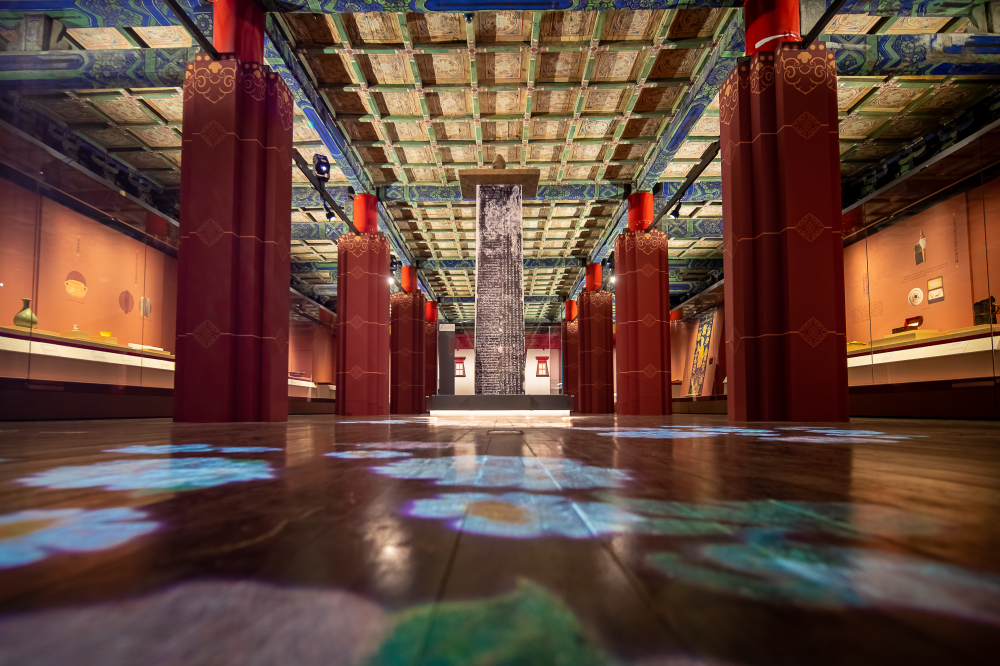
Dongnuange bridal chamber has a happy wedding. This picture shows the wedding bridal chamber of the East Nuan Pavilion of Kunning Palace restored based on documentary records. The word “Shou” is written in cursive on the top of the door, and the word “Xi” is decorated on the gilded door below. When the double doors are closed, the word “囍” is formed. There are couplets inscribed by Emperor Qianlong on both sides of the door: “Heaven is pure and blessed, and the valley of Beirjian is like a lotus; the people are harmonious under the edict, and Sui Yi will be blessed and live forever.” On the screen wall leading to the east and west gates of the bridal chamber, It is also decorated with the golden word “囍”, which means happiness upon opening the door. The main color of the door is red, creating a festive atmosphere..

在久久看中华 – The chrysanthemum

“will make the golden stamens flood with clouds”. The chrysanthemum petals reflect the morning light, and there are broken shadows accompanying the floating fragrance. Even if the dew is heavy and the frost is heavy, the yellow leaves will not dance in the autumn wind.

Panoramic view of the bridal chamber of Kunning Palace. The bridal chamber originally referred to a deep and secret room, and later specifically referred to the wedding room, also known as the wedding room. The bridal chamber of Kunning Palace was originally used for the wedding of Emperor Kangxi. The subsequent emperors were already married before taking the throne, so it was not used again until Emperors Tongzhi and Guangxu. The bridal chamber of Dongnuang Pavilion has a kang bed to the south and two rooms to the north separated by bright pillars. Both rooms have a floor-to-ceiling kang bed with a dragon and phoenix character “囍” and vines and gourd patterns. The northeast kang (outer north kang) is the living room, with mattresses, backrests, handrails, etc. on the kang, and the northwest kang (inner north kang) is the bedroom. The floor is covered with a large red carpet, embroidered with dragon and phoenix patterns, and the golden character “囍” embroidered between the dragon and phoenix, echoing the golden character “囍” on the wooden shadow wall. The bridal chamber is full of festive

Kunning Palace bridal chamber waist knife. The Manchus are martial people, and this tradition can still be reflected in wedding items. This knife is hung on the pillar of the bridal chamber, which has the same meaning as the bow and arrow bag hung along the nose pillar of the bridal chamber. According to the records of the Qing Palace, such weapons were only hung during festivals, not only for the sake of martial arts but also to ward off evil spirits.

Interior view of the bridal chamber of Kunning Palace. In the bridal chamber, there is a floor-to-ceiling kang bed with a gourd and vine pattern of “囍” and dragon and phoenix, and a tent with a dragon and phoenix in auspicious “囍” pattern. A bedding is placed on the kang, and a plaque hangs “the sun rises and the moon stays forever.” There is a saying in the book of the emperor and empress of Tongzhi that “the two rituals of movement and coordination will make the husband smooth; the light will shine on the four sides, and the rising sun will praise the husband and the moon.” Therefore, the plaque contains the meaning of blessing. The vine gourd symbolizes the endless supply of melons, which corresponds to the couplet on the indoor wall: “The treasures last forever, the eight poles of mankind and heaven rejoice; the gold and yellow flowers bloom together, the sun and the moon shine brightly in the sky”

Images and visuals are from – Forbidden City –Palace Museum Beijing- China –People’s Republic of China…..

#北京。 #中國 #China #Beijing | #紫禁城 #ForbiddenCity #August2023 | #ForbiddenCityDairies -The Palace Museum #ForbiddenCity Collections of Chinese intangible cultural heritage.  Collection  7th   –  15th August 2023..

On July 19th 2023 , the multilingual website of the Forbidden City Palace Museum- Beijing, China, People’s Republic of Chinawas officially released at the Digital Cultural Tourism Development Forum of the 2023 China Internet Civilization Conference! The website covers five languages: English, French, Russian, Japanese, and Spanish, and will meet the needs of audiences with different languages.

 The multilingual website of the Palace Museum is committed to establishing an international website that is concise, clear, easy to use for overseas audiences, and fits the construction of the modern civilization of the Chinese nation, including tour guides, information, panoramic tours, online exhibitions, collection appreciation, cultural topics, etc. Rich immersive content describing of the most detail collection that housed within the Forbidden city collection… . 

When the red sun is scorching and the heat is unbearable, the refrigerator in which is an invention of China Chinese… is a necessity for modern people 消暑生冷. So, how did the ancients chill melons, fruits and drinks? This cypress refrigerator in the Palace Museum tells us the answer.

The exterior of the refrigerator is cypress wood. There is a layer of grid drawers inside the box, ice cubes are placed under the grid drawers, and food is placed on the drawer boards to play the role of freezing and keeping fresh. At the same time, the four walls inside the box are inlaid with lead skin, which can not only insulate heat, but also maintain low temperature. Two copper lifting rings are installed on both sides of the outside of the refrigerator for easy lifting. Keeping cold and portable, this “can walk at any time” cypress refrigerator is ingeniously designed and quite practical, from which it is not difficult to glimpse the wisdom of the ancients!  古人也太会吧

去我们一起来读历史 The buildings, streamers, Jing, etc. (replicas) in the emperor’s brine book. According to the records, there are Changshou Building, Zi Building, Ni Building, Yu Bao Building, Xin Ban, Jiang Yin Ban, Leopard Tail Banner, Longtou Gan Ban, Jiaoxiao Biao Festival Banner, Ming Xingbi Jiao Banner, Banners, streamers, Jing, etc. of different shapes and colors, such as Shihui Jing for Celebration, Huaiyuan Jing for Praising Merit, Zhenwu Jing, Fuwen Jing, Nayan Jing, Jinshan Jing, Jinjie, Yiqi, Huanghui, etc. Shown here are reproductions of Huanghui, Jinjie, Longtou Ganfan, Nizhu, Yizheng and Jing.

On the eighth of August 2023 Looking from afar, autumn is condensing in the depths of the clouds. Today 立秋Liqiu Tue, 8 Aug 2023 – Wed, 23 Aug 2023 The traditional Chinese calendar divides a year into 24 solar terms. Lìqiū, Risshū, Ipchu, or Lập thu is the 13th solar term. It begins when the Sun reaches the celestial longitude of 135° and ends when it reaches the longitude of 150°.

Let us read the calendar together The flag (replica) in the emperor’s brine book. There are more than 120 flags in the halogen book, including the sun, moon, cloud, thunder, wind, rain, twenty-eight mansions, five stars, five mountains, four directions, four dunes, phoenix, luan, wandering Lin, and lion taming, which is the largest number in the halogen book. A class of items.

禁禁欣芳 In the sixth month of the lunar calendar, lotus flowers are used as the order of the month. The ancients endowed the lotus with a clean and elegant character, praised its noble character of “the root is jade in the mud, and the heart bears the bead”. In addition, the lotus flower can be used as a vegetable for meat and meat, porridge for soup, nourishing and health-preserving, and making tea and medicine. It can be described as a good product for refreshing summer heat. ​​​​

Let us read the calendar together#The weapons (replicas) in the emperor’s brine book. The weapons in the Lubo ceremonial guards all had practical functions at first, and then gradually evolved into symbols of the emperor’s majesty. Shown in the picture include leopard tail spear, halberd, shu, star, standing melon, lying melon and axe.

去我们一起来读计划 Qing, Qingkuan, etc., set up a welcome picture in the album of big wedding pictures. From this picture, the Guangxu Emperor’s wedding welcome team exits the middle gate of the Taihe Gate from the Hall of Supreme Harmony, and then leaves the palace from the middle gate of the Daqing Gate to the Queen’s Mansion. After the ceremony of appointing envoys, the cabinet and the officials of the Ministry of Rites carried out the books and treasures together with the case from the Hall of Supreme Harmony, and then the deputy envoys placed the books and treasures in the Dragon Pavilion of His Majesty Dan respectively. In the picture, the chief envoy Chijie has stepped down from Dan Bi, and the deputy envoy is holding the hand of the king .

Qing, the treasure of Queen Jinlong. The gold books and gold treasures presented to the queen have become the symbol of the queen’s status. This is the “Queen’s Treasure”, made of gold, with a dragon button, attached to a yellow ribbon, and the seal is in Manchu and Chinese jade chopsticks, and the script is the same as the emperor’s imperial treasure.

Modern and modern times, the queen’s gold book. After Puyi  forcefully abdicated, according to the “Preferential Treatment Conditions of the Qing Dynasty”, he still lived a life of “little court” in the inner court of the Forbidden City, and married Wanrong as the queen according to the wedding ceremony of the Qing emperor. This is the golden book that canonized Wanrong, with a total of ten pages. It reads: “Xuantong’s fourteenth year…the daughter of Rongyuan…I hereby take Baolier as the queen…” The “little imperial court” still uses the Xuantong year name, “Xuantong fourteen years” is the eleventh year of the Republic of China (1922). This gold book is the only queen gold book in existence in the Palace Museum..

Qing, Qingkuan, etc., set up a welcome picture in the album of big wedding pictures. This picture depicts the wedding procession arriving at the residence of the queen-to-be, and the stepfather leading the children kneeling outside the gate to greet her. In the lead of the imperial battle, Huang Gai accompanied, followed by officials in charge of ceremonies, Honglu Temple Xuban officials and Mingzan officials, then envoys and deputy envoys, followed by Ceting, Baoting and Fengyu carried by 16 people. They entered the courtyard one by one, followed by the queen-to-be’s father and clan members. In the government…

Qing Dynasty Qianlong, Lengjian, Huangmen, etc., the Fengyu page of the Atlas of Imperial Ritual Vessels. In the Qing Dynasty, the emperor used a phoenix to marry the queen’s wedding sedan chair. The body of the Fengyu sedan chair is made of wood, painted with bright yellow lacquer. The dome is double-layered, and each octagon is decorated with a golden phoenix. The hanging eaves are bright yellow satin, painted with golden phoenix. The four curtains are painted with blue stones and golden phoenixes. The interior is painted with red lacquer, the sedan chair is bright yellow satin with golden phoenix painted on it, and the sedan chair cushion is bright yellow satin with colorful phoenix embroidered on it. The shoulder poles are topped with bronze brass and golden phoenix heads and tails. The style of the phoenix was determined in the book “Illustration of Ritual Vessels of the Dynasty” during the Qianlong period. It was used by the empress when she participated in the silkworm ceremony of offering sacrifices to the god of silkworms.

Images and visuals are from – Forbidden City –Palace Museum Beijing- China –People’s Republic of China…..

#QIPAO #旗袍 #Cheongsam |#茧迹原创礼服定制 #Cocoon #BeijingYujiFashionDesignCo. #August 2023| #FashionLookBook #武汉时装周 Gorgeous Chinese painting embroidery of #ArtHauteCouture #TraditionalChineseQipao #ModernCheongsam #ChineseWeddingDress #ModernQipao Collection  5th May – 8th August 2023

Located in an ancient post-modern Three thousand years old ultra Megatroplis city Beijing City, Capital of  China – People’s Republic of China, 茧迹原创礼服定制 Cocoon – Beijing Yuji Fashion Design Co in which Cocoon trace original dress customization: No. D05, Zhongyi Street, 798 Art District, Jiuxianqiao, Chaoyang District, Beijing …. Innovatingly Post Modern Qipao- Cheongsam …. in which innovatively bringing a New Chinese style cheongsam-Qipao high-end brand-Embroidery Embroiderer seamstressing   …….it is committed to the high-end private specialization of Chinese Shanghai style cheongsam innovatively… in which each dress is customised towards the wear’s in which tailoring takes least in between 20-60 days depending on the extremely level of detailing of brocade in which using the most finest heavy silks are hand sewn and crafted …..

Introducing Cocoon Trace Original Dress Customization Chinese innovative in between Ming and Qing Dynasty fusion traditional wedding dresses  in some in modern fusion of its  2023 Art Haute Couture series in which their inspirationally Continuation from the   Chinese Painting of spring flowersCocoon Trace 2022’s original and improved cheongsam … Fengdai” has chosen a design that is very suitable for summer in both fabric and color matching…

Dream back to Luoshen|Ada Choi Chaohua X Cocoon Actor Ada Choi appeared
in a special custom-made cocoon 装风2023 The early stage is like a light cloud covering the moon, and if the flowing wind returns to the snow, it is light, flowing, and graceful . Achieving the beauty of your heart….

古纸婚婚 At the beginning of summer, feel happiness and beauty
through the light and shadow of the shade of the trees …..

古座婚婚Taking the solemn and noble feeling of court clothes, the dragon and phoenix gowns are innovated. While shining brightly, they are not bound by tradition, and draw a unique and trendy silk brocade picture for the bride.

Yinyuanjihui | Antique Clothes and Contemporary Clothing Show
Cocoon x Yiyuan x Langyuan x Yoyo Search We have witnessed this time that has spread for more than a hundred years. Aesthetics recreates elegance and interest in the vast time. At the beginning of a new chapter Inexhaustible thread, achievement mind beautiful clothes…

Xiaoman|Everything is flourishing, full but not full. As for this, it is just the right wisdom to be so small that everything is full and rich.

Cocoon Ji 2023’s new work “Mu Ye Ji”

coexists with the nature of the world, draws on its vigorous power of free growth,
creates an infinite sense of beauty in the exploration of nature, and writes a chapter of natural anthology called Xia in the veins of leaves…

Cocoon Ji 2023’s new work “Mu Ye Ji”

is a light and soft silk taken from nature , with its unique temperature and inherited the characteristics of breathing…

Green BreezePine Trees🌲Inspired
by the works of art collected by the Hong Kong Museum of History, we improved it into a short-sleeved double-breasted version, and made more sophisticated treatments on the buttons and details. Printed silk all over the body, when sewing, turn one side of the pattern originally printed on the two ends of the fabric to ensure that the patterns on both ends are exactly on the front and back of the skirt.


Cocoon Ji 2023 original Chinese style “Linqi”Who knows the “mermaid princess” in the cheongsam session~
The clarity of the sky and the transparency of the sea are all from hand-made custom dyeing, matched with high-end sequin lace all over the body, sparkling when walking Moving, it is completely “mermaid fish”


Come and “collide with nature” 🌿 Cocoon Ji 2023 original Chinese dress “Mengying” is a
natural flower color matching of pink,
white and black. It chooses high-end lace imported from Italy to create petal-like layers and clarity, and the color is harmonious and advanced. The shoulder-shaved design highlights the shoulder and neck lines, cleverly grasping the sweet and high-end sex appeal 🌷

Happy in a little time, quiet in a small

place 🍃Venue: 晴玉酒店
dress: 古已original dress custom
photography: 一级一故事
Makeup: Rachel-MakeupModel
: Marcee
​Media Support: 婚礼News

千维Thousands of strands, the achievement of beautiful clothes

Wooden leaves moving autumn sound 🍂
Today 立秋 let’s blow the wind of new autumn together!

QIPAO 旗袍 Cheongsam …. In which from historically Shenyang is the birth place of the Qing Dynasty 1636-1912plus ….  In which Qipao is termed for Qing Dynasty Clothing that the Manchu ethnic adoptively wore…… in which the Shenyang Palace Museum was an imperial palace towards two Qing Dynasty emperors. Previously two years ago During the event it which was an eight day forums, with exhibitions also related workshops illustrating the birth place of the Old Capital of Cheongsam where the Qing Dynasty- Qipao was inspired from..   Before that Shanghai 1930’s Qipao-Cheongsam revolution, the Manchurian Cheongsam was the fashion of choice of the Qing Dynasty (1636-1912)   throughout as it standardized that style during the dynasty… Replacing the previous clothing standard Han Fu – Han Dynasty clothing style, in which also is form fitting towards the women’s silhouette but with a higher degree of freedom of flare of personal, individual style… 

Qipao-Cheongsam is uniquely hand crafted tailored Chinese dress to the customer’s various measurements… in which you can still have them brought of the rack in which is accustomed to the standard measurements… in which you can tell which is western influenced with the back zipped in which the Eastern traditional Chinese Tailors would have the side zipped of the Qipao dress due it interrupts the flow of the pattern work at the back of the dress..  Also it creates a continuous seamless back look…  after as the measurements are translated drafted onto the silk or the customer desired accustomed fabric of choice, from the measurements book with the associated look of the design elements with additional accessories the sexiness of Qipao lies subtlety.. Measuring, patterning, cutting, and button making are crucial, in where passion and art comes together in tailoring….

 In which traditionally Qipao- Cheongsam dresses are worn for from straight forwardly every day towards after work evening wear in without having to change to another set of wardrobe dressing only to accessories for the required occasion… … in which the Qipao dress pattern silhouette is design for the lady’s figure in which accentuating the silhouette without giving away too much of what’s underneath in retaining…. its timeless classic silhouettes in which are designed to be worn every day, from work, evening,  casually  towards to the weekend… with sleek simple, elegant, sexy intelligent sophistication in which are easy to be accessorised with any pieces of clothing in your current or upcoming wardrobe…

  Images and visuals are from Weibo also from茧迹原创礼服定制Cocoontrace original dress customization: No. D05, Zhongyi Street, 798 Art District, Jiuxianqiao, Chaoyang District, Beijing 010-59789809 – China –People’s Republic of China ..

#北京。 #中國 #China #Beijing | #紫禁城 #ForbiddenCity #August2023 | #ForbiddenCityDairies -The Palace Museum #ForbiddenCity Collections of Chinese intangible cultural heritage. 27th July- 7th August 2023

On July 19th 2023 , the multilingual website of the Forbidden City Palace Museum- Beijing, China, People’s Republic of Chinawas officially released at the Digital Cultural Tourism Development Forum of the 2023 China Internet Civilization Conference! The website covers five languages: English, French, Russian, Japanese, and Spanish, and will meet the needs of audiences with different languages.

 The multilingual website of the Palace Museum is committed to establishing an international website that is concise, clear, easy to use for overseas audiences, and fits the construction of the modern civilization of the Chinese nation, including tour guides, information, panoramic tours, online exhibitions, collection appreciation, cultural topics, etc. Rich immersive content describing of the most detail collection that housed within the Forbidden city collection… . 

During the Months of late July towards early August 2023 it has been serve Rainstorms in Beijing in which the  603 year old Forbidden city Drainage has been designed very well in countering those intense weather conditions….

去我们一起来读计划  In the Guangxu period of the Qing Dynasty, a red silk embroidered gold Xi word butterfly pattern single cloak. Cloaks, shirts, waistcoats, etc. are all casual clothes worn by concubines in the Qing Dynasty, and they are also gorgeous and colorful parts of court costumes. According to Guangxu’s “Great Wedding Ceremony Red Documents”, the items prepared by Emperor Guangxu for the queen’s wedding include: a total of 236 pieces of casual clothes such as shirts, cloaks, tights, ragged coats, and mandarin jackets of various materials. Forty-four pieces of clothing, eighty sets of various inner garments, eighty pairs of various shoes and socks, etc. “Red Archives of Tongzhi Wedding Ceremony in the Qing Dynasty” also has records of the colors, textures, patterns and craftsmanship of the various garments in the queen’s dowry. This cloak should be the summer casual clothes of Emperor Guangxu, Empress Xiao Dingjing. The whole body is covered with red silk, mainly with gold thread, and the Chinese character “囍” is embroidered with hundreds of butterflies. Butterflies are a symbol of happiness and love, and the word “囍” in Baidie means a happy marriage for a hundred years….

去我们一起来读计划  In the Guangxu period of the Qing Dynasty, a single cloak with bright yellow silk embroidered with peony circles and longevity patterns. This cloak is the concubine’s summer casual dress, with bright yellow plain silk as the ground, embroidered with lake-colored, white, and light-green silk threads to embroider peony flowers with folded branches, and decorated with flat gold embroidered group “Shou” in between. The neckline, sleeves and hem are all traditional auspicious patterns, woven with gold dancing butterfly tapestry and Yuanqing satin flat gold “Shou” peony border, the color matching is very coordinated, and the embroidery is exquisite, highlighting the imperial royal clothing​​ .

去我们一起来读计划 Qing and Ming yellow silk 囍 word mink fur coat. The Palace Museum has a wide variety of ready-made garments for empresses and concubines of the Qing Dynasty, available in all seasons and in various textures. Manchu people who originally lived in the cold region of Northeast China, their love for fur products has not diminished in the slightest after entering the customs. Wool products such as winter clothing and crown hats occupied an important position in the ceremonial clothing of the Qing Dynasty. What grade and type of fur people of different status levels wore was also determined in the system…..

[The Forbidden City opened a new exhibition in Xinjiang! 】On July 28 2023, “Glory of the Flourishing Age-Exhibition of Qing Dynasty Palace Jade Collected by the Palace Museum” opened in the “Forbidden City Hall” of the Xinjiang Uygur Autonomous Region Museum. This exhibition is also the first appearance of the “Forbidden City Hall” of the museum. For thousands of years, the excellent cultures of various ethnic groups have converged and jointly created a brilliant Chinese civilization. Among them, jades in the Qing Dynasty used a large number of unique Xinjiang jade materials, with excellent materials, regular shapes, and designs .

去我们一起来读计划 Guangxu in the Qing Dynasty, a small waistcoat with pink and gold 囍 word butterfly pattern on the front. This vest is the queen’s daily casual dress, also known as tight-fitting, round neck, double-breasted, sleeveless, with open skirts on both sides and back. The pink ground on the front and back and the back, as well as the stone-blue garment hem, are woven with the word “囍”, interspersed with a pair of colorful butterflies dancing together, implying happy reunion. The rich and colorful dowry costumes of the empress not only reflect the noble status of the empress and the exquisiteness of the wedding in the emperor’s home, but also show the exquisite craftsmanship of our country’s weaving and embroidery.

Qing, Qing Kuan, etc., the queen’s dowry picture of the big wedding picture. This is the end of the dowry procession in “The Queen’s Dowry Picture”. The scene depicted is the dowry procession walking outside the Donghua Gate, carrying some red sandalwood carved boxes and a pair of red sandalwood carved cabinets as the final push. So far, the queen The 200 dowries carried into the palace were all carried into the palace, and the two-day dowry delivery event came to an end. During the entire process of the dowry entering the palace, in order to protect the safety of the dowry all the way, the troop carrying the dowry is composed of the school lieutenant Luan Yiwei and various personnel from the Ministry of Internal Affairs. , the Ministry of Internal Affairs, etc. will be taken care of along the way.

There is a time to see the end of the day when the clouds are cleared. When the wind stops and the rain stops, enjoy the beautiful sunlight and the fragrance of golden stamens together. Hello August….!

去我们一起来读计划 Qing, Qingkuan, etc., set up a welcome picture (partial) in the album of big wedding pictures. In the evening before the big wedding, the emperor of the Qing Dynasty held a grand canonization ceremony at the queen’s mansion first, and then welcomed the queen into the palace when she was a child. Although registration and welcome are two consecutive etiquettes, they are actually completed over two days. The sixth volume of Emperor Guangxu’s “Big Marriage Picture” “Collecting the Picture of Ingratiation” depicts the process of these two pre-wedding ceremonies, including 16 pages of images and 6 pages of illustrations. The following set of pictures are all taken from this volume. This is part of the page of “Picture of Salutation at the Palace of Compassion and Peace” The wedding ceremony of Emperor Guangxu was scheduled to be held on the twenty-seventh day of the first lunar month in the fifteenth year (1889). On the twenty-sixth day of the first lunar month, before the welcoming procession set off, Emperor Guangxu went to the Cining Palace to salute Empress Dowager Cixi and announce that he was about to become a queen. The eight pieces of gold in the empress dowager’s ceremonial car are located in Ciningmen Square. On the east side are the gold furnace, gold incense box, gold spit pot, and gold bottle; , Jinping, and the golden chair in the south.

去我们一起来读计划  Qing, Qingkuan, etc., set up a welcome picture in the album of big wedding pictures. These two pages show spectacular scenes, collectively known as “Pictures of Reception and Reception in the Palace of Imperial Harmony”. After Emperor Guangxu saluted the Empress Dowager in the Palace of Compassion and Ning, he was led by officials from the Ministry of Rites to the Hall of Supreme Harmony, where he first received the congratulations from the ministers, and then appointed envoys. In the picture, the senior scholar stands under the east eaves of the Hall of Supreme Harmony, the cabinet officials, publicity officials, and officials of the Ministry of Rituals stand behind the senior scholar, the envoys, deputy envoys, and saluting princes and ministers kneel on Majesty Dan, and His Majesty Dan is more Saluting civil and military officials ranked according to the grade level according to the grade mountain mark, waiting for the emperor to come…..

去我们一起来读计划Qing , Qingkuan, etc., the album of the big wedding picture sets up a welcome picture (partial); the interior view of the Hall of Supreme Harmony. This is a part of the “Picture of the Welcome Ceremony in the Book of the Palace of Imperial Harmony”. On the screen, there is a festival table in the middle of the Hall of Supreme Harmony, with a red lacquer festival frame on the table. There are book cases and treasure cases on the left and right, and a gold box on the top, which is used to hold the gold book and the queen’s treasure. Under the eaves of the Hall of Supreme Harmony, there are eight pieces of gold from the Emperor’s Fajia brine book, namely, two gold furnaces, two gold vases, two gold incense boxes, one gold spit pot, and one gold washbasin. Under the east and west eaves of the Hall of Supreme Harmony, there are Zhonghe Shaoyue chime bells, chime chimes and other musical instruments.

去我们一起来读计划Qing , Qingkuan, etc., the album of the big wedding picture sets up a welcome picture (partial); the interior view of the Hall of Supreme Harmony. This is a part of the “Picture of the Welcome Ceremony in the Book of the Palace of Imperial Harmony”. On the screen, there is a festival table in the middle of the Hall of Supreme Harmony, with a red lacquer festival frame on the table. There are book cases and treasure cases on the left and right, and a gold box on the top, which is used to hold the gold book and the queen’s treasure. Under the eaves of the Hall of Supreme Harmony, there are eight pieces of gold from the Emperor’s Fajia brine book, namely, two gold furnaces, two gold vases, two gold incense boxes, one gold spit pot, and one gold washbasin. Under the east and west eaves of the Hall of Supreme Harmony, there are Zhonghe Shaoyue chime bells, chime chimes and other musical instruments.

The umbrella cover (replica) in the emperor’s brine book. The umbrella covers in the emperor’s law driving brine book include: curved nine-dragon cover, emerald green cover, purple sesame cover, straight handle nine-dragon cover, five-color flower cover, five-color dragon cover and red and purple two-color square umbrellas. The picture shows the five-color flower cap with straight handle.

The fan (replica) in the emperor’s brine book. The fans in the emperor’s law driving brine book include longevity fans, double dragon fans, single dragon fans, peacock fans, pheasant tail fans, and phoenix fans. They are square and round in different shapes, and red, yellow, and green. The four pieces shown in the middle are fans, the one on the right is a battle-axe, and the one on the left is a leopard-tailed gun used by the leopard-tailed squad.

去我们一起来读计划 Qing, Qingkuan, etc., set up a welcome picture (partial) in the album of big wedding pictures. This is a part of the “Picture of the Welcome Ceremony in the Book of the Palace of Imperial Harmony”. It depicts princes and ministers, civil and military officials, and chief and deputy envoys standing in sequence, waiting for the emperor to preside over the ceremony in person, and appointing envoys to go to the queen’s residence for registration and welcome ceremony. The details in the picture can be seen in various fans, buildings, flags, banners, Jing, flags, weapons, etc. in the ceremonial guard of the halogen book, and the musical instruments of Danbi Dale are placed under the eaves on both sides of the Taihe Gate.

Images and visuals are from – Forbidden City –Palace Museum Beijing- China –People’s Republic of China…..

#北京。 #中國 #China #Beijing | #紫禁城 #ForbiddenCity #July2023 | #ForbiddenCityDairies -The Palace Museum #ForbiddenCity Collections of Chinese intangible cultural heritage.  Collection 20th   to 20th July 2023…

On July 19th 2023 , the multilingual website of the Forbidden City Palace Museum- Beijing, China, People’s Republic of Chinawas officially released at the Digital Cultural Tourism Development Forum of the 2023 China Internet Civilization Conference! The website covers five languages: English, French, Russian, Japanese, and Spanish, and will meet the needs of audiences with different languages.

 The multilingual website of the Palace Museum is committed to establishing an international website that is concise, clear, easy to use for overseas audiences, and fits the construction of the modern civilization of the Chinese nation, including tour guides, information, panoramic tours, online exhibitions, collection appreciation, cultural topics, etc. Rich immersive content describing of the most detail collection that housed within the Forbidden city collection… . 

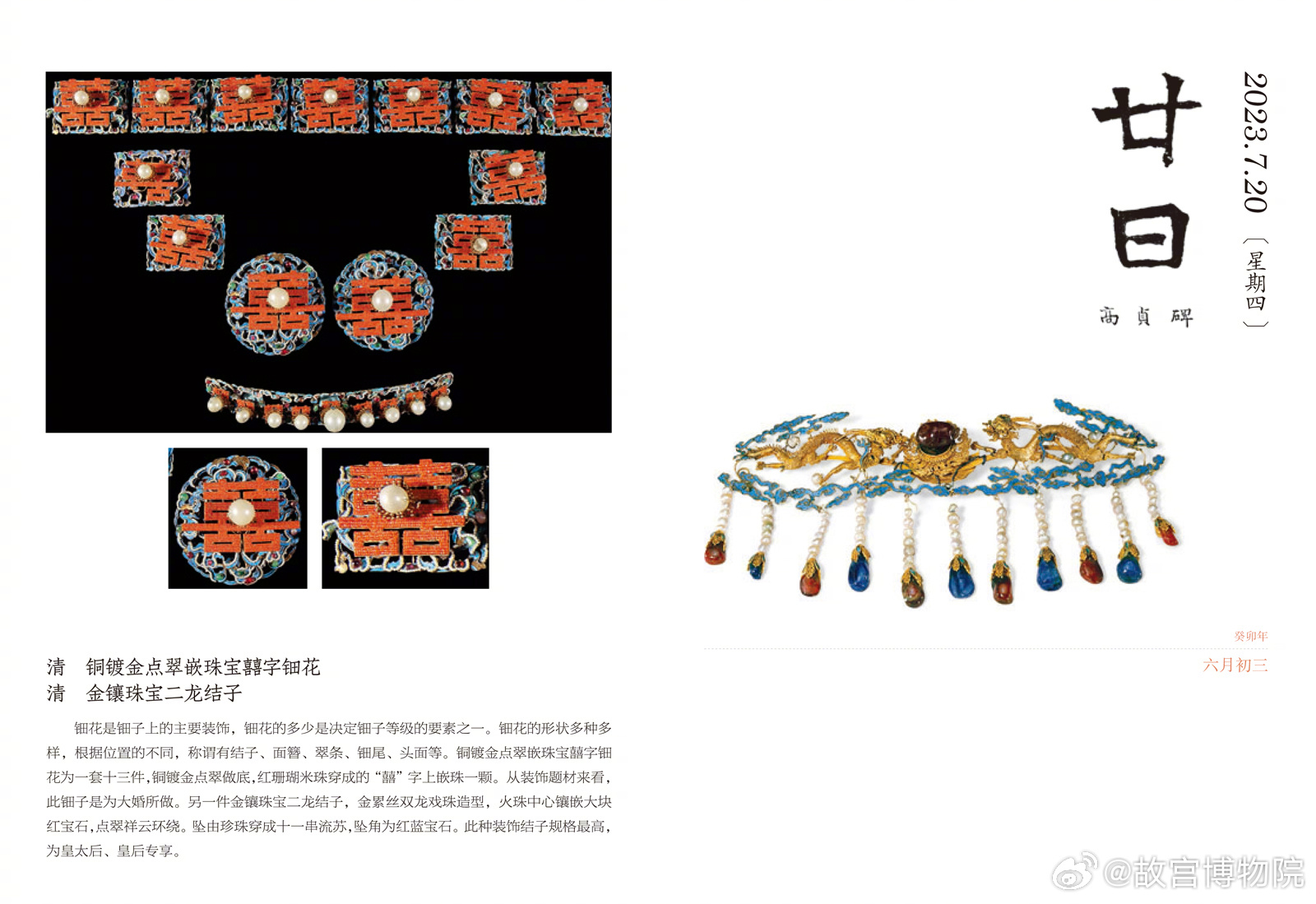
In the Qing Dynasty, gold-plated copper dots emerald inlaid with jewelry and the word Tianhua; in Qing Dynasty, gold-plated jewelry with two dragon knots. Tin flowers are the main decoration on the tin, and the number of tin flowers is one of the factors that determine the grade of the tin. Tin flowers come in a variety of shapes, and depending on their location, they are called knots, face hairpins, green strips, tin tails, head faces, etc. Gold-plated copper dot emerald jewels inlaid with the word “囍” is a set of thirteen pieces, with gold-plated copper dot emerald as the base, and a bead embedded in the character “囍” made of red coral rice beads. Judging from the decorative theme, this tin is made for a big wedding. Another piece of gold inlaid jewelry is a two-dragon knot, in the shape of two dragons playing with gold silk. The center of the fire bead is inlaid with a large ruby, surrounded by green and auspicious clouds. The pendant is made of pearls threaded into eleven strings of tassels, and the corners of the pendant are red sapphires. This kind of decorative knot has the highest standard and is exclusively used by empress dowagers and empresses.

Qing Daoguang, silver-plated hairpin with gold-plated emerald dots inlaid with gemstones, and Tongzhi in Qing Dynasty, silver-plated hairpin with gold-plated gemstones and fake beads and phoenix pattern. In the jewelry of concubines, there are a large number of hairpins of various types, and although they have different themes, they all have auspicious meanings. The number of pearls and the types of gemstones on these jewelry reflect the rank and status of the jewelry owner. Three pieces of silver – plated emerald “囍” character hairpins, with pearls inlaid on the center “囍” character, “囍” character above and below…

In the Qing Dynasty, the golden chiseled word butterfly pattern is flat and square. Bianfang is a unique headdress for Manchu noblewomen in the Qing Dynasty, and it is also a bracket used for dressing up the “two heads”. It has a similar function to the long hairpin used by Han women. This flat square is made of gold, chiseled with sesame seeds as the ground, with a circle of flowers and grass patterns chiseled on the frame, six dancing butterflies and five “囍” characters chiseled inside the frame, and a bat chiseled on the head, implying the double arrival of happiness and happiness. It is a special decoration for the queen’s wedding…

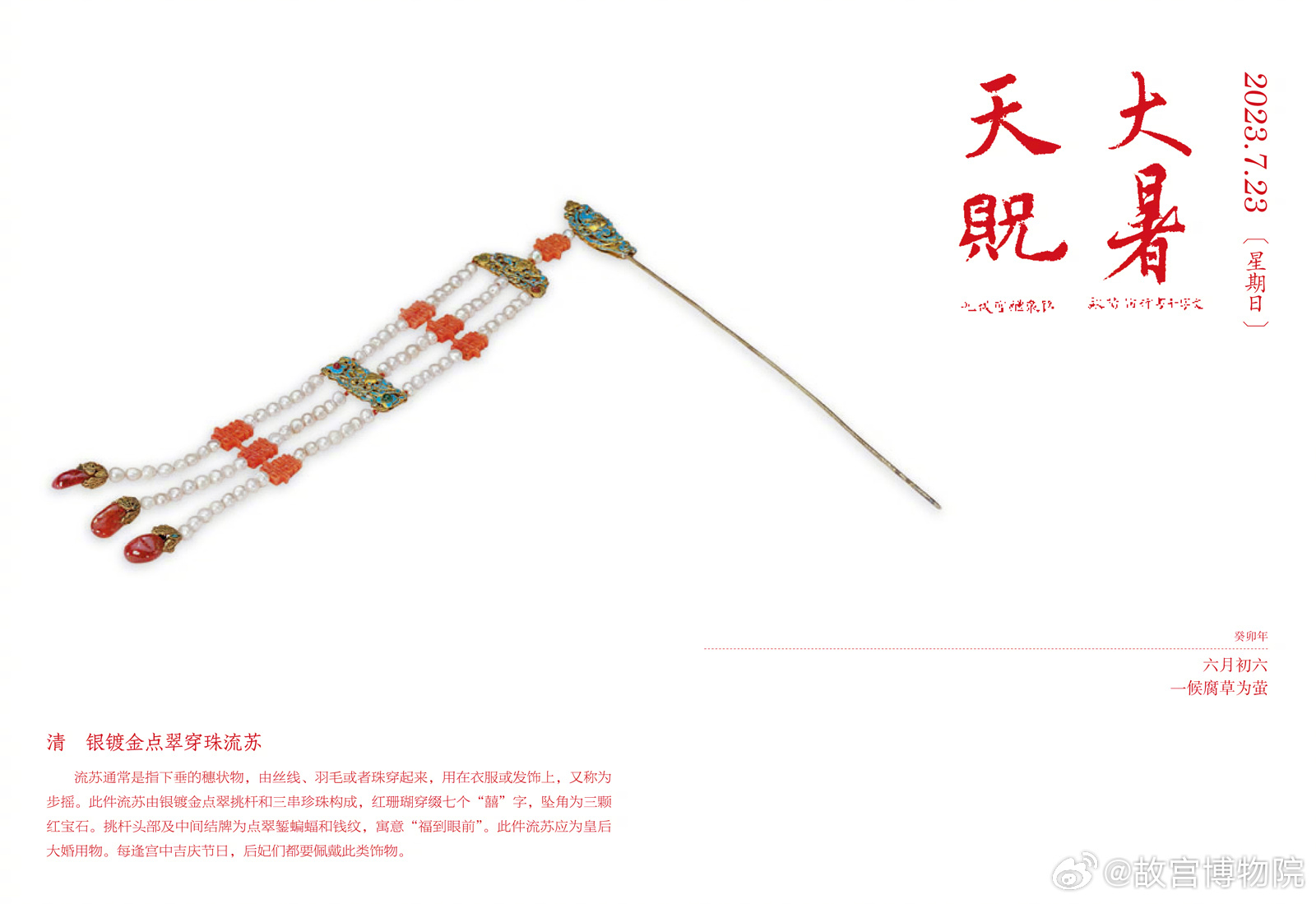
Clear, silver-plated dots emerald beads tassels. Tassels usually refer to drooping tassels, threaded by silk threads, feathers or beads, used on clothes or hair ornaments, also known as step shakes. This tassel is composed of silver-plated dot emerald poles and three strings of pearls. The red coral is embellished with seven “囍” characters, and the pendant corners are three rubies. The head of the pole and the knot in the middle are dotted emerald chiseled bats and money patterns, which means “blessings come to you”. This tassel should be used for the queen’s wedding. Every auspicious festival in the palace, concubines have to wear such ornaments.

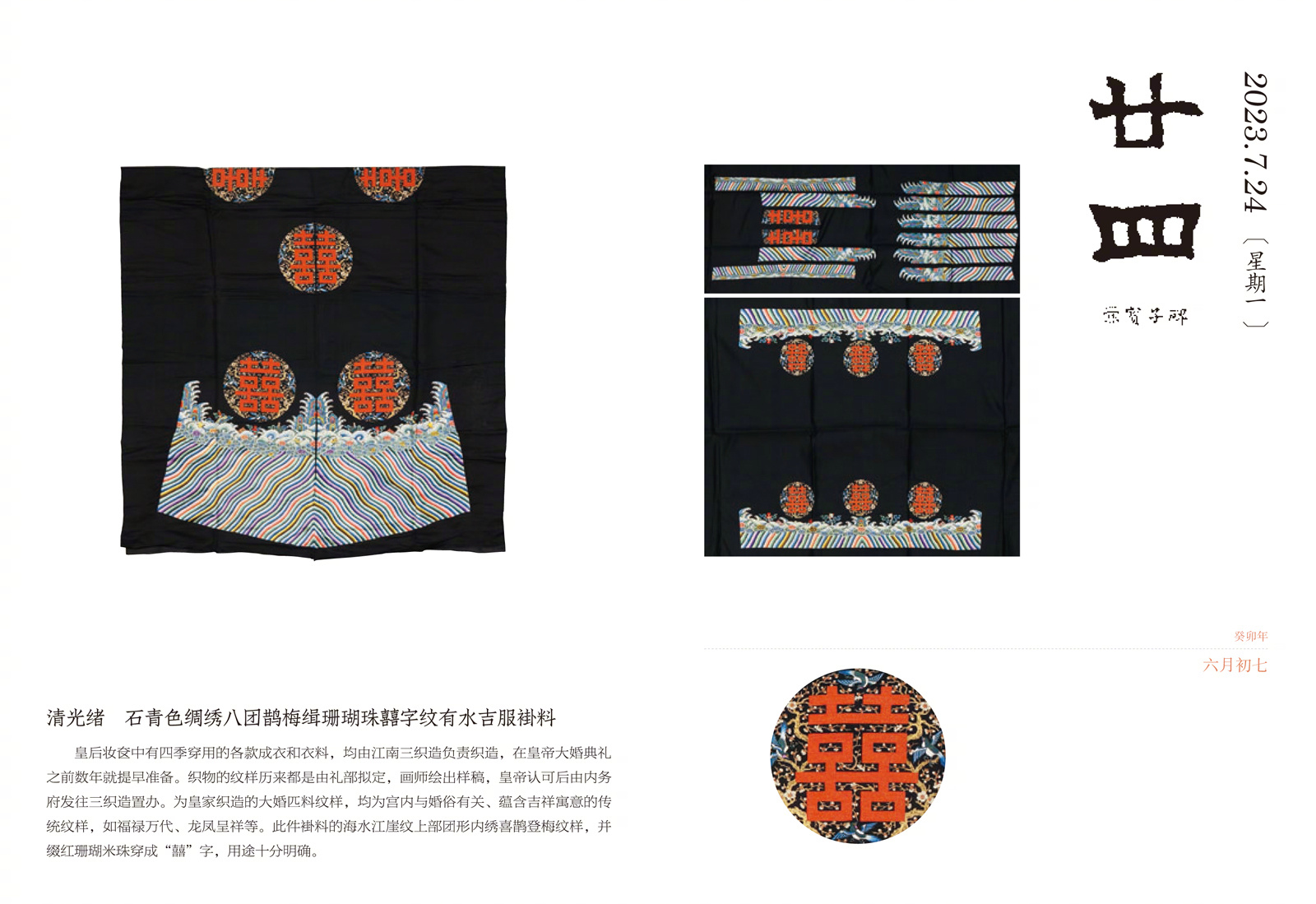
Qing Guangxu, stone blue silk embroidered with eight groups of magpies, plums, coral beads and Chinese characters, with water and auspicious clothing materials. The queen’s dowry includes all kinds of ready-made clothes and materials for the four seasons, all of which are woven by Jiangnan Sanzhi, which is prepared in advance several years before the emperor’s wedding ceremony. The pattern of the fabric has always been drawn up by the Ministry of Rites, and the artist draws a sample draft. After the emperor approves, the Ministry of Internal Affairs sends it to Sanzhizao for purchase. The wedding patterns woven for the royal family are all traditional patterns that are related to marriage customs in the palace and contain auspicious meanings, such as Fulu Bandai, Dragon and Phoenix Bringing Good Fortune, etc. The seawater river cliff pattern of this gown is embroidered with a magpie and a plum pattern on the upper part, and decorated with red coral and rice beads to form the character “囍”. The purpose is very clear.

Qing Guangxu, bright yellow silk embroidered with eight groups of magpies, plums, coral beads and 囍 characters, with Shui Jifu gowns. This gown is embroidered with bright yellow silk, with eight embroidered plum blossoms in full bloom, four magpies jumping on the branches, and red coral rice beads in the middle to form the character “囍”, with distinct layers and echoing up and down. Bright yellow is the imperial color exclusively used by the royal family. The magpie and plum blossoms imply happy brows, and the word “囍” pressed on the top implies happiness on top of happiness, highlighting the joy and peace of the emperor’s wedding. Plum blossoms have strong cold resistance, and they can brave the severe cold and bloom alone in the middle of winter when all the flowers are withered. Emperor Guangxu’s wedding coincided with the midwinter when plum blossoms were in full bloom, and such patterns added a festive atmosphere to the wedding..

Images and visuals are from – Forbidden City –Palace Museum Beijing- China –People’s Republic of China…..