On a very clear wonderful elegant beautiful 12th January 2022 week in which following Least than a month time 4 February 2022 is the Beijing winter Olympics in which The Capital of China – People’s Republic of China – 万多洛云大美京城 In Beijing in winter, the clouds in the sky are like blooming hibiscus flowers, which are very beautiful. The rising sun will turn thousands of miles of clouds into golden yellow, rendering the dreamiest colours. The moat still reflects the sky in the rippling blue waves, like water and sky….
In this year’s 2022 , the second decade from the turn of the century in Beijing the Capital of China also the People’s Republic of China, in which is also the year of the rat, marking its six hundred years anniversary of the Forbidden city that marks the transitional point of in between the middle of the Ming Dynasty (1368- 1644) transitionally from Nanjing to Beijing towards the Qing Dynasty (1636-1644-1911) …. The Imperial Palace seen so many countless seasonally transitional equinoxes but further its six hundred years is iconic, but it’s five hundred ninety nine years it marks it Autumn Equinox…. In which it only took twelve years to build the same of the Daming Palace of The Tang Dynasty Xian Imperial Capital only it was least twenty times larger…
恭王府Prince Gong- Kung Mansion Located in 17 Qianhai W St, Xicheng District, Beijing, China, 100035- China – People’s Republic of China Prince Gong’s Mansion, also known as the Prince Kung Mansion, is a museum and tourist attraction located in Xicheng District, Beijing, just north of the Shichahai Lake. It consists of large siheyuan-style mansions and gardens. In which It consists of large siheyuan-style mansions and gardens. Originally constructed for Heshen, an official highly favoured by the Qianlong Emperor, it was later renamed after Prince Gong, a Manchu prince and influential statesman of the late Qing dynasty, who inhabited the mansion in the late 19th century. covers an area of 6.112 hectares. In the forty-five year of Qianlong (1780), the academician He Shen was ordered to build this mansion. In the first year of Xianfeng (1851), the Qing court awarded this mansion to Prince Gong Aixinjueluo Yixin. Therefore, the name of the mansion was given.
Prince Gong’s Mansion is the largest palace complex in the Qing Dynasty. It has gone through the historical process of the Qing Dynasty from its heyday to its decline. It carries extremely rich historical and cultural information. Therefore, there is “a Prince Gong’s mansion, half of the history of the Qing Dynasty”. Statement.
The historical evolutionally elements of恭王府Prince Gong- Kung Mansion consisting many elements of halls, buildings and great halls. Heshen Mansion In the forty-five year of Qianlong (1780), the academician He Shen was ordered to build the ten princess mansion.
Bestowed to Yonglin In the fourth year of Jiaqing (1799), Emperor Jiaqing gave Heshen’s house to his younger brother (the seventeenth son of Qianlong) Qingjun Wang Yonglin, who was the palace of the Qing Dynasty. In the 25th year of Jiaqing, Wang Yonglin of Qingjun died and was inhabited by his son and descendants…..
Prince Gong Mansion In the 30th year of Daoguang (1850), Emperor Xianfeng bestowed the palace of Qing Dynasty to his sixth brother, Prince Gong Yixin. On April 22 of the second year of Xianfeng, Prince Gong Yixin moved to this mansion and was originally called Prince Gong’s Mansion. In the 20th year of Guangxu (1894), Prince Gong died, and his grandson Puwei attacked Prince Gong…..
Architectural Pattern Summary
The buildings of Prince Gong’s Mansion are clearly divided into East Road buildings, Middle Road buildings and West Road buildings. The buildings of each road run through the entire residence and courtyard from south to north in a rigorously symmetrical manner, with a clear layout.
Mansion Building
Middle Road Building There are mainly two buildings on the middle road, Yin’an Temple and Jiale Hall. Yin’an Temple, commonly known as Yinluan Temple, is the main building in the palace and the main hall of the palace. It is mainly used to hold major ceremonial activities in the palace and is only used for major events or festivals. In 1921, because the owner accidentally burned incense and caught fire, the main hall was burned down together with the east and west halls. However, the grandness of this hall can still make us feel the majestic and majestic style of the palace. Yin’an Temple is five rooms wide, with the top of Xieshan Mountain, and the main hall is made of green glazed tiles. The architectural paintings cannot use the emperor’s exclusive Hexi colored paintings, but the highest grades in the revolver paintings can be used, such as the gold-cut ink stone grinds the jade, the dragon brocade and the heart. Sitting dragon is available.
Jialetang is located behind Yin’an Temple. It is the last entrance of the building on Gongwangfu Middle Road, the front corridor, the five-bay room, and the hard top of the mountain. The “Jia Le Tang” plaque hangs directly above the gate.
East Road Building – The front yard of East Road is Duofuxuan, and the back yard is Ledaotang.
Duofuxuan in the front yard is the living room through the hall. The main function of the second hall is to receive guests, relatives or subordinates who give back and forth to things, and can also store gifts from the emperor. At that time, the hall was surrounded by plaques with the words “Fu Shou”. The decorations in the house were all based on historical photos and were arranged according to the original situation. Many historical photos of Prince Gong’s Mansion were displayed.
The main house in the courtyard behind it is named “Le Dao Tang”, which is the largest one in the building on the East Road. In the time of Prince Gong, this was his daily residence. At this time, Prince Gong, Prince Yixin, Emperor Daoguang once bestowed the “Ledaotang” plaque, so this place may also be named for it.
West Road Building – The buildings and courtyards on West Road are more elegant than those on Middle Road and East Road. The main buildings are Baoguang Room and Xijinzhai.
The Baoguang Room is located on the west road of the mansion. It was used as a living room during the period of Heshen and King Qing. In the period of Prince Gong, it was a secret living room for receiving the prince and relatives. The most exquisite among them is the Baoguang Room. The inner and outer eaves are painted with colorful paintings. The most amazing is the painted paintings of the Chinese and foreign eaves, which were painted by the highest-level color painting technicians in the country at that time. The inner eaves are also beautifully painted. Lun Meihuan, “The golden patterns under the eaves of the mansion are all plated with real gold.” As early as the Qing Dynasty, this place was a resting place for Emperor Daoguang to pay homage to his ancestors. After this rebuilding, it is mainly used to display the ancient relics left by Prince Gong’s Mansion. The plaque in the Baoguang room is the inscription of Prince Gong Yixin when Emperor Xianfeng was visiting Prince Gong’s residence. It is of far-reaching significance.
Xijinzhai is a classic in the architecture of Prince Gong’s Mansion, and the one with the most historical memory is Xijinzhai. Plane convex shape, the east, west and north sides of the hall are two-story fairy buildings, and the upper and lower floors are separated by beautifully carved nanmu partitions. According to historical records, the construction of Xijinzhai with nanmu is the thirteenth crime of Heshen. It is said that the eunuchs under the Heshen faction studied and borrowed the architecture of the Forbidden City, requiring craftsmen to imitate the architectural layout of the Ningshou Palace. , Far beyond the building specifications that ministers can have. In the 6th year of Guangxu, Prince Gong Yixin obtained the earliest surviving calligraphy work of famous masters in my country from Chengxin Wangfu-“Ping Fu Tie” handwritten by the great scholar of the Jin Dynasty, Lu Ji, which he treasured very much. Xijinzhai”.
Back Cover or South – At the junction of the mansion and the garden, there is a second-story back cover building that connects the buildings on the East, Middle, and West Roads. The length of the entire building is about 180 meters, and there are 108 rooms on the facade, commonly known as “ninety-nine and a half rooms”, which means “surplus upon expiration” in Taoism. It is called “Zhanji Tower” in the east and “Baoyue Tower” in the west, which is particularly stylish. There is the only indoor landscape garden in the country to the west of the back cover building, using a “small labyrinth” created by five rooms. The front eaves of the back cover building are out of the gallery, and each opening on the back eaves wall is equipped with a window. There are assorted windows of different forms on the upper floor. In the shape of silver ingots, there are also “fuqingyu” composed of bats, chime and fish. The windows have fine brick carvings, simple and elegant, and are harmoniously unified with the style of the garden on the north side. There is an aisle door on the lower level of the one west of the middle of the building, leading to the garden at the back of the house. It is said that there are countless treasures from the gentry family. In order to remember where the various treasures are, it can be said that he racked his brains. He marked each room, that is, the shape of each window is different.
Travelling Information
Tickets
40 yuan/person.
transportation
subway
Take Beijing Metro Line 6, get off at Beihai North Station, and exit at the northeast exit of B.
Bus
Take Beijing Bus No. 3 , No. 4, No. 13, No. 42, No. 107, 111, No. 118, No. 612 or Sightseeing No. 3 and get off at Beihai Beimen Station.
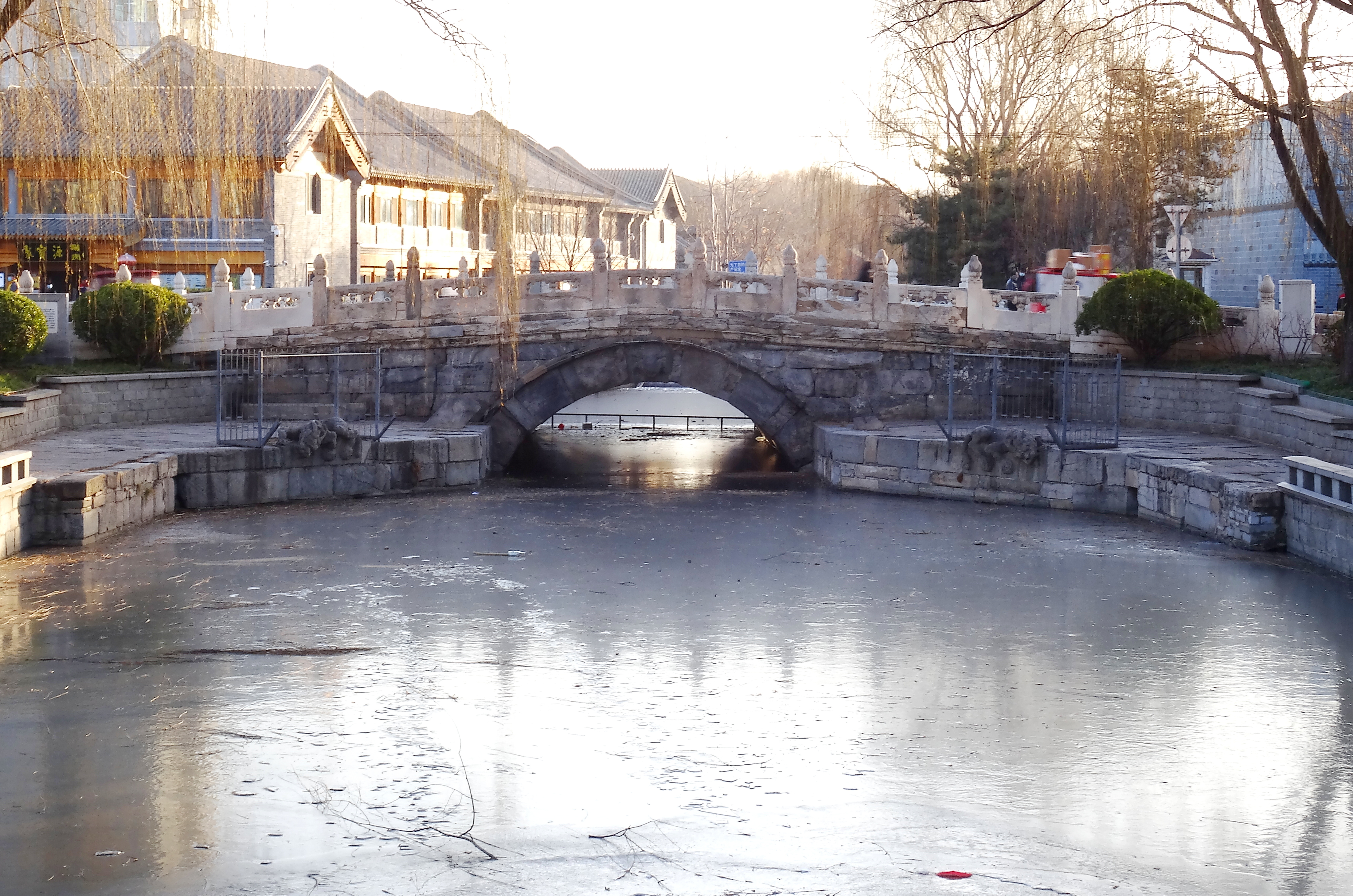
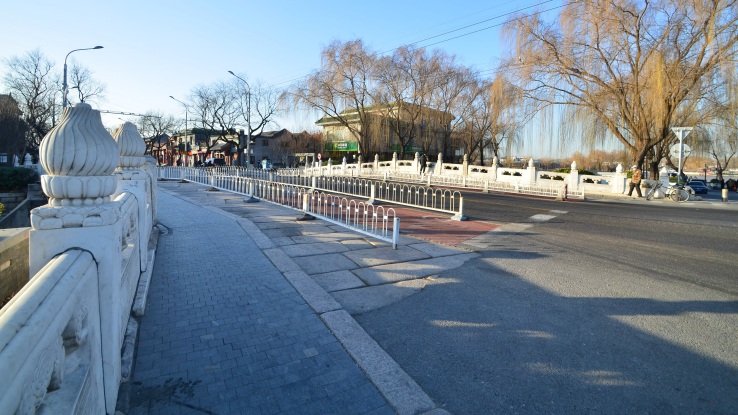
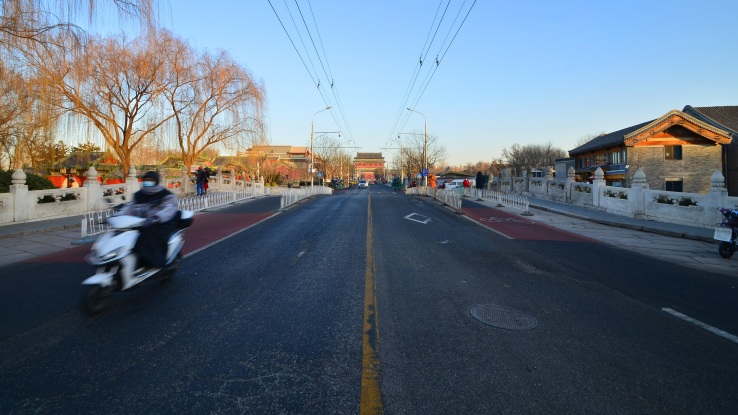
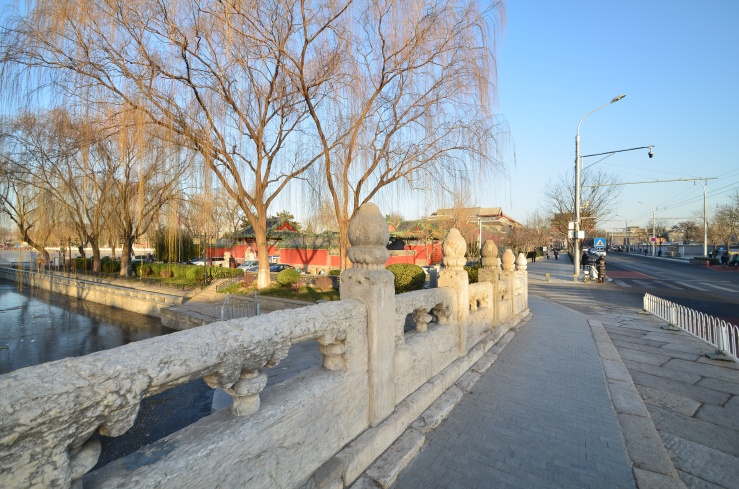
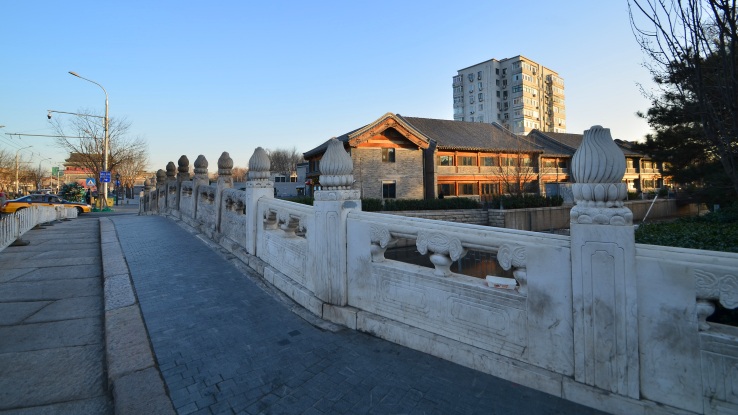
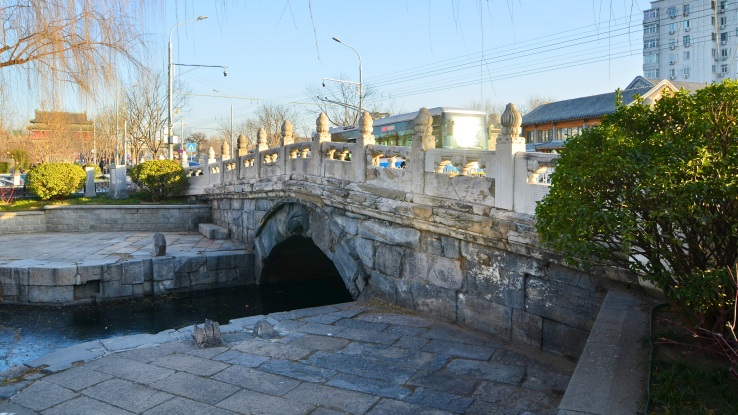
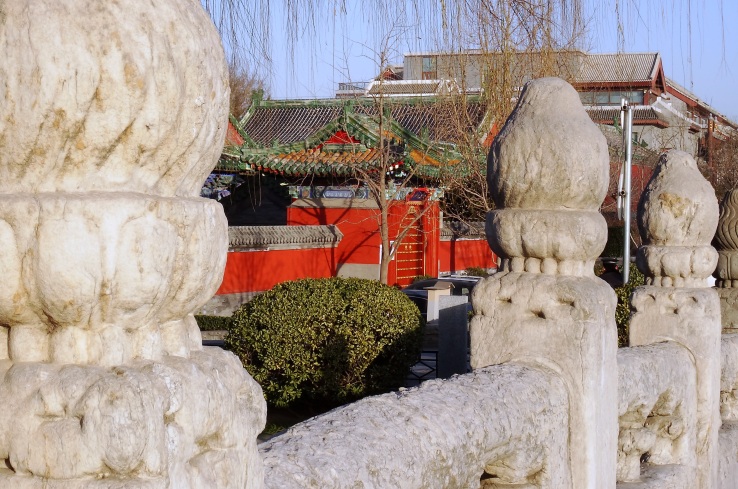
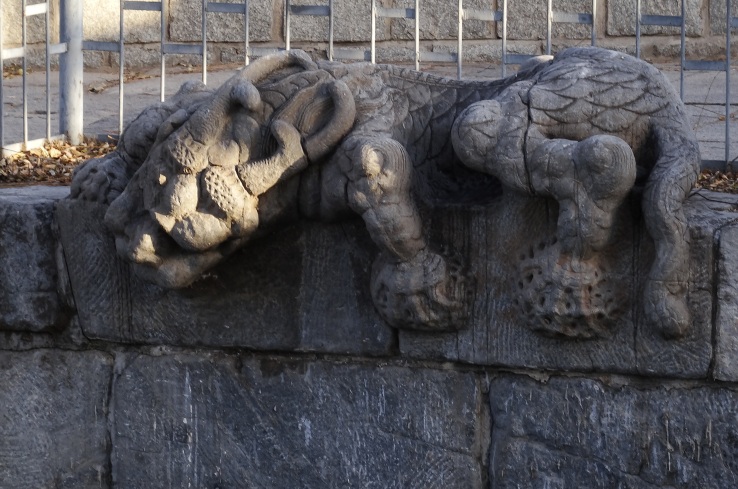
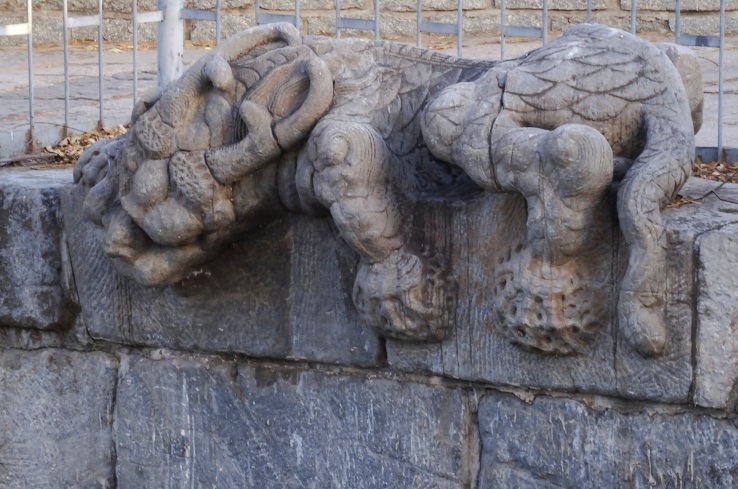
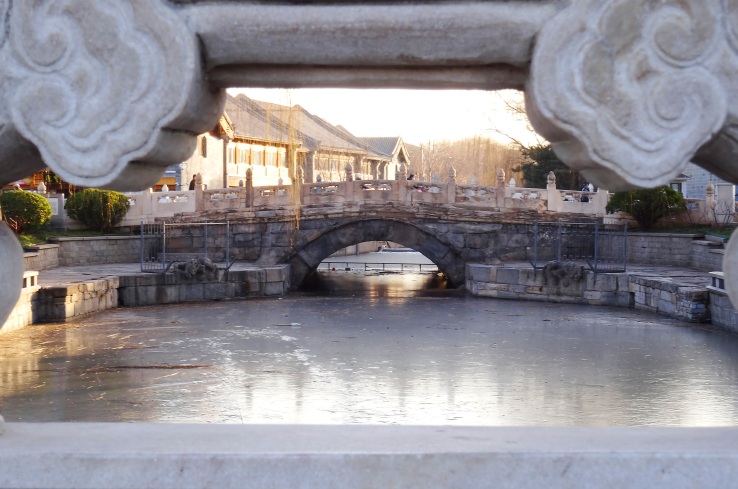
On the 21st December 2021 it was the Winter Solstice 2021 in which during the Beijing – China – People’s Republic of China was a clear blue skies with Located in Di’anmenwai Ave, 什刹海 Xicheng District, Beijing, China, 100009 the 736 year old Yuan Dynasty Bridge named the后门桥 Wanning Bridge or known as the Houmen Bridge .. located near Shichahai, was built in 1285. A sluice is installed under the bridge, and the sluice is lifted and released to stop the water from passing the boat. This “high-tech” stone bridge was the starting point for grain transportation on the Grand Canal in the Yuan Dynasty, and all grain ships entering the imperial city of Beijing would pass here. There are dragon-shaped water-separating beasts on all four sides of the bridge, which have the meaning of blessing the safety of water transport. This century-old bridge is still in use today!
后门桥 Wanning Bridge, also known as the Bridge , the Bridge , is located in Beijing Tiananmen Square , the Shichahai near, a bridge located in Beijing’s central axis. It was built in the 22nd year of Yuan Shizu to Yuan Dynasty (1285), originally named Wanning Bridge. Because the bridge is to the north of Di’anmen, Di’anmen is the back gate of the imperial city, so it is called the Houmen Bridge. Municipal cultural relics protection unit.
Located in Di’anmenwai Street, Xicheng District. It was built in the twenty-second year of Yuan Zhi Yuan (1285). Originally a wooden bridge, it was changed to a stone arch bridge in the Yuan Dynasty, named Wanning Bridge. Also known as Haizi Bridge and Houmen Bridge…….. was built from the Yuan Dynasty to the 22nd of the Yuan Dynasty. It was called Wanning Bridge at that time. It was the most prosperous period of the Yuan Dynasty under Kublai Khan’s rule. The Wanning Bridge at that time was a wooden bridge. At that time, its “little name” was not called “Houmen Bridge”. Historical materials record Wanning Bridge in Yuan Dynasty, also known as “Sky Bridge”. In the Yuan Dynasty, Kublai Khan repaired the end of the Beijing-Hangzhou Grand Canal to today’s Jishuitan, and this Wanning Bridge is the northernmost gate of the Beijing-Hangzhou Grand Canal . The water transport ships entering the Imperial City of Beijing must pass here. The “Tonghui River” in the Beijing section was not only built by Kublai Khan’s decree, but the Tonghui River was also named by Kublai Khan on the Wanning Bridge, and it is also a bridge that Kublai Khan must walk in and out of Beijing. That’s why its nickname is qualified to be called “Tianqiao”.
Wanning Bridge is a “bridge gate” with dual functions: it can be used as a bridge to pass through, and it can also be used as a gate to control water. Guo Shoujing dug a canal, used Jishuitan as a reservoir, and set up ten locks and dams along the Tonghui River for control. There are boats to release the water from the Fangti locks, but they are usually closed. It seems to be energy efficient. Set up under the Wanning Bridge is the Qingcheng sluice, also known as the Haizi sluice. It is the first checkpoint for the water flow in Jishuitan (formerly known as Haizi). At the same time, it serves as the terminal of the Grand Canal. The sail passes through the tunnel of the Wanning Bridge and enters a safe haven for anchoring and unloading.
During the Month of December 2021, in which current Beijing – China – People’s Republic of China the Beijing the three thousand more ancient postmodern ultra-metropolis mega city in which the evening of 12 December 2021 there was in the evening of Beihai Park, the afterglow of the setting sun is sprinkled on Yong’an Bridge, and the gorgeous sunset glows on the lake, and the white pagoda is reflected in each other, like a fairy mountain and Qiongyu, making the night of Beihai beautiful
Beihai Park 北海公園; 北海公园is a public park and former imperial garden located in the north-western part of the Imperial City, Beijing. First built in the 11th century, it is among the largest of all Chinese gardens and contains numerous historically important structures, palaces, and temples. Since 1925, the place has been open to the public as a park. It is also connected at its northern end to the Shichahai.
The park has an area of more than 69 hectares (171 acres), with a lake that covers more than half of the entire park. At the center of the park is an island called Jade Flower Island (瓊華島; 琼华岛; whose highest point is 32 meters.
Beihai literally means “Northern Sea”. There are also corresponding Central (Zhonghai) and Southern (Nanhai) “Seas” elsewhere. These latter two are joined inside a complex of buildings known after them as Zhongnanhai; it is the home of China’s paramount leaders.
The Beihai Park, as with many of Chinese imperial gardens, was built to imitate renowned scenic spots and architecture from various regions of China such as Lake Tai, the elaborate pavilions and canals of Hangzhou and Yangzhou, the delicate garden structures in Suzhou and others all served as inspirations for the design of the numerous sites in this imperial garden. The structures and scenes in the Beihai Park are described as masterpieces of gardening technique that reflects the style and the superb architectural skill and richness of traditional Chinese garden art….
On previously on 11th December 2021 on the night of the Summer Palace in the winter is charming with crescent moon waxing towards the full moon from the first quarter in winter romantically walks of romance mystery walks.
During the Month of December 2021, in which current Beijing – China – People’s Republic of China the Beijing the three thousand more ancient postmodern ultra-metropolis mega city in which the evening, with gorgeous sunset glows on the capital, and the lights of the corner tower of Dongbianmen gradually come on. The ancient buildings and the sunset glow together, attracting the public to stop and watch…. In which one of Beijing city fortifications in東便門Dongbianmen Eastern Convenient Gate’) was located at the north-eastern corner of the Outer city walls at the point where the outer wall stopped.. The defense system of Beijing during the Ming and Qing dynasties included city walls, moats, gate towers, barbicans, watchtowers, corner guard towers, enemy sight towers, and military encampments both outside and inside the city. The mountains immediately north of the city and the interior Great Wall sections on those mountain ranges also acted as a defensive perimeter…..
‘Eastern Upright Gate’) was located on the northern section of the Inner city eastern wall. It was built on the location of the Chongrenmen (崇仁門) gate of the Yuan era, the central gate of the eastern city wall of Dadu. In 1419 the name was changed, quoting “东方盛德属木、为春” and “直东方也,春也”. Dongzhimen’s gate tower was five rooms long (31.5 metres), three rooms wide (15.3 metres), and two floors high (34 metres). It was built in the multi-eaved Xieshanding style, with grey tiles with green glazed edges. The watchtower was similar to the one at Zhengyangmen, but on a slightly smaller scale. The barbican was built during the final years of the Yuan dynasty (ended 1368). It was nearly square, and was the smallest barbican of any of the nine Inner city gates. The northern and southern walls were 68 metres long, and the eastern and western walls were 62 metres long. Archways and sluice gates were present on the eastern and western sides. A Guandi Temple was located on the northeast corner, facing southward. The temple had no proper statue of Guandi; a minor deity made of wood was located there instead. This gave rise to the old Beijing saying: “Nine gates, ten temples, one without morality”. The sluice gate towers and the barbican were dismantled in 1915 when the circum-city railway was built. The watchtower was dismantled in 1930 and its platform in 1958. The gate tower was dismantled in 1965.
Outside Dongzhimen was a pagoda made completely from iron, with a stone statue of Yaowangye. Many carts carrying raw wood entered the city through Dongzhim
In During 2020, the second decade from the turn of the century in Beijing the Capital of China also the People’s Republic of China, in which is also the year of the rat, marking its six hundred years anniversary of the Forbidden city that marks the transitional point of in between the middle of the Ming Dynasty (1368- 1644) transitionally from Nanjing to Beijing towards the Qing Dynasty (1636-1644-1911) …. The Imperial Palace seen so many countless seasonally transitional equinoxes but further its six hundred years is iconic, but it’s five hundred ninety nine years it marks it Autumn Equinox…. In which it only took twelve years to build the same of the Daming Palace of The Tang Dynasty Xian Imperial Capital only it was least twenty times larger…
Previously season three is 北京卫视上新了故宫 Treasures in the Forbidden City … in which during September 2020 this month film for the Trendy Documentary show started film in Beijing with the same host of cast but company of new host celebrities from all walks of life…..
” 北京卫视上新了故宫 Treasures in the Forbidden City ” is the Chinese Beijing Palace Museum and Beijing TV station produced, co-produced Huazhuan Wen of Springfield’s cultural film and television production season broadcast programs. originally planned three quarters will be produced quarterly 10, it is the third season aired Forbidden City built 600 anniversary of the foundation of the 95 anniversary of the National Palace Museum. In the first quarter since November 9, 2018, every Friday at 21:05 Beijing TV and iQIYI broadcast simultaneously, and on January 11, 2019 ending…..
Roof beasts are sculptures placed on the ridges of houses and palaces in ancient Chinese traditional architecture. Distributed on the vertical ridges at both ends of the houses, the ancients decorated the buildings with these beasts, making the ancient buildings more majestic, magnificent, and full of artistic charm.. In which are Mysterious Animals on the Palace Roofs of the Forbidden City…. In which show the palace building importance’s in which for example of the Hall of Supreme Harmony is the most important and highest ranked palace in the Forbidden City. It is also called Golden Carriage Palace, which was used to hold significant activities like emperors’ birthdays and wedding ceremonies. Why the Hall of Supreme Harmony is the most special and highest ranked one? It is not only because of its size and architecture style, but also because it has 10 animal statues on each roof ridge, which cannot be seen anywhere else.
The 10th animal statue is Hangshi. It is like a standing monkey with wings on its back, and holding a vajra pestle. The image is like a Thunder God in Chinese legend. Its function is to prevent lighting strokes. Thus it is usually placed on the roof. There are only 8 Hang Shi statues in China’s ancient buildings, which are all located on the roof of the Hall of Supreme Harmony in the Forbidden City.
There are more or less rows of small animal statues on the roofs of each palace in the Forbidden City. They are mythical creatures in ancient Chinese legends, which represent all kinds of magic and wonderful things. Generally speaking, there are 3, 5, 7, or 9 animal statues on the roofs, and the order is also fixed, by Dragon, Phoenix, Lion, Sea Horse, Heavenly Steed, Suan Ni, Ya Yu, Xie Zhi, Dou Niu. The more animal statues, the higher palace rank. But there is an exception: Hall of Supreme Harmony, the highest-ranking ancient building in China. It has 10 mysterious animal statues on the roof. Also, they are arranged in a different order.
1. Dragon
It is one of mythical creatures living in the sea in ancient China myths and legends. Dragon is honored as the leader of marine benthos, having abilities of carrying rain with clouds. As the master of wind and rain, it is often used to symbolize auspiciousness. In ancient times, Dragon was also a symbol of the emperor and the imperial power.
2. Phoenix
In Chinese legend, it is the king of all birds with a crown on its head, which is similar to today’s peacock. Its appearance is a sign of peace in the world. People will obtain happy lives blessed by it. Like a Dragon, it is considered as a noble and magical animal too. Phoenix can also symbolize the empress.
3. Lion
The lion, a symbol of bravery and majesty, is the custodian in Buddhism. The lion is the king of the beasts. It has a sturdy and strong body, and great momentum. Lion is regarded as the beast that guarantees the peace of the palace. The governors think that the lion can not only avoid evil, but also bring auspicious things.
4. Sea Horse
The Sea Horse comes and the calamities can be turned into blessings. It is a heroic mythical creature in China’s ancient mythologies. At the same time, it symbolizes the royal’s stateliness.
5. Heavenly Steed
In Chinese mythology, Heavenly Steed is a galloping steed with no horns and no wings. In order to show the difference with other horses, clouds are often drawn under the horse, which reflects that it can run across the sky. It is said that Heavenly Steed can chase the wind and sun.
6. Suan Ni
Shaped like a lion, it likes smoke very much. Therefore, the image generally appears on the incense burner. The ancient book records that it looks fierce that can eat tigers and leopards. Suan Ni is a symbol of the mighty beasts.
7. Ya Yu
As a kind of combination of fish and beast, Ya Yu is the leader of all kinds of fishes. It is generally believed that Ya Yu is the ‘Qiu Long’, a kind of small dragon with horns in ancient legends. It has the magical power to change weather into rainy days in order to avoid fire disasters.
8. Xie Zhi
Xie Zhi is similar to a unicorn, who has thick hair all over its body with bright eyes. It usually has a horn on its forehead. In ancient Chinese culture, Xie Zhi has always been regarded as a symbol of fairness and justice. It is capable of discriminating evil and loyalty. Its positive image is intended to inherit the spirit of the law.
9. Dou Niu (Ox)
It is an auspicious animal which can bring good luck to people. Dou Niu has the functions of relieving evil and protecting the house.