
#北京。 #中國 #China #Beijing | #紫禁城 #ForbiddenCity #May2022 | #ForbiddenCityMoments #ForbiddenCityPress #ForbiddenCityBookStore #ForbiddenCityBooks The Forbidden City 100 #ForbiddenCityArchitecture ancient A little bit of color hidden in the Forbidden City….

Currently on 16th May 2022 on Beijing – China – People’s Republic of China in a critical month period during the critical period of Beijing’s epidemic prevention and control, can those wishing to visit the Forbidden City and see exhibitions have to be sealed again in which the announcement was made on the 11th May 2022 the Forbidden City Palace Museum Management “Dear audience: According to the latest situation of epidemic prevention and control in Beijing, in order to further reduce the risk of social spread of the epidemic caused by the flow of people, the Palace Museum will be temporarily closed from May 12, 2022 until further notice. Thank you for your understanding and cooperation….!

On 23rd May 2022 showing A little bit of color hidden in the Forbidden City…. Today, I will “walk” around the Forbidden City with you to find the beautiful colours hidden in the Forbidden City…

​​The Forbidden City is temporary closed. I believe many friends who like the Forbidden City and the Forbidden City exhibition will regret not being able to come to the Forbidden City, but don’t worry, the official website of the Forbidden City will definitely make everyone’s eyes shine, and you may find a lot of things that you haven’t discovered before. Little details….

Today, I will “walk” around the Forbidden City with you to find the beautiful colours hidden in the Forbidden City~

Pastel peach pattern straight neck bottle

Speaking of the colours in the Forbidden City, we must mention the Hall of Supreme Harmony….. This hall, commonly known as the “Golden Luan Hall”, is located in a prominent position on the main axis of the north and south of the Forbidden City. . In the 41st year of Jiajing (1562), it was renamed Huangji Hall. Finally, in the second year of Shunzhi in the Qing Dynasty (1645), it was officially renamed the “Taihe Hall” as we know it now. The Hall of Supreme Harmony has been burnt down and rebuilt many times since its completion. The Hall of Supreme Harmony you see now is actually the shape after the reconstruction in the 34th year of Emperor Kangxi of the Qing Dynasty (1695).

Hall of Supreme Harmony

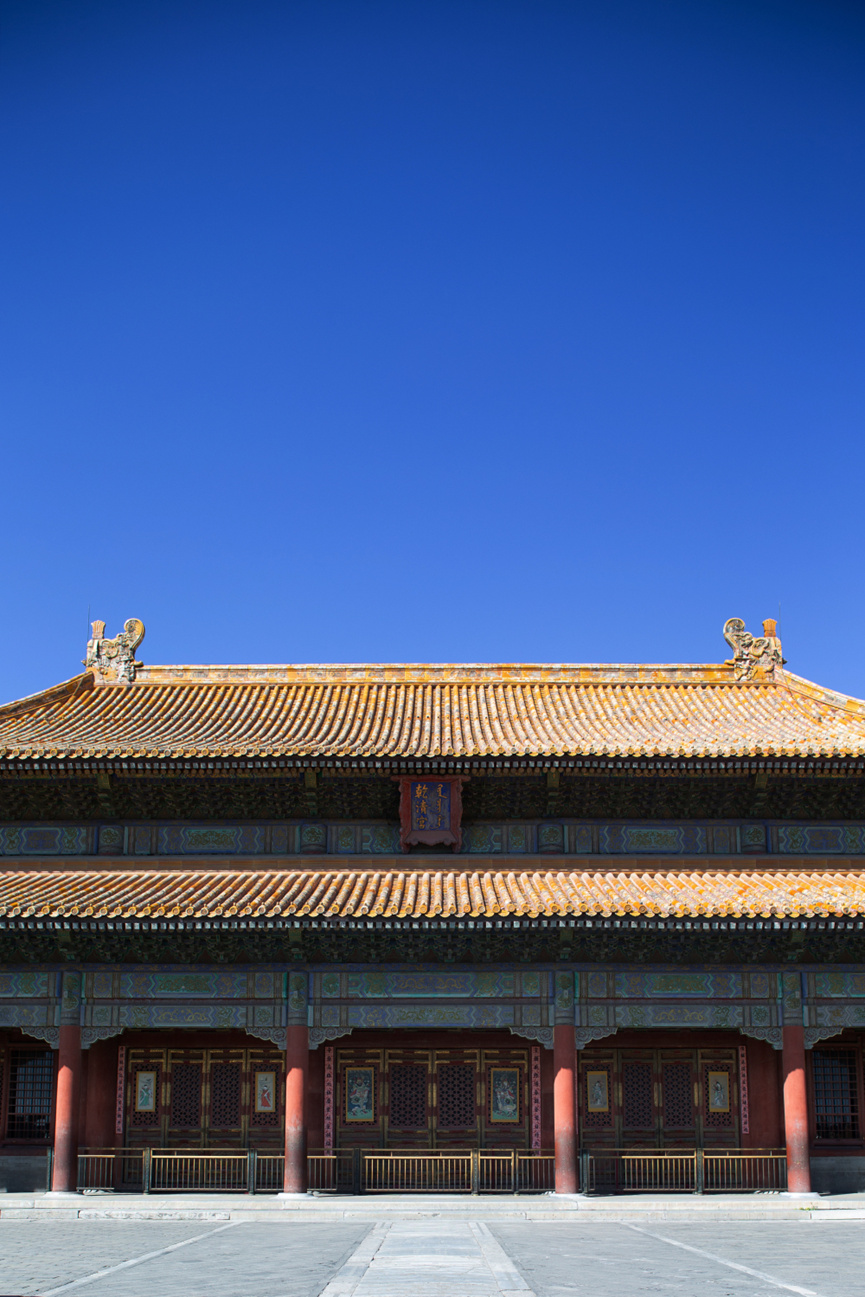
Speaking of the decoration of the Hall of Supreme Harmony, it is really beautiful and unique. There are dense buckets, and the indoor and outdoor beams are decorated with Hexi colored paintings. The upper part of the doors and windows is inlaid with a rhombus pattern, the lower part is embossed with a cloud-dragon pattern, and a gilt copper leaf engraved with a dragon pattern is installed at the joint. The appearance alone makes people feel that this beautiful palace is full of beautiful and solemn colours then why does the Hall of Supreme Harmony give everyone such an impression? Very important role ….

Hall of Supreme Harmony

Speaking of Hexi color painting, everyone may have heard of it, so what kind of expression is it? Hexi color painting is the highest grade of architectural color paintings in the Qing Dynasty. It consists of three parts: Fangxin, looking for head, and hoop head. With connecting herringbone curves as intervals, it is painted with dragon and phoenix patterns, and the main lines are powdered and gilded. , and the ground is lined with green and red, and the colours are gorgeous, which can be said to be “resplendent” in the true sense…..

Forbidden City architectural color painting sample

Of course, the Hexi color painting is not unique to the Hall of Supreme Harmony. The Qianqing Palace and the Hall of Mental Cultivation in the Forbidden City, the Renshou Hall and the Hall of Paiyun in the Summer Palace, and the Hall of Prayer for the New Year of the Temple of Heaven are all painted with Hexi color paintings. Why did Hexi color painting occupy such an important position in the palace architecture of the Qing Dynasty? In fact, it also has a very strong cultural background and meaning. Before the Hexi color painting came into being, the architectural color paintings mostly used religious and folk patterns as the basic themes, the application of dragon and phoenix patterns was extremely limited, and the content of the color paintings mainly implied divine power and auspiciousness. With the passage of time, the idea of ​​imperial power began to strengthen ideologically, and color paintings with the theme of the dragon pattern symbolizing imperial power began to appear to show the rank and status of the building…..

Forbidden City architectural color painting sample

Of course, in addition to its unique connotations, Hexi Caihua also has a very special decorative technique, that is, a large number of gold stickers are used. Before the appearance of Hexi color painting, the use of “gold foil” was very limited, and it was only used to embellish the prominent position of the color painting. In the Qing Dynasty, Hexi color paintings far surpassed the previous color paintings in the use of gold foil, turning gold, which is only used for embellishment, into one of the main colours, and the area is second only to the two colours of blue and green. One of the reasons for choosing gold is because of all the colours; gold is the easiest color to express luxury and solemnity.
Qianqing Palace

But what is interesting is that although the palaces of princes and ministers have strict hierarchical regulations on the application of color paintings, there is no clear hierarchical system for color paintings in the palace. However, there is a clear difference from the color painting itself, which can be seen from the category of Hexi. For example: Dragon and Seal, which are generally used in Palaces where the emperor ascends the throne, manages affairs, and lives, such as the Hall of Supreme Harmony, Qianqing Palace, etc.; Dragon and Phoenix and Seals are used in Palaces where emperors and concubines live, such as Kunning Palace, etc.; Dragon grass and seal: used for important gates and palace gates of the Imperial City and the Forbidden City. You may wish to take a closer look at these beautifully colored Hexi colored paintings and see where their corresponding palaces are located……

Kunning Palace

Imagines credits are of the Forbidden City –Imperial Palace –Beijing – China- People’s Republic of China also from the Series Weibo北京卫视上新了故宫 Treasures in the Forbidden City…

#北京。 #中國 #China #Beijing | #紫禁城 #ForbiddenCity #May2022 | #ForbiddenCityMoments #ForbiddenCityPress #ForbiddenCityBookStore #ForbiddenCityBooks The Forbidden City 100 #ForbiddenCityArchitecture ancient Chinese architecture….

The Forbidden City Book Store which in the grounds of the Forbidden City Complex Forbidden City Hundred Excellent Books Public welfare reading activities! ” Forbidden City Hundred Excellent Books  “故宫出版社 紫禁城100 Forbidden City 100 Excellent “The Forbidden City 100” is a work carefully created by Mr. Zhao Guangchao, his design, cultural team and the Forbidden City cultural research and development team for many years. This book can firstly understand the six hundred years of history of the Forbidden City. During the Ming and Qing dynasties, a total of 24 emperors lived, lived and exercised the highest state power here. In 1911, the Qing emperor abdicated. In 1913, the Antiquities Exhibition Center was established in the outer court of the Forbidden City. In 1924, Puyi left the palace. In 1925, the Palace Museum was established ….

The Forbidden City 100 Excellent Books  is one  is “The Forbidden City 100″ is a work carefully created by Mr. Zhao Guangchao, his design, cultural team and the cultural research and development team of the Forbidden City for many years. This book can firstly understand the six hundred years more of history of the Forbidden City. During the Ming and Qing dynasties, a total of 24 emperors lived, lived and exercised the highest state power here. In 1911, the Qing emperor abdicated. In 1913, the Antiquities Exhibition was built in the Forbidden City. In 1924, Puyi left the palace. In 1925, the Palace Museum was established.

One Hundred Excellent Books in the Forbidden City The Ming Empire initially chose Fengyang as the capital, and then settled in Nanjing (1368). When Zhu Di, the third emperor of the Ming Dynasty, had just ascended the throne (1406 in the fourth year of Shui Le), he dispatched the imperial court to China. The officers collected building materials from all over the country, distributed 100,000 craftsmen, more than one million people, and built the Forbidden City in Beijing on a larger scale on the former site of the palace in the Yuan Dynasty, based on the Nanjing Palace City. In the eighteenth year of Yongle’s reign (1420), the palace city was completed, and Zhu Di immediately moved the capital from Nanjing to his own land of Longxing, and Peiping became the largest city in the country (and the world at that time) from the beginning.

The newly built Miyagi moved about 1,000 meters eastward from the ruins of the Forbidden City in the Yuan Dynasty, and moving away from today’s Beihai Park means to some extent from the Yuan people’s customs of “living by water and grass”, back to the stable farming in the Han culture. on the pattern. The new palace pushes the fate of the Yuan people’s annihilation to the position of the white tiger killed by the main Tibetan in the five elements in the west, and then uses the building materials left over from the construction of the palace, together with the soil for excavating the moat, to build a hill behind the palace (Jingshan Mountain). ), creating a barrier against the cold north wind for the originally flat Miyagi, becoming the commanding height of the Forbidden City and even the city of Beijing at that time, and also the backing of Wanshi Foundation.

“Forbidden City 100” entered the Forbidden City. Jingren Palace is one of the six east palaces that everyone is familiar with, and it retains a relatively complete appearance of the Ming Dynasty. In the early Ming Dynasty, it was called Chang’an Palace and was renamed Jingren Palace in Jiajing. The Qing Dynasty followed the old name of the Ming Dynasty. The most special feature of Jingren Palace is that there is a stone screen in the front yard that was passed down from the Yuan Dynasty (the symmetrical Yongshou Palace also has the same stone screen). Although the center of the screen is only about 2 cm thick, the patterns on both sides are different. In addition, the shape of the seated beast on Shiping is very rare in the palace, and it is exquisite and vivid. “Animal style” has existed in China since ancient times. The beauty of masonry in the Yuan and Ming dynasties and the concise style of the Qing Dynasty are placed in the same space. All of a sudden, this palace seems to have become a history of modern Chinese sculpture, and it even evokes the legendary antecedents of the masters who once lived here. Here, it was originally the birthplace of Emperor Kangxi in the early Qing Dynasty, and the palace of the legendary concubine Zhen in the late Qing Dynasty… The

owner of the Ming Dynasty: Empress Hu (Hu Shanxiang) of Xuanzong of the Ming Dynasty. Emperor Xuande favored concubine Sun Gui and Cricket, and ordered Empress Hu to resign on the grounds of “no children and many illnesses”, and placed them in Chang’an Palace (Jingren Palace) to practice Taoism, and was given the title “Jingci Immortal Master”. The owner of the Qing Dynasty: In the eleventh year of Shunzhi (1654), the 15-year-old Shunzhi Concubine Tong gave birth to the future Kangxi here. Concubine Xi (Qianlong’s biological mother, Niuhulu), who ascended the throne under Yongzheng, moved from Lama Temple to Jingren Palace. Concubine Zhen of Guangxu entered the palace with her elder sister Concubine Jin at the age of 14, and lived in the east and west side halls of Jingren Palace, and was finally drowned by order of the Empress Dowager Cixi…

Among the six east palaces, the history of Yanxi Palace can be described as troubled. When it was completed in the early Ming Dynasty, it was renamed Yanqi Palace after its initial name Changshou Palace, and was renamed Yanxi Palace in Qing Dynasty. Since its completion, the Yanxi Palace has suffered repeated fires: it was rebuilt in the 25th year of Kangxi (1686) and the 7th year of Jiaqing (1802). In the twelfth year of Daoguang (1832), a fire broke out, which burned down the entire Yanxi Palace and rebuilt it again. In the 25th year of Daoguang (1845), a fire broke out in the Yanxi Palace, leaving only the palace gate. Xianfeng five years (1855) fire, rebuilt again. In the first year of Xuantong’s reign (1909), Empress Dowager Longyu spent 4 million to build a Western-style building “Water Palace” Lingzhao Xuan (commonly known as Crystal Palace). Lay the glass, and when you’re done it’ll be a walk-in super aquarium. This move has the meaning of suppressing the anger and revival of the Qing Dynasty, but until Xuantong abdicated, the project was not completed. When Zhang Xun was restored in 1917, the northern part of Yanxi Palace was unfortunately destroyed by plane bombs. In the entire palace, only the wellhead is in line with the original location of the well pavilion, leaving the only remaining remains. In 1931, the Palace Museum built a new cultural relic warehouse, which eventually became the first reinforced concrete building in the palace. In recent years, the story of the palace has been exaggerated by the media, and the little-known Yanxi Palace has once again aroused everyone’s curiosity. In fact, the concubines living in this secluded palace are living in hardship and poverty, and it is said that they do not even have enough food, even clothes, shoes and socks. The owner of Yanxi Palace in the Ming Dynasty is unknown, and the owners of the Qing Dynasty include Kangxi Chang in Xu and two people whose emblems are unknown and promised to live here.

The biggest difference between the West Six Palaces and the East Six Palaces in “100 Forbidden City” is that Taiji Palace and Changchun Palace, Yikun Guan and Chuxiu Palace are all connected into one. It makes the whole palace area have a strong color of life, and also makes the remaining Yongshou Palace and Xianfu Palace appear dull. Today, we look at Yikun Palace and Chuxiu Palace through “Forbidden City 100”. The Yikun Palace was originally called Wan’an Palace, and was renamed Yikun Palace in the Jiajing Period of the Ming Dynasty .

Imagines credits are of the Forbidden City –Imperial Palace –Beijing – China- People’s Republic of China also from the Series Weibo北京卫视上新了故宫 Treasures in the Forbidden City…

#東京。 #中國 #China #Beijing | #紫禁城 #ForbiddenCity #September2020|#ForbiddenCityarchitecture built 600 years of rich architectural language briefly explained- #TheForbiddenCityCentralAxis ..

In this year’s 2020, the second decade from the turn of the century in Beijing the Capital of China also the People’s Republic of China, in which is also the year of the rat, marking its six hundred years anniversary of the Forbidden city that marks the transitional point of in between the middle of the Ming Dynasty (1368- 1644) transitionally from Nanjing to Beijing towards the Qing Dynasty (1636-1644-1911) …. The Imperial Palace seen so many countless seasonally transitional equinoxes but further its six hundred years is iconic, but it’s five hundred ninety nine years it marks it Autumn Equinox…. In which it only took twelve years to build the same of the Daming Palace of The Tang Dynasty Xian Imperial Capital only it was least twenty times larger……

The Forbidden City Central Axis The central axis is the core Yuanshu supporting the capital as the center of the world, and it is taken from the sky axis. First, build a royal road, and build a hall at the northern end of the royal road. The hall becomes a symbol of the North Star, and the royal road becomes a symbol of the axis of the sky. This is the center of the world. This kind of planning method is simple and easy to implement. It gets rid of the geographical center restriction and can find any place to build the capital. It has greater flexibility and has been inherited by the past.

The central axis of Beijing city passes from Fengtian Hall (Qing Taihe Hall) to the north through Huagai Hall (Qingzhonghe Hall), Jinshen Hall (Qingbaohe Hall), Qianqing Palace, Jiaotai Hall, Kunning Palace, Qin’an Hall, Long Live Mountain (Qingjingshan), Houmen Bridge, and finally Drum Tower; south through Taihemen, Meridian Gate, Duanmen, Tiananmen, Damingmen (Daqingmen), and finally Zhengyangmen, and finally Yongdingmen in Jiajing. The total length of the central axis is about 8 kilometers. The three most important halls, the Hou Sangong, and Longevity Mountain are all located on the central axis. The other minor buildings strictly follow the principle of symmetrical arrangement and are arranged on the left and right sides of the central axis to enhance The central axis and the buildings on the central axis are supreme.

The central axis of Beijing City contains the central axis of the Forbidden City. The central axis of the Forbidden City is from the Meridian Gate to the Shenwu Gate. There are seven palaces on the central axis to symbolize the Big Dipper. They are Fengtian Hall (Qing Taihe Hall) and Huagai Hall (Qing Dynasty). Zhonghe Hall), Jinshen Hall (Qingbaohe Hall), Qianqing Palace, Zhongyuan Hall (Jiaotai Hall), Kunning Palace and Qin’an Hall.

中轴是支撑都城为天下中心的核心元枢,取象于天轴。首先建一条御道,于御道的北端建一座大殿,大殿成为北极星的象征,御道成为天轴的象征,这里就成了天下的中心。这种规划之道简单且容易做到,摆脱了地域上的中心限制,可以找任何地方建都,灵活性更大了,因此被历代所继承。

北京城中轴从奉天殿(清太和殿)向北穿过华盖殿(清中和殿)、谨身殿(清保和殿)、乾清宫、交泰殿、坤宁宫、钦安殿、万岁山(清景山)、后门桥,终于鼓楼 ;向南穿过太和门、午门、端门、天安门、大明门(大清门),终于正阳门,嘉靖时终于永定门。中轴全长约 8 千米,最重要的三大殿和后三宫、万岁山均位于中轴上,其他次要建筑则都严格遵守对称排列的原则,配置在中轴的左右两边,以增强中轴及中轴上的建筑至高无上的地位。

北京城的中轴包含着紫禁城中轴,紫禁城中轴是指从午门至神武门,中轴上布置了七座宫殿以象征北斗七星,它们是奉天殿(清太和殿)、华盖殿(清中和殿)、谨身殿(清保和殿)、乾清宫、中圆殿(交泰殿)、坤宁宫和钦安殿……

Imagines credit are of the Forbidden city –Imperial Palace –Beijing – China- People’s Republic of China

#東京 #中國 #China #Beijing | #紫禁城 #ForbiddenCity #September2020 | #ForbiddenCityarchitecture built 600 years of rich architectural language briefly explained …

In this year’s 2020, the second decade from the turn of the century in Beijing the Capital of China also the People’s Republic of China, in which is also the year of the rat, marking its six hundred years anniversary of the Forbidden city that marks the transitional point of in between the middle of the Ming Dynasty (1368- 1644) transitionally from Nanjing to Beijing towards the Qing Dynasty (1636-1644-1911) …. The Imperial Palace seen so many countless seasonally transitional equinoxes but further its six hundred years is iconic, but it’s five hundred ninety nine years it marks it Autumn Equinox…. In which it only took twelve years to build the same of the Daming Palace of The Tang Dynasty Xian Imperial Capital only it was least twenty times larger……

Forbidden City Architecture emphasis on order, proportion and symmetry principles. The central axis is the backbone of the building and the Yuanshu that supports the entire palace; the five gates and three dynasties, the front and back sleeping quarters, and the east and west six palaces in the “Zhou Li” constitute the framework of the Forbidden City; the Qiankun hexagram in the “Book of Changes” The combination of has a metaphysical height, and has a solid foundation. For example, the plane structure of the six palaces in the east and the west presents three painted hexagrams, symbolizing the hexagrams of Kun hexagrams, and the names of the Qianqing Palace, Kunning Palace and Jiaotai Palace are directly derived from The hexagrams Yu Qian, Kun and Tai gave the Forbidden City a logical law of positioning and intersecting heaven and earth. The red walls and yellow tiles constitute the colour tone of the Forbidden City.

In traditional cognition, yellow symbolizes soil and red symbolizes fire. The soil is located in the center. Therefore, the three halls are built on the foundation of the earth-shaped platform. The colour is yellow, so the central emperor called the Yellow Emperor”. According to the principle of the five elements, fire can produce soil, so the red wall symbolizes fire, the yellow tile symbolizes soil, and the fire produces soil. When the fire is prosperous, the soil is thick, which shows that the agricultural civilization cannot be separated from the soil. The building roofs in the Forbidden City include almost all the forms of ancient Chinese building roofs, such as hard mountains, hanging mountains, Xieshan, 庑殿, zuanjian, cross ridges, double eaves, roll sheds, and roofs. They have strict grades. The difference reflects the ritual characteristics of that era.

In addition to deciphering the architectural language from the building itself, when the landscape and the building are integrated and are no longer isolated natural landscapes, they also become part of the architectural language and are responsible for the interpretation of architectural ideals. The Jinshui River and Long Live Mountain in the Forbidden City are no longer natural mountains and water in the pure sense, but have an inseparable relationship with architecture. Long live mountain is the backer of the Forbidden City. Without this mountain, the Forbidden City would lose its strongest barrier and become an isolated city. The Jinshui River also has this function. It not only provides water for the entire Miyagi, and guarantees the water and drainage of the Miyagi, it also plays a role in connecting the north-western trunk with the southeast Sunda, making the Jinshui River a trunk in the image. The River of Gold allows the world to communicate and the mountains to connect……

紫禁城建筑强调秩序、比例和对称原则。中轴是建筑的脊梁,是支撑整个宫城的元枢 ;《周礼》中的五门三朝、前朝后寝、东西六宫,构成紫禁城的框架 ;《周易》中的乾坤卦象使建筑的组合有了形而上的高度,有了贞固不动的基础,如东西六宫的平面结构呈现三画卦,象征坤卦卦象,而乾清宫、坤宁宫和交泰殿的名称直接来源于乾卦、坤卦和泰卦,使紫禁城有了天地定位、天地相交的逻辑法则。红墙黄瓦构成紫禁城建筑的色彩基调,在传统的认知里,黄色象征土,红色象征火,土位于中央,故三大殿建在土字形的台基上,“中央戊己属土,其色黄,故中央帝曰黄帝”。按五行之理,火可以生土,故红墙象征火,黄瓦象征土,火生土,火旺则土厚,体现了农业文明的根本离不开土。紫禁城中的建筑屋顶几乎包括了中国古代建筑屋顶的所有形式,如硬山、悬山、 歇山、庑殿、攒尖、十字脊、重檐、卷棚、盝顶等,它们有着严格的等级区别,体现了那个时代的礼制特征。

除了从建筑本身去破解建筑语言外,当山水与建筑融为一体,不再是孤立的自然景观时,它们也成为建筑语言的一部分,担负着诠释建筑理想的重任。紫禁城的金水河和万岁山,二者已经不是纯粹意义上的自然的山与水,而是与建筑有着不可分割的关系。万岁山是紫禁城的靠山,没有这座山,紫禁城将失去最坚固的屏障,变成孤城。金水河也同样具有此作用,它不仅为整个宫城提供水源,保证宫城的用水与排水,同时它还起着将西北乾与东南巽相连接的作用,使金水河成为意象上的一条乾金之河,使天地得以沟通,山泽得以相连…

Imagines credit are of the Forbidden city –Imperial Palace –Beijing – China- People’s Republic of China