#北京。 #中國 #China #Beijing | #紫禁城 #ForbiddenCity #August2020 | #故宫书店 #ForbiddenCityBookStore #CITICPressGroup #中信出版集团The first historical Chinese #Comic, Echo of the Forbidden City: The Legend of National Treasures Moving South towards #重慶 #Chongqing…

The night of February 6, 1933, Beiping- Peking- Beijing, the Forbidden City Gate of Supreme Harmony in the Place Museum, 13,427 boxes of cultural relics were in full order, ready for the southward salvage campaign. In 2017, a secret stop on the southbound migration of cultural relics of the Forbidden City — Chongqing Andersen Firm, was found by a man who decided to preserve it. Designer Zhang Yonghe and his team took on the job of the restoration and renovation of the buildings, which finally opened to the public in June 2021. YIT came to the mountain city of Chongqing on the opening day of the Memorial Museum, to listen to Zhang Yonghe’s story about the transformation of the buildings, and to explore the secret “national treasures long march”

During the War of Resistance, there were 3,694 boxes of cultural relics from the Forbidden City stored by the former site of Anderson Firm, which made important contributions to the protection of national treasures and the inheritance of Chinese culture. Under the joint promotion of the Palace Museum, Chongqing Municipal Commission of Culture and Tourism Development, and the Nan’an District Government, Chongqing has renovated the cultural relics, created the surrounding environment, and presented a variety of business formats there. Eight buildings in the former site of Anderson Firm were constructed as cultural relics of the Memorial Hall for the Cultural Relics from the Forbidden City in Nanbin Road. The entire hall covers an area of about 2,500 square meters, including cultural venues such as Memorial Exhibition Halls, Cultural Lecture Halls, Education Classrooms, Forbidden Academy, bookstores, and more.

[Adapted from real history, the Forbidden City’s first new book of historical Chinese comics is on the market! ] More than 13,000 boxes of precious cultural relics, which lasted 25 years, spanned more than half of China in the midst of war, creating the longest and largest history of cultural relics in modern history. The new Forbidden City comic book “Echo of the Forbidden City: The Legend of National Treasures Moving South” artistically reproduces the story of the people of the Forbidden City guarding the antiquities in the prosperous years. The book also includes a large number of precious historical photos and archives, which is like a documentary on paper; there is also a “picture-in-picture” format, which interestingly explains 11 precious cultural relics from the south, including stone drums and Yonggu cups in Jin Mau.

Forbidden City The first historical Chinese comic, adapted from a true story, was reviewed by experts from the Palace Museum, and recommended by Tencent Animation App with a high score of 9.8. Comic art reappears the prodigious years. 13,491 boxes of precious cultural relics, which lasted 25 years, spanned more than half of China in the midst of war, creating the longest and largest history of cultural relics in modern history. It’s not just a comic book, it’s also filled with precious historical photos and archives, like a documentary on paper. Supplement the knowledge of national treasures and present precious cultural relics in the upper courtyard on paper. ….Follow the comic “Echo of the Forbidden City: The Legend of National Treasures Moving South” to look back on those turbulent years. Not forgetting history is the best tribute to our ancestors…..

In this year’s 2022, the second decade from the turn of the century in Beijing the Capital of China also the People’s Republic of China, marking its six hundred and two years anniversary of the Forbidden city that marks the transitional point of in between the middle of the Ming Dynasty (1368- 1644) transitionally from Nanjing to Beijing towards the Qing Dynasty (1636-1644-1911) …. The Imperial Palace seen so many countless seasonally transitional equinoxes but further its six hundred years is iconic, but it’s five hundred ninety nine years it marks it Autumn Equinox…. In which it only took twelve years to build the same of the Daming Palace of The Tang Dynasty Xian Imperial Capital only it was least twenty times larger..

CITIC Press Group 中信出版集团, formerly CITIC Publishing Group, is a publishing company founded in 1988 based in Beijing, China People’s Republic of China. The publisher is a subsidiary of CITIC Group. They engage in digital and physical book retail and provide professional education.

Images and visuals are from – Forbidden City –Palace Museum Beijing- China –People’s Republic of China…..

#北京。 #中國 #China #Beijing | #紫禁城 #ForbiddenCity #May2022 | #ForbiddenCityMoments #ForbiddenCityPress #ForbiddenCityBookStore #ForbiddenCityBooks The Forbidden City 100 #ForbiddenCityArchitecture ancient Chinese architecture….

The Forbidden City Book Store which in the grounds of the Forbidden City Complex Forbidden City Hundred Excellent Books Public welfare reading activities! ” Forbidden City Hundred Excellent Books  “故宫出版社 紫禁城100 Forbidden City 100 Excellent “The Forbidden City 100” is a work carefully created by Mr. Zhao Guangchao, his design, cultural team and the Forbidden City cultural research and development team for many years. This book can firstly understand the six hundred years of history of the Forbidden City. During the Ming and Qing dynasties, a total of 24 emperors lived, lived and exercised the highest state power here. In 1911, the Qing emperor abdicated. In 1913, the Antiquities Exhibition Center was established in the outer court of the Forbidden City. In 1924, Puyi left the palace. In 1925, the Palace Museum was established ….

The Forbidden City 100 Excellent Books  is one  is “The Forbidden City 100″ is a work carefully created by Mr. Zhao Guangchao, his design, cultural team and the cultural research and development team of the Forbidden City for many years. This book can firstly understand the six hundred years more of history of the Forbidden City. During the Ming and Qing dynasties, a total of 24 emperors lived, lived and exercised the highest state power here. In 1911, the Qing emperor abdicated. In 1913, the Antiquities Exhibition was built in the Forbidden City. In 1924, Puyi left the palace. In 1925, the Palace Museum was established.

One Hundred Excellent Books in the Forbidden City The Ming Empire initially chose Fengyang as the capital, and then settled in Nanjing (1368). When Zhu Di, the third emperor of the Ming Dynasty, had just ascended the throne (1406 in the fourth year of Shui Le), he dispatched the imperial court to China. The officers collected building materials from all over the country, distributed 100,000 craftsmen, more than one million people, and built the Forbidden City in Beijing on a larger scale on the former site of the palace in the Yuan Dynasty, based on the Nanjing Palace City. In the eighteenth year of Yongle’s reign (1420), the palace city was completed, and Zhu Di immediately moved the capital from Nanjing to his own land of Longxing, and Peiping became the largest city in the country (and the world at that time) from the beginning.

The newly built Miyagi moved about 1,000 meters eastward from the ruins of the Forbidden City in the Yuan Dynasty, and moving away from today’s Beihai Park means to some extent from the Yuan people’s customs of “living by water and grass”, back to the stable farming in the Han culture. on the pattern. The new palace pushes the fate of the Yuan people’s annihilation to the position of the white tiger killed by the main Tibetan in the five elements in the west, and then uses the building materials left over from the construction of the palace, together with the soil for excavating the moat, to build a hill behind the palace (Jingshan Mountain). ), creating a barrier against the cold north wind for the originally flat Miyagi, becoming the commanding height of the Forbidden City and even the city of Beijing at that time, and also the backing of Wanshi Foundation.

“Forbidden City 100” entered the Forbidden City. Jingren Palace is one of the six east palaces that everyone is familiar with, and it retains a relatively complete appearance of the Ming Dynasty. In the early Ming Dynasty, it was called Chang’an Palace and was renamed Jingren Palace in Jiajing. The Qing Dynasty followed the old name of the Ming Dynasty. The most special feature of Jingren Palace is that there is a stone screen in the front yard that was passed down from the Yuan Dynasty (the symmetrical Yongshou Palace also has the same stone screen). Although the center of the screen is only about 2 cm thick, the patterns on both sides are different. In addition, the shape of the seated beast on Shiping is very rare in the palace, and it is exquisite and vivid. “Animal style” has existed in China since ancient times. The beauty of masonry in the Yuan and Ming dynasties and the concise style of the Qing Dynasty are placed in the same space. All of a sudden, this palace seems to have become a history of modern Chinese sculpture, and it even evokes the legendary antecedents of the masters who once lived here. Here, it was originally the birthplace of Emperor Kangxi in the early Qing Dynasty, and the palace of the legendary concubine Zhen in the late Qing Dynasty… The

owner of the Ming Dynasty: Empress Hu (Hu Shanxiang) of Xuanzong of the Ming Dynasty. Emperor Xuande favored concubine Sun Gui and Cricket, and ordered Empress Hu to resign on the grounds of “no children and many illnesses”, and placed them in Chang’an Palace (Jingren Palace) to practice Taoism, and was given the title “Jingci Immortal Master”. The owner of the Qing Dynasty: In the eleventh year of Shunzhi (1654), the 15-year-old Shunzhi Concubine Tong gave birth to the future Kangxi here. Concubine Xi (Qianlong’s biological mother, Niuhulu), who ascended the throne under Yongzheng, moved from Lama Temple to Jingren Palace. Concubine Zhen of Guangxu entered the palace with her elder sister Concubine Jin at the age of 14, and lived in the east and west side halls of Jingren Palace, and was finally drowned by order of the Empress Dowager Cixi…

Among the six east palaces, the history of Yanxi Palace can be described as troubled. When it was completed in the early Ming Dynasty, it was renamed Yanqi Palace after its initial name Changshou Palace, and was renamed Yanxi Palace in Qing Dynasty. Since its completion, the Yanxi Palace has suffered repeated fires: it was rebuilt in the 25th year of Kangxi (1686) and the 7th year of Jiaqing (1802). In the twelfth year of Daoguang (1832), a fire broke out, which burned down the entire Yanxi Palace and rebuilt it again. In the 25th year of Daoguang (1845), a fire broke out in the Yanxi Palace, leaving only the palace gate. Xianfeng five years (1855) fire, rebuilt again. In the first year of Xuantong’s reign (1909), Empress Dowager Longyu spent 4 million to build a Western-style building “Water Palace” Lingzhao Xuan (commonly known as Crystal Palace). Lay the glass, and when you’re done it’ll be a walk-in super aquarium. This move has the meaning of suppressing the anger and revival of the Qing Dynasty, but until Xuantong abdicated, the project was not completed. When Zhang Xun was restored in 1917, the northern part of Yanxi Palace was unfortunately destroyed by plane bombs. In the entire palace, only the wellhead is in line with the original location of the well pavilion, leaving the only remaining remains. In 1931, the Palace Museum built a new cultural relic warehouse, which eventually became the first reinforced concrete building in the palace. In recent years, the story of the palace has been exaggerated by the media, and the little-known Yanxi Palace has once again aroused everyone’s curiosity. In fact, the concubines living in this secluded palace are living in hardship and poverty, and it is said that they do not even have enough food, even clothes, shoes and socks. The owner of Yanxi Palace in the Ming Dynasty is unknown, and the owners of the Qing Dynasty include Kangxi Chang in Xu and two people whose emblems are unknown and promised to live here.

The biggest difference between the West Six Palaces and the East Six Palaces in “100 Forbidden City” is that Taiji Palace and Changchun Palace, Yikun Guan and Chuxiu Palace are all connected into one. It makes the whole palace area have a strong color of life, and also makes the remaining Yongshou Palace and Xianfu Palace appear dull. Today, we look at Yikun Palace and Chuxiu Palace through “Forbidden City 100”. The Yikun Palace was originally called Wan’an Palace, and was renamed Yikun Palace in the Jiajing Period of the Ming Dynasty .

Imagines credits are of the Forbidden City –Imperial Palace –Beijing – China- People’s Republic of China also from the Series Weibo北京卫视上新了故宫 Treasures in the Forbidden City…

#北京。 #中國 #China #Beijing | #紫禁城 #ForbiddenCity #September2021|#ForbiddenCityMoments #ForbiddenCityPress #ForbiddenCityStore the year 2022 the Most awaitingly international iconic #ForbiddenCityCalendar from the 601 years old Forbidden City Press…

On the 6th September 2021 Monday Forbidden City – Beijing- China- People’s Republic of China, it’s here The 2022 “Forbidden City Calendar” the official launch of conference will be held on the 6th September 2021  at Jianfu Palace of the Forbidden City Palace Museum. An official MV “Forbidden City Time”, composed by a professional team of music and photography, and composed of lyrics by the Forbidden City, is also newly released! In the exquisite pictures of the four seasons of the Forbidden City and the cultural relics exhibition, in which storytelling the indicated places of the forbidden City’s moments  as reading together  Walking together in Calendaring’s Palace and looked at the lucky tigers, the tigers welcoming the rui, the tigers blessing the peace, and the tigers rejuvenating, looking forward to a new year with more wings… in which the tiger is a Chinese  Zodiac sign in which view during the summery night sky of constellation Orion in which it’s constellation components makeup of the body of the white tiger in which is a symbolism for good luck charm for Chinese Military personals and there’s family. As to that sayngly it’s also the imperial military Commanding mandate seal order in which comes in pair for conformation.   

The year of Renyin, the zodiac tiger. 2022 “Forbidden City Calendar” selects cultural relics related to tigers from the vast collections of the Forbidden City, expressing the lucky tiger welcoming the auspiciousness, the safety of the tiger, the winter ice play, etc., forming the auspicious picture of the lucky tiger welcoming the New Year and the mountains and rivers celebrating the prosperity. AR interaction is also added. With the electronic calendar reading function. Feel the Calendaring’s Palace, and accompany you to usher in a new year with a new year!

Jihu welcomes the New Year, and the mountains and rivers celebrate the rise of peace. The newly revised 2022 “Forbidden City Calendar” is here! The cover image is selected from the “Flying Tiger Flag with Red Gauze Embroidered Cloud Patterns in the Qing Dynasty”, which reflects 国潮正当红#. The character “tiger” in the background is a collection of Weibei, with lingering charm. In addition, the new calendar also adds AR interaction and electronic calendar reading functions in which gives you the reader a more interactive experience as if you’re still in the Forbidden City exploring its’ untold stories. ….

Imagines visuals credit are from the Forbidden city –Imperial Palace –Beijing – China- People’s Republic of China…

#北京。 #中國 #China #Beijing | #紫禁城 #ForbiddenCity #June2021|#ForbiddenCityMoments #ForbiddenCityPaintings #ChineseArtworks #QingDynastyEmperor #EmperorQianlong imperially Understanding “Agriculture Book” governing understanding foundation of the world must be based on agriculture.

One of the priceless exhibits of the 601年 year old Forbidden City that’s located in the heart of Beijing also its Central Axis of three thousands year old  Ancient Modern Ultra megapolis city….让我们与来读校园 The imperial pages of the imperial farming and weaving picture poem printed  agricultural book during the Qianlong period of the Qing Dynasty. 让我们与来读历Qianlong of the Qing Dynasty, Wuyingdian juzhen edition of “Agricultural Book”. This book, written by Wang Zhen in the Yuan Dynasty, is an important work that gathers the achievements of ancient Chinese agronomy. In the forty-first year of Qianlong (1776), it was compiled by Confucian officials from the “Yongle Dadian” and printed in the Wuying Hall Juzhen Edition (wood type). The original preface of “Agriculture Book” stated in the beginning, “Agriculture is the world’s biggest foundation. One husband does not cultivate or teaches him, and a woman does not weave or teaches cold”, emphasizing the importance of farming and weaving

Imagines visuals credit are from the Forbidden city –Imperial Palace –Beijing – China- People’s Republic of China…

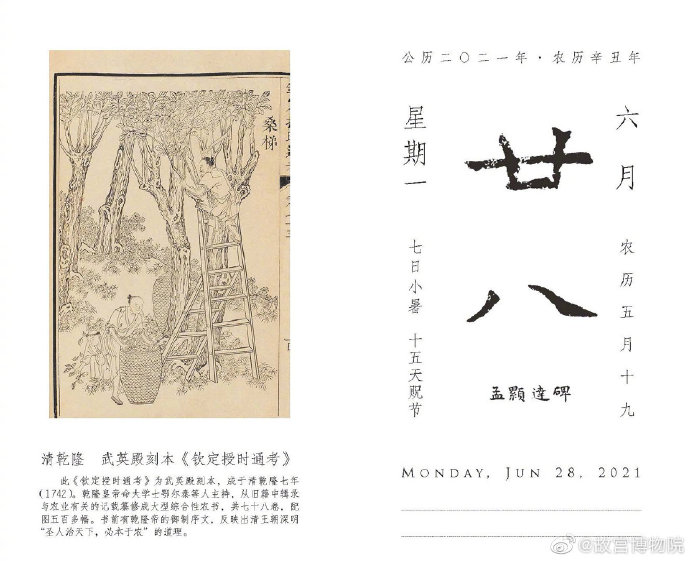
#北京。 #中國 #China #Beijing | #紫禁城 #ForbiddenCity #June2021|#ForbiddenCityMoments #ForbiddenCityPaintings #ChineseArtworks #QingDynastyEmperor #EmperorQianlong imperially Through Exams of the Imperial Appointment deep understanding govern the world based on agriculture”.

One of the priceless exhibits of the 601年 year old Forbidden City that’s located in the heart of Beijing also its Central Axis of three thousands year old  Ancient Modern Ultra megapolis city….让我们与来读校园 The imperial pages of the imperial farming and weaving picture poem printed  agricultural book during the Qianlong period of the Qing Dynasty. 让我们与来读历 Qianlong, Qing Dynasty, Wuyingdian carved edition “Through Exams of the Imperial Appointment”. This “Tong Kao” is a block-printed version of Wuying Temple, completed in the seventh year of Qianlong in the Qing Dynasty (1742). Emperor Qianlong ordered Ertai, a scholar of the university, and others to preside over it, compiling records related to agriculture from old books into a large-scale comprehensive agricultural book, with a total of 78 volumes and more than 500 pictures. There is a preface to Emperor Qianlong’s imperial system at the front of the book, reflecting the Qing Dynasty’s deep understanding that “sages govern the world must be based on agriculture”.

Imagines visuals credit are from the Forbidden city –Imperial Palace –Beijing – China- People’s Republic of China…