#北京。 #中國 #China #Beijing | #紫禁城 #ForbiddenCity #September2023 | #ForbiddenCityDairies -The Palace Museum #ForbiddenCity Collections of Chinese intangible cultural heritage.  Collection Seventh – Eleventh September 2023..

On July 19th 2023 , the multilingual website of the Forbidden City Palace Museum- Beijing, China, People’s Republic of Chinawas officially released at the Digital Cultural Tourism Development Forum of the 2023 China Internet Civilization Conference! The website covers five languages: English, French, Russian, Japanese, and Spanish, and will meet the needs of audiences with different languages.

 The multilingual website of the Palace Museum is committed to establishing an international website that is concise, clear, easy to use for overseas audiences, and fits the construction of the modern civilization of the Chinese nation, including tour guides, information, panoramic tours, online exhibitions, collection appreciation, cultural topics, etc. Rich immersive content describing of the most detail collection that housed within the Forbidden city collection… . 

Ming Dynasty, Tao Cheng, Toad Palace Jade Rabbit scroll. Tao Cheng (date of birth and death unknown), whose courtesy name was Mengxue, whose first name was Maoxue, and whose name was Yunhushanren, was from Baoying, Jiangsu. He was wild by nature and versatile. The landscapes he painted mostly used green colors, which were bright and lustrous. The bamboos, rabbits and cranes and deer he painted were interesting and had the realistic style of the Song Dynasty. Toad Palace refers to the Moon Palace and is synonymous with the moon. From the poem written by Tao Cheng in the picture, we can see that he is depicting a rabbit looking up at the bright moon in the sky and missing the comfortable life in Toad Palace. For this reason, he specially painted the rabbit raising its front legs as if it were flying to the moon. This detailed depiction not only makes the painting lively and interesting, but also reveals the Jade Rabbit’s eagerness to return to the Toad Palace.

From the Ming Dynasty to the early Qing Dynasty, the talc Guanghan Qingjing Seal was used. Talc is a silicate mineral that is soft and smooth. The material is not expensive and is rarely used in seals. Although the toad has a bad image, it symbolizes longevity, so it is also quite popular among people. The seal “Guanghan Qingjing” echoes the toad seal, but it is in the secret palace of the deep palace. Using this as a metaphor will inevitably give  people a sense of resentment.

On the 8th September 2023 The autumn wind is getting colder, and the dew condenses in the cold. The pomegranates are full and ripe. Today 白鹿

During the Qianlong reign of the Qing Dynasty, the red sea-water bathing moon plate was carved. This lacquer plate was made during the Qianlong period. It is engraved with water ripples and the center of the plate is illuminated to represent the full moon. In the middle of the moon, the ocher-colored Jade Rabbit with fine hair scratched out on the yellow paint ground is concentrating on pounding the elixir of eternity under the laurel tree. This is the story of the Jade Rabbit in the Moon Palace in myths and legends. This plate is a masterpiece that combines red and gold lacquer techniques. The bottom of the plate is engraved with the model “Made in the Qianlong Year of the Qing Dynasty” and the name of the “Haiyue Incense Plate”. It is a royal vessel.

Qing Dynasty, Qianlong imperial inscription Chengni set inkstone imitates Song Dynasty Yuantu Dynasty Yuan inkstone. This inkstone is one of the antique clear clay inkstones. It is round in shape, has no inkstone pool on the surface, and is embossed with a jade rabbit and a full moon. A poem inscribed by the emperor is engraved with gold around the edge: “The small round and big round are like the moon, and the jade shape is more pregnant in it. The study room should be in charge of the city, and the promulgated hair can be ruthless in everything?” There are also four words “Qianlong Imperial Inscription” , “Knowing hearts are not far away” seal. On one side of the inkstone is engraved the product name “Imitation Song Dynasty Jade Rabbit Chaoyuan Inkstone”, and on the other side are the words “Chen Zheng Rui Gongjin”. The inkstone comes with a red sandalwood engraved brocade ground cover box, and the name of the product and the name of the tribute are also engraved on the side.
According to the “Xiqing Inkstone Book”, the pattern on the “Jade Rabbit Chaoyuan Inkstone” in the Qing Palace imitated the natural texture on the She inkstone in the Song Dynasty. Its shape can be said to be either a rabbit or a rhinoceros, reflecting the antique style of that time. characteristics of the times. During the Qianlong period, various kinds of antique inkstones were made from Duanshi, Sheshi, Chengni, etc. Among them, the complete sets of antique Chengni inkstones are the most praised.

Images and visuals are from – Forbidden City –Palace Museum Beijing- China –People’s Republic of China…..

#北京。 #中國 #China #Beijing | #紫禁城 #ForbiddenCity #July2023 | #ForbiddenCityDairies -The Palace Museum #ForbiddenCity Collections of Chinese intangible cultural heritage.  Collection 20th   to 20th July 2023…

On July 19th 2023 , the multilingual website of the Forbidden City Palace Museum- Beijing, China, People’s Republic of Chinawas officially released at the Digital Cultural Tourism Development Forum of the 2023 China Internet Civilization Conference! The website covers five languages: English, French, Russian, Japanese, and Spanish, and will meet the needs of audiences with different languages.

 The multilingual website of the Palace Museum is committed to establishing an international website that is concise, clear, easy to use for overseas audiences, and fits the construction of the modern civilization of the Chinese nation, including tour guides, information, panoramic tours, online exhibitions, collection appreciation, cultural topics, etc. Rich immersive content describing of the most detail collection that housed within the Forbidden city collection… . 

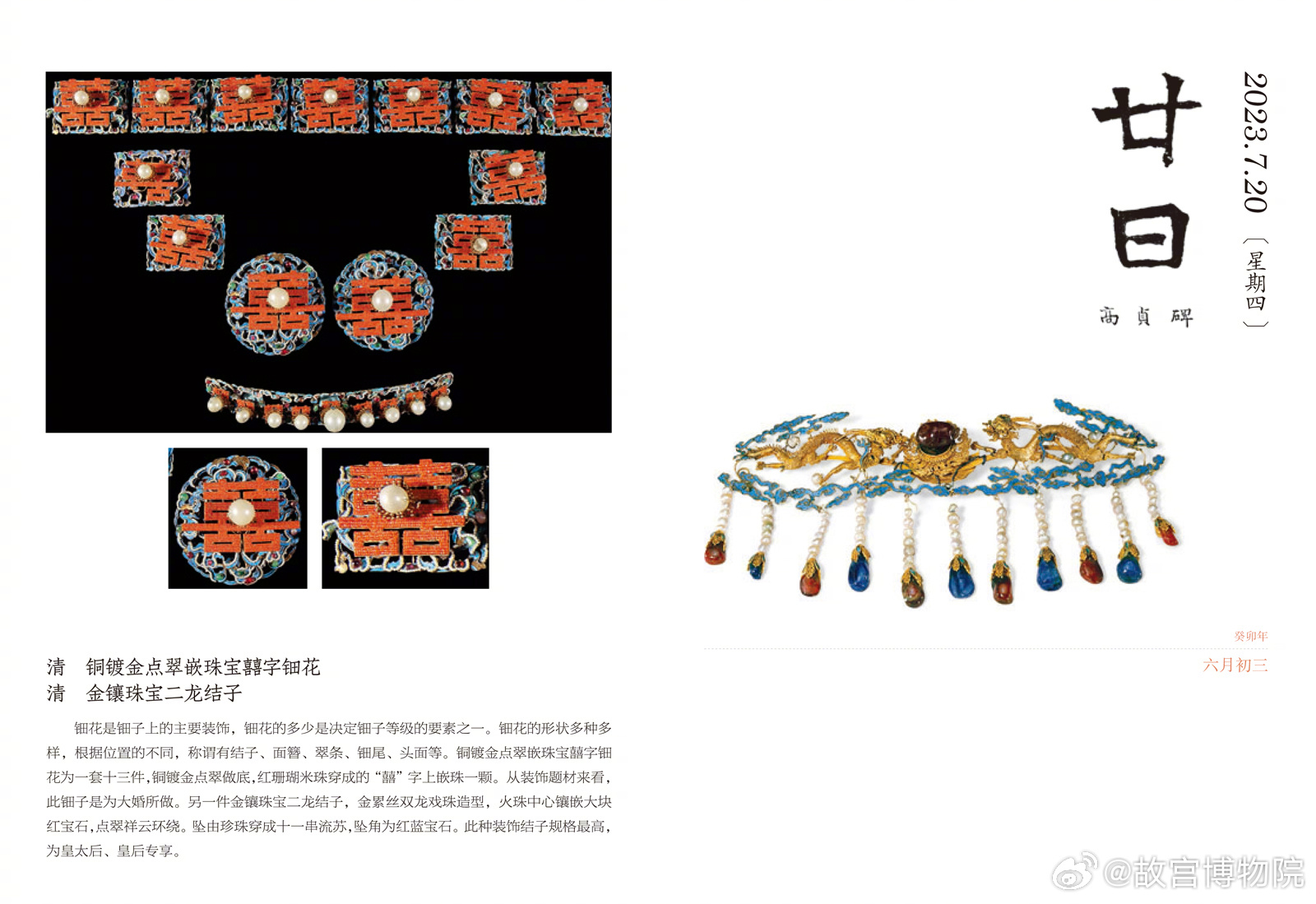
In the Qing Dynasty, gold-plated copper dots emerald inlaid with jewelry and the word Tianhua; in Qing Dynasty, gold-plated jewelry with two dragon knots. Tin flowers are the main decoration on the tin, and the number of tin flowers is one of the factors that determine the grade of the tin. Tin flowers come in a variety of shapes, and depending on their location, they are called knots, face hairpins, green strips, tin tails, head faces, etc. Gold-plated copper dot emerald jewels inlaid with the word “囍” is a set of thirteen pieces, with gold-plated copper dot emerald as the base, and a bead embedded in the character “囍” made of red coral rice beads. Judging from the decorative theme, this tin is made for a big wedding. Another piece of gold inlaid jewelry is a two-dragon knot, in the shape of two dragons playing with gold silk. The center of the fire bead is inlaid with a large ruby, surrounded by green and auspicious clouds. The pendant is made of pearls threaded into eleven strings of tassels, and the corners of the pendant are red sapphires. This kind of decorative knot has the highest standard and is exclusively used by empress dowagers and empresses.

Qing Daoguang, silver-plated hairpin with gold-plated emerald dots inlaid with gemstones, and Tongzhi in Qing Dynasty, silver-plated hairpin with gold-plated gemstones and fake beads and phoenix pattern. In the jewelry of concubines, there are a large number of hairpins of various types, and although they have different themes, they all have auspicious meanings. The number of pearls and the types of gemstones on these jewelry reflect the rank and status of the jewelry owner. Three pieces of silver – plated emerald “囍” character hairpins, with pearls inlaid on the center “囍” character, “囍” character above and below…

In the Qing Dynasty, the golden chiseled word butterfly pattern is flat and square. Bianfang is a unique headdress for Manchu noblewomen in the Qing Dynasty, and it is also a bracket used for dressing up the “two heads”. It has a similar function to the long hairpin used by Han women. This flat square is made of gold, chiseled with sesame seeds as the ground, with a circle of flowers and grass patterns chiseled on the frame, six dancing butterflies and five “囍” characters chiseled inside the frame, and a bat chiseled on the head, implying the double arrival of happiness and happiness. It is a special decoration for the queen’s wedding…

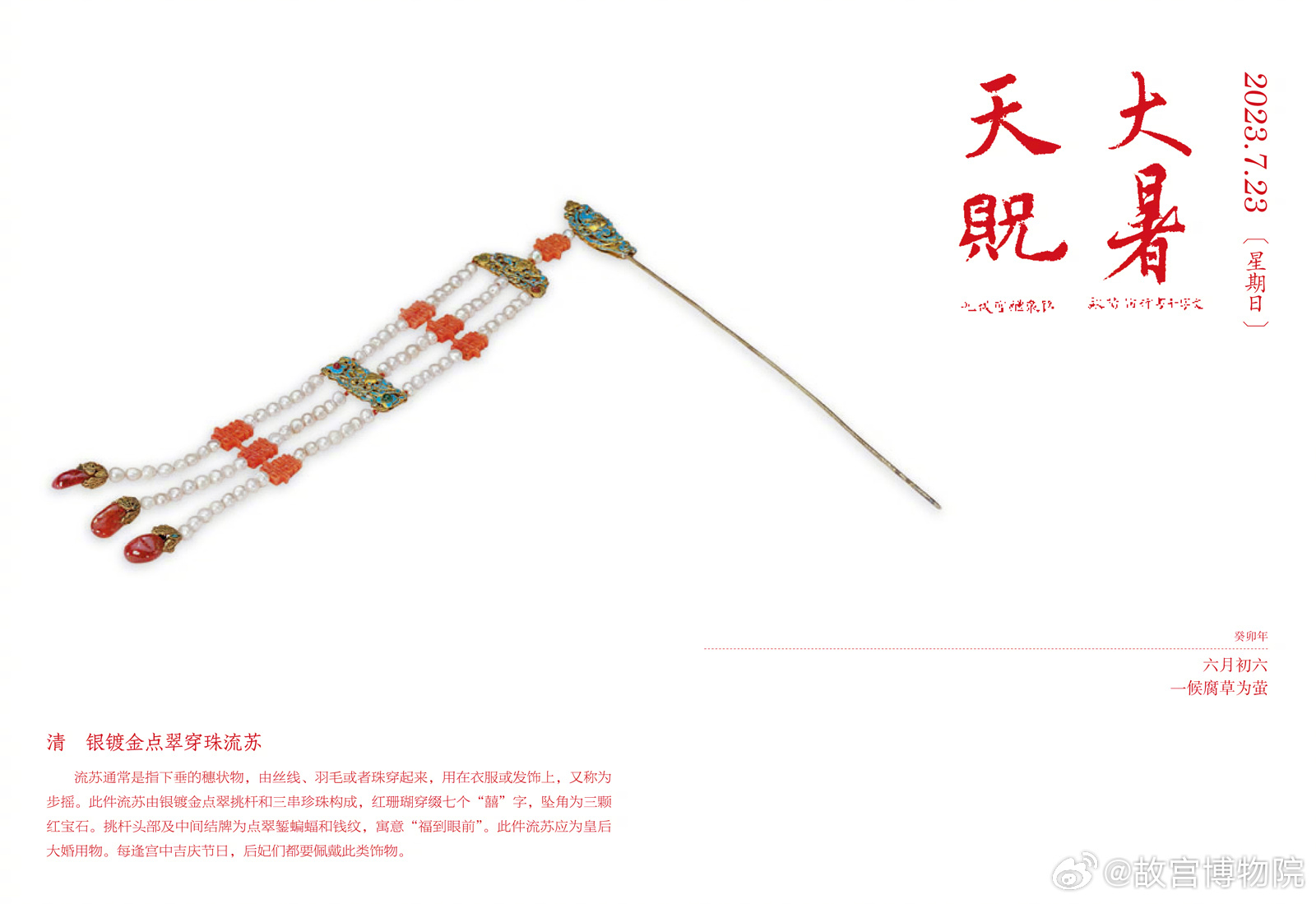
Clear, silver-plated dots emerald beads tassels. Tassels usually refer to drooping tassels, threaded by silk threads, feathers or beads, used on clothes or hair ornaments, also known as step shakes. This tassel is composed of silver-plated dot emerald poles and three strings of pearls. The red coral is embellished with seven “囍” characters, and the pendant corners are three rubies. The head of the pole and the knot in the middle are dotted emerald chiseled bats and money patterns, which means “blessings come to you”. This tassel should be used for the queen’s wedding. Every auspicious festival in the palace, concubines have to wear such ornaments.

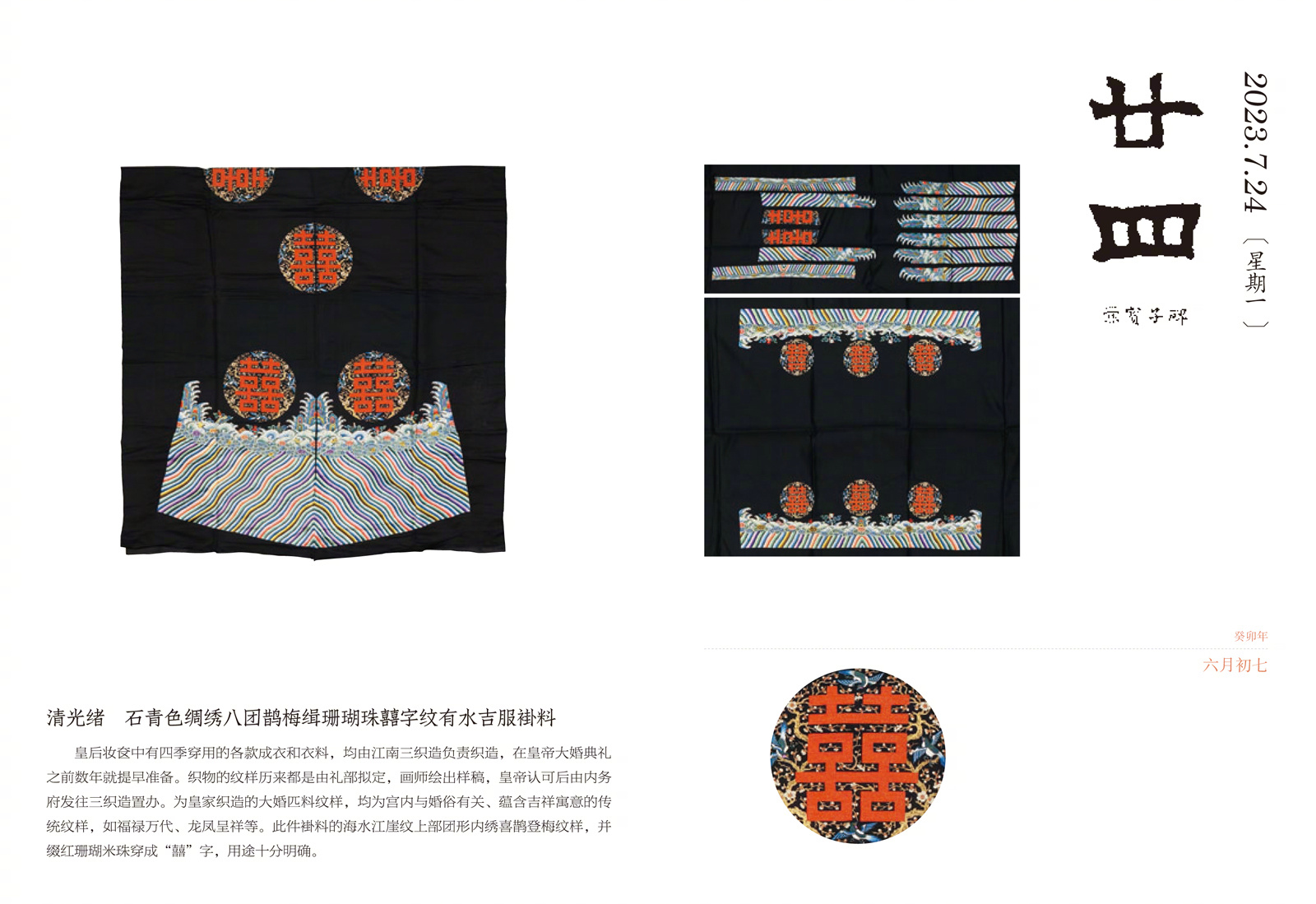
Qing Guangxu, stone blue silk embroidered with eight groups of magpies, plums, coral beads and Chinese characters, with water and auspicious clothing materials. The queen’s dowry includes all kinds of ready-made clothes and materials for the four seasons, all of which are woven by Jiangnan Sanzhi, which is prepared in advance several years before the emperor’s wedding ceremony. The pattern of the fabric has always been drawn up by the Ministry of Rites, and the artist draws a sample draft. After the emperor approves, the Ministry of Internal Affairs sends it to Sanzhizao for purchase. The wedding patterns woven for the royal family are all traditional patterns that are related to marriage customs in the palace and contain auspicious meanings, such as Fulu Bandai, Dragon and Phoenix Bringing Good Fortune, etc. The seawater river cliff pattern of this gown is embroidered with a magpie and a plum pattern on the upper part, and decorated with red coral and rice beads to form the character “囍”. The purpose is very clear.

Qing Guangxu, bright yellow silk embroidered with eight groups of magpies, plums, coral beads and 囍 characters, with Shui Jifu gowns. This gown is embroidered with bright yellow silk, with eight embroidered plum blossoms in full bloom, four magpies jumping on the branches, and red coral rice beads in the middle to form the character “囍”, with distinct layers and echoing up and down. Bright yellow is the imperial color exclusively used by the royal family. The magpie and plum blossoms imply happy brows, and the word “囍” pressed on the top implies happiness on top of happiness, highlighting the joy and peace of the emperor’s wedding. Plum blossoms have strong cold resistance, and they can brave the severe cold and bloom alone in the middle of winter when all the flowers are withered. Emperor Guangxu’s wedding coincided with the midwinter when plum blossoms were in full bloom, and such patterns added a festive atmosphere to the wedding..

Images and visuals are from – Forbidden City –Palace Museum Beijing- China –People’s Republic of China…..
#漢服 #HanFu #HanTraditionalClothing | #June2023 #正好遇见你 #HiProducer | Episode 10 to 13 – Chinese cultural Inheritance of an intangible cultural | The inheritance of Ru kiln porcelain in the past dynasties also classical dance restoration Han and Tang Dynasties…..

正好遇见你 #HiProducer  is an intangible cultural heritage urban drama directed by Gao Han , starring Guo Xiaodong , Zhang Nan , Li Xiaoran , Zhang Bo , Zheng Kai , Sun Yihan , Niu Zifan , Sheng Langxi , and Wu Qianyu  .

The series tells the story of a variety show team with literary director Yu Zazao and young cultural relics expert Tao Tang as the core, working together to launch a cultural TV program in order to show the beauty of Chinese civilization. The series covers 35 episodes in which is produce by Huanyu Film and Television in collaboration streaming with iQyi and Tencent Video ….. Majority of the Production is done in Suzhou for its modern setting among with the Chinese Cultural Traditional Heritages recreation is done at Hengdian, Subo studios…

Behind the Scenes of the production shooting process….  During the filming, the crew was allowed to enter the Suzhou Museum for on-site shooting, but in order to protect cultural relics, most of the cultural relics appearing in the play are imitation props. In the early stage of filming, the drama team found historians of relevant cultural relics, searched a large number of documents to repeatedly compare the status and details of real cultural relics, and invited professional relics masters to copy them, so as to achieve the effect of false ones. The biggest one is the filigree inlay technology, which represents the highest level of imperial crafts. When making the Jin Ou Yonggu Cup props in the filigree inlay unit, the drama crew carried out a one-to-one replica in strict accordance with historical data, which took a full two months…

Main Cast

Guo Xiao Dong as Liao Muyun

Zhang Nan as Yu Zaizao

Li Xiao Ran as Wang Xining

Jaco Zhang Bo as Tao Tang

Zheng Kai as Gu Shiyong

Annie Sun Yi Han as Yuan Jiaying

Niu Zi Fan as Xie Yao

Joy Sheng Lang Xi as Shu Rong

Karena Ng as Zhuang Yiyi

Li De Long as A Xun

Synopsis Gu Shiyong, CEO of Palace Culture Film and Television Production Company, is determined to create a new large-scale cultural variety show “Inheritance”. He strongly invites Tao Tang, a young cultural relic expert, Mu Zongyun, a well-known director, and Wang Xining, a senior host. However, just when the program was ready to start, the young female director Yu Zazao suddenly parachuted into the company and joined the program group, disrupting the overall plan of the program and being strongly rejected by everyone. Surprisingly, Yu Zazao is calm and witty, dares to break the rules, and has inexhaustible inspiration like a genius. With her help, the originally scattered production team became unprecedentedly cohesive. Everyone worked together, starting from the historical relics of the Forbidden City, devoted themselves to excavating the core memory of the nation, promoting historical and traditional culture, and solving the problem of non-genetic inheritance. In the end, “Inheritance” stood out from many homogeneous programs and became a great success. Yu Zazao also successfully healed his soul and gained a complete friendship and career..

Episode 10

Zazao decided to make museum porcelain for the fifth issue. Yuan Jiaying assisted Tao Tang to shoot the inheritance of porcelain in the past dynasties and the daily work of ancient porcelain restorers with the theme of Tang Sancai. Yu Zazao led Team B to the home of Yang Wan, a famous antique porcelain artist. Yang Wan was silent and immersed in her own art world. Her husband Xiao Hong took good care of his wife and knew every piece of his wife’s works like the back of his hand. Yu Zazao accidentally discovers a mysterious attic in the Yang family, but Xiao Hong stops him when he tries to open the door. Fortunately, Tao Tang shows up in time to explain to Yu Zazao, and Xiao Hong agrees to continue filming. Yu Zaizao pointed out that there is a huge difference in the style of Yang Wan’s works. Xiao Hong told Yu Zaizao that Yang Wan has a twin sister, Yang Xuan. Both sisters are very good at making porcelain, but their styles are very different. Ru kiln is shiny and pure, while the Jun kiln made by sister Yang Wan is luxurious and elegant. However, her younger sister Yang Xuan died unexpectedly, and Yang Wan suffered a very heavy blow. In order to commemorate her sister, Yang Wan turned to study Ru kiln.

Episode 11

On the other hand, Wen Zhou, the host invited by the program group, was intercepted, causing Yuan Jiaying, who was going to film Tang Sancai porcelain, to open the skylight. Yu Zaizao said that even if Wang Xining was injured, she could still shoot perfectly. Wang Xining was injured on her right face and leg, so she asked her to sit quietly, and told the story of Emperor Cheng Hua, Zhu Jianshen and the Chicken Crock Cup in one scene. The email of the restored photo was sent, and the photos of Hang Sharong were displayed inch by inch on the computer. Yu Zazao looked at the group photo of Hang Sharong and the sisters of the Yang family, and fell into deep thought. Yuan Jiaying thought that the latest issue of porcelain was well received, and proposed to make a sequel, which was opposed by everyone. Seeing the ancient murals and photos of pottery figurines brought by Tao Tang, Yu Zazao decided to overthrow Yuan’s idea and turn to classical dance restoration. Tao Tang introduced the Guofeng Song and Dance Troupe, which is working with Su Bo to restore the classical dance of the Han and Tang Dynasties, and Lu Feiyu, the chief dancer of the dance troupe, agreed to be interviewed. But when she saw the fish in the water, she suddenly changed her mind and told everyone that she would never cooperate with someone who had no sense of responsibility. At this time, everyone knew that Yu Zazao and Lu Feiyu had studied under the same famous dancer Feng Yunying.

Episode 12

Yu Zaizao suddenly disappeared, and everyone thought she was devastated. The show was in danger of being opened up, so Yuan Jiaying asked her to film it first. Just when the show was at an impasse, Feng Yunying, who was supposed to be gathering in Dunhuang, returned unexpectedly, and Lu Feiyu was both surprised and delighted. Feng Yunying told the truth to Lu Feiyu. It turned out that Lu Feiyu and Yu Zazao were the most important things to her back then. However, Yu Zazao’s insensitivity to the emotions around her affected her shaping of dance drama characters, and she would never be able to become a qualified dance artist. . In order to train Lu Feiyu wholeheartedly, and to allow Yu Zazao to open her heart and gain emotional experience, she encourages Yu Zazao to accept the “pursuit” of psychologist Ye Fujun. This move greatly stimulated Lu Feiyu, who also admired Dr. Ye, and caused the dance troupe to fall apart. In order to further make Lu Feiyu feel the pain, Feng Yunying gave corner A to Yu Zazao and asked Lu Feiyu to jump corner B. This incident was known to Fei Yu’s male partner Xie Hui. In order to teach Yu Zazao a lesson, he intentionally made an accident when throwing Yu Zazao high during training, causing Yu Zazao to fall directly to the ground and fracture his tail vertebrae. After the incident, Professor Feng felt deeply guilty, and Yu Wangqing took Yu Zazao away in a fit of anger. In order to protect Lu Feiyu, Feng Yunying concealed the truth of the incident, and only said that Yu Zazao gave up dancing after being injured. Lu Feiyu thought that Yu Zazao had broken her promise to learn dance all her life, and developed hatred for her.

Episode 13

Knowing the truth, Lu Feiyu felt regretful and heartbroken, and immediately agreed to participate in the filming of the variety show. During the filming of the program group, Lu Feiyu led the students to dance the Dunhuang dance that had been choreographed, which amazed everyone. However, Lu Feiyu fell to the ground due to severe lumbar muscle strain. Fortunately, Yu Zazao had already seen the clue and invited an acupuncture expert in advance. Lu Feiyu had to rest to ease the pain in her body, which meant no time for rehearsals for her solo performance. In addition, Yu Zazao also readjusted the ending of the dance. Gu Shiyong couldn’t help feeling worried, but Yu Zazao and Lu Feiyu were full of confidence. Lu Feiyu’s solo recording was very successful. Fang Quan, the producer of “Intangible Cultural Heritage” who was waiting for Lu Feiyu’s appearance, learned that his plan had failed. Zao’s victory doll, blood pressure soared. After the performance, Lu Feiyu reached out and hugged Yu Zazao. Feng Yunying formally apologizes to Yu Zazao, but Yu Zazao doesn’t understand why the teacher is crying.

Images and Visuals are from of their respectives …

#北京。 #中國 #China #Beijing | #紫禁城 #ForbiddenCity #June2023 | #ForbiddenCityDairies the #端午节 #DragonBoatFestival….. #AGallery

Thursday, 22nd June 2023- Dragon Boat Festival 2023…. in which celebrates offering of Dragon boat racing, consumption of realgar wine and zongzi..

“also known as Tuen Ng, falls on the fifth day of the fifth lunar month. It commemorates the death of Qu Yuan, a Chinese poet and minister known for his patriotism and contributions to classical poetry and who eventually became a national hero.”

Though heartbroken to see his country being intruded, Qu Yuan never abandoned his faith and country. On May 5th(in Chinese lunar calendar), after writing down his last poem, Qu Yuan drowned himself in Miluo River(a branch of Yangtze River) as a gesture of dying along with his beloved motherland.

Why is it called Duan Wu Jie? The Dragon Boat Festival is called Duan wu Jie (端午节) in Mandarin Chinese. Duan (端) means ‘start’, while wu (午) means ‘noon’, but also ‘the fifth solar month’ in the traditional Chinese calendar (approximately June 6 – July 6), centered around the summer solstice. ‘The month of noon’ marks the middle of summer.

Where did dragon boats originate? Southern central China The use of dragon boats for racing is believed to have originated in southern central China more than 2500 years ago, in Dongting Lake and along the banks of the Chang Jiang (now called the Yangtze river).

“Crossing the waves stands out from the crowd, jumping the waves to be the first to retreat.” Dragon boat racing is a traditional folk activity of 端午节 in China. It contains the national spirit of hard work, enterprising and positive, and inherits unity and courage to move forward. national genes. The dragon boat culture has lasted for thousands of years, carrying the rich humanistic emotions of the Chinese nation, and leading us to “row” towards a better life.

How old is the Dragon Boat Festival?  2,000 years…….The Dragon Boat Festival is a traditional Chinese festival. It has a history of more than 2,000 years, and is believed to have originated during the Warring States period.

What do Dragon Boat Festival people eat during the festival? For Dragon Boat Festival the Chinese usually eat zongzi (rice dumpling) and various other foods below, depending on the region.

Zongzi — Sticky Rice Dumplings. Zongzi. …

Dagao — Glutinous Rice Cake. Dagao. …

Mianshanzi. Mianshanzi. …

Fried Cake (Jiandui) Fried Cake (Jiandui) …

Eel. …

Thin Pancakes. …

Eggs Steamed with Tea. …

Egg with Garlic.

Yunxia is unpredictable, and the Forbidden City is full of weather. During the Dragon Boat Festival holiday, enjoy the auspicious clouds and the infinite sunset together…

端午安康 “Zong” has a light-year road to explore, and it has to ride the wind and waves to reach it! Rabbit Xingxing wishes everyone a healthy Dragon Boat Festival !

Images and visuals are from – Forbidden City –Palace Museum Beijing- China –People’s Republic of China…..

#漢服 #HanFu #HanTraditionalClothing | #June2023 #正好遇见你 #HiProducer | Episode Two – Chinese cultural Inheritance of an intangible cultural-  daughter’s enthusiasm and dedication To Ancient Chinese filigree inlay craftwork ……

正好遇见你 #HiProducer  is an intangible cultural heritage urban drama directed by Gao Han , starring Guo Xiaodong , Zhang Nan , Li Xiaoran , Zhang Bo , Zheng Kai , Sun Yihan , Niu Zifan , Sheng Langxi , and Wu Qianyu  .

The series tells the story of a variety show team with literary director Yu Zazao and young cultural relics expert Tao Tang as the core, working together to launch a cultural TV program in order to show the beauty of Chinese civilization. The series covers 35 episodes in which is produce by Huanyu Film and Television in collaboration streaming with iQyi and Tencent Video ….. Majority of the Production is done in Suzhou for its modern setting among with the Chinese Cultural Traditional Heritages recreation is done at Hengdian, Subo studios…

Behind the Scenes of the production shooting process….  During the filming, the crew was allowed to enter the Suzhou Museum for on-site shooting, but in order to protect cultural relics, most of the cultural relics appearing in the play are imitation props. In the early stage of filming, the drama team found historians of relevant cultural relics, searched a large number of documents to repeatedly compare the status and details of real cultural relics, and invited professional relics masters to copy them, so as to achieve the effect of false ones. The biggest one is the filigree inlay technology, which represents the highest level of imperial crafts. When making the Jin Ou Yonggu Cup props in the filigree inlay unit, the drama crew carried out a one-to-one replica in strict accordance with historical data, which took a full two months…

Main Cast

Guo Xiao Dong as Liao Muyun

Zhang Nan as Yu Zaizao

Li Xiao Ran as Wang Xining

Jaco Zhang Bo as Tao Tang

Zheng Kai as Gu Shiyong

Annie Sun Yi Han as Yuan Jiaying

Niu Zi Fan as Xie Yao

Joy Sheng Lang Xi as Shu Rong

Karena Ng as Zhuang Yiyi

Li De Long as A Xun

Synopsis Gu Shiyong, CEO of Palace Culture Film and Television Production Company, is determined to create a new large-scale cultural variety show “Inheritance”. He strongly invites Tao Tang, a young cultural relic expert, Mu Zongyun, a well-known director, and Wang Xining, a senior host. However, just when the program was ready to start, the young female director Yu Zazao suddenly parachuted into the company and joined the program group, disrupting the overall plan of the program and being strongly rejected by everyone. Surprisingly, Yu Zazao is calm and witty, dares to break the rules, and has inexhaustible inspiration like a genius. With her help, the originally scattered production team became unprecedentedly cohesive. Everyone worked together, starting from the historical relics of the Forbidden City, devoted themselves to excavating the core memory of the nation, promoting historical and traditional culture, and solving the problem of non-genetic inheritance. In the end, “Inheritance” stood out from many homogeneous programs and became a great success. Yu Zazao also successfully healed his soul and gained a complete friendship and career..

Episode 2

Gu Shiyong was very satisfied with the material provided by Yu Zazao, but Tao Tang expressed strong opposition to the content about the conflict between Liu’s father and daughter, and immediately left the crew. Yu Zazao was unwilling to give up, so he chased Tao Tang to ask for an explanation. Tao Tang believed that Yu Zazao had obtained the permission to shoot, and he was not at fault from a legal point of view. Cracks are difficult to repair. Gu Shiyong was very dissatisfied with Yu Zazao’s behavior of leaving Tao Tang, and asked Yu Zazao to please return to Tao Tang, otherwise she would be let out of the show. Master Liu was furious at his daughter when he learned that his daughter Liu Jiamei asked the program group to broadcast a clip of their discord. The daughter tearfully confessed her father’s preference for her younger brother, and the two broke up unhappy. In the middle of the night, Yu Zazao and Tao Tang came to the studio and found that Master Liu was crying alone. Yu Zazao played the video of Liu Jiamei doing filigree inlay seriously to Master Liu. Master Liu saw his daughter’s enthusiasm and dedication to filigree inlay with his own eyes, and fell into deep thought. Liu Jiamei suddenly returned to the studio and bumped into her father who had not yet left. Master Liu decided to teach her daughter the technique of filigree inlay. The father and daughter finally reconciled, and Master Liu even made a bet that if his daughter can get a place in the provincial competition, he will inherit the studio to her. The program team also quietly set up recording equipment to record this warm and beautiful scene without disturbing the two.

Images and Visuals are from of their respectives …