#北京。 #中國 #China #Beijing | #紫禁城 #ForbiddenCity #August2023 | #ForbiddenCityDairies -The Palace Museum #ForbiddenCity Collections of Chinese intangible cultural heritage.  Collection  12th – 20th August 2023..

On July 19th 2023 , the multilingual website of the Forbidden City Palace Museum- Beijing, China, People’s Republic of Chinawas officially released at the Digital Cultural Tourism Development Forum of the 2023 China Internet Civilization Conference! The website covers five languages: English, French, Russian, Japanese, and Spanish, and will meet the needs of audiences with different languages.

 The multilingual website of the Palace Museum is committed to establishing an international website that is concise, clear, easy to use for overseas audiences, and fits the construction of the modern civilization of the Chinese nation, including tour guides, information, panoramic tours, online exhibitions, collection appreciation, cultural topics, etc. Rich immersive content describing of the most detail collection that housed within the Forbidden city collection… . 

During the Months of late July towards early August 2023 it has been serve Rainstorms in Beijing in which the  603 year old Forbidden city Drainage has been designed very well in countering those intense weather conditions….

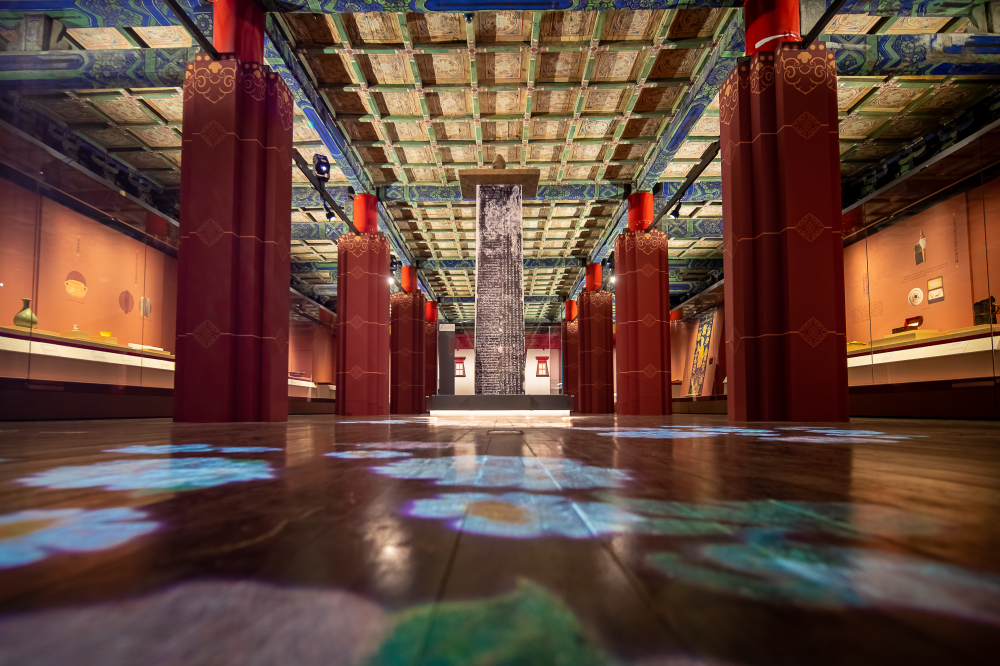
Qing, the treasure of Queen Jinlong. The gold books and gold treasures presented to the queen have become the symbol of the queen’s status. This is the “Queen’s Treasure”, made of gold, with a dragon button, attached to a yellow ribbon, and the seal is in Manchu and Chinese jade chopsticks, and the script is the same as the emperor’s imperial treasure.

The floating haze is warm and emerald, the branches and leaves support the Su, and the ribbon bird can be seen inhabiting the branches among the shadows of the trees, just like “the fairy in the forest”. Ribbon birds are colorful, with a dark blue glow on the head, neck and crest. When the ribbon bird is engraved on the cultural relics, it meets thousands of flowers, carrying people’s hopes and blessings. The ribbon is an ornament that marks the official rank. The name “ribbon” means to increase the rank and rank, and because “ribbon” and “shou” have the same pronunciation, it also means longevity. Therefore, the ribbon bird has the meaning of good fortune and longevity, which was deeply loved by the ancients.

Modern times, the queen’s gold book. After Puyi abdicated, according to the “Preferential Treatment Conditions of the Qing Dynasty”, he still lived a life of “little court” in the inner court of the Forbidden City, and married Wanrong as the queen according to the wedding ceremony of the Qing emperor. This is the golden book that canonized Wanrong, with a total of ten pages. It reads: “Xuantong’s fourteenth year…the daughter of Rongyuan…I hereby take Baolier as the queen…” The “little imperial court” still uses the Xuantong year name, “Xuantong fourteen years” is the eleventh year of the Republic of China (1922). This gold book is the only queen gold book in existence in the Palace Museum…

千位百瓶 Garlic bottle, named after the mouth of the bottle is shaped like a head of garlic. Pictured  is a bright red Panchi garlic bottle with white glaze and plastic paste from the Jiajing period of the Ming Dynasty. The mouth of the bottle is in the shape of eight cloves of garlic. Copper red glaze, the glaze color is eye-catching and unusual. The red panchi protrudes on the white glaze, which has a three-dimensional effect and is quite artistic.

去我们一起来读计划 Qing, Qingkuan, etc., set up a welcome picture in the album of big wedding pictures. This picture depicts the wedding procession arriving at the residence of the queen-to-be, and the stepfather leading the children kneeling outside the gate to greet her. In the lead of the imperial battle, Huang Gai accompanied, followed by officials in charge of ceremonies, Honglu Temple Xuban officials and Mingzan officials, then envoys and deputy envoys, followed by Ceting, Baoting and Fengyu carried by 16 people. They entered the courtyard one by one, followed by the queen-to-be’s father and clan members. After the emperor’s golden festival and the queen’s ceremony are arranged in the mansion, the canonization ceremony is waiting to be held.

去我们一起来读计划  Qing Dynasty Qianlong, Lengjian, Huangmen, etc., the Fengyu page of the Atlas of Imperial Ritual Vessels. In the Qing Dynasty, the emperor used a phoenix to marry the queen’s wedding sedan chair. The body of the Fengyu sedan chair is made of wood, painted with bright yellow lacquer. The dome is double-layered, and each octagon is decorated with a golden phoenix. The hanging eaves are bright yellow satin, painted with golden phoenix. The four curtains are painted with blue stones and golden phoenixes. The interior is painted with red lacquer, the sedan chair is bright yellow satin with golden phoenix painted on it, and the sedan chair cushion is bright yellow satin with colorful phoenix embroidered on it. The shoulder poles are topped with bronze brass and golden phoenix heads and tails. The style of the phoenix was determined in the book “Illustration of Ritual Vessels of the Dynasty” during the Qianlong period. It was used by the empress when she participated in the silkworm ceremony of offering sacrifices to the god of silkworms.

千件百锅# The Weibo text introduced last time This white-glazed plastic paste bright red panchi garlic bottle from the Jiajing period of the Ming Dynasty was handed down to the Qing Dynasty. It may be very popular with Emperor Yongzheng. It is painted by Qing people in the Palace Museum. The depiction of this bottle can be seen in “Yinzhen’s Pleasure Picture” and “Yinzhen Concubine’s Pleasure Picture”.

去我们一起来读计划  Guangxu in the Qing Dynasty, Jin Xi character Ruyi, Yubi dragon character axis. In the Qing Dynasty, the phoenix of the emperor’s wedding to please the queen had a built-in “dragon” character axis, gold ruyi, and apples. In folk weddings, the groom goes to the bride’s house to meet the bride in person, but the emperor is supreme, and when he marries the queen, he sends envoys to greet him, so the word “dragon” is used as the groom’s incarnation. In many ceremonies of the emperor’s wedding, Ruyi and apples were used, implying auspiciousness and peace. This gold ruyi is in a three-inlaid style, with a raised “囍” character on the first, middle and tail parts, with a red “囍” knot and silk tassels underneath. Jin Ruyi and the “Dragon” scroll are placed together in a yellow brocade box, and the scroll is engraved with “The Treasure of Empress Dowager Cixi’s Royal Brush”, which was used for the wedding of Emperor Guangxu.

The heat is in full swing, and everything is transpiring. It’s the season when gardenias are in full bloom. If you can meet a gardenia that is “suspected to be leaves in frost, and covered with branches like snow”, the flower color like snow and ice is accompanied by bursts of intoxicating fragrance. It is extremely cool!

Gardenia, also known as scorpion, has a soft and elegant floral fragrance. “Snowflakes and ice flowers are cool and clear, and the deep part of the song bar is bright and spiritual.” Gardenia is white in color, and its six petals are like snowflakes. Therefore , the ancients often associated gardenia with snowflakes….

In the Qing Dynasty, Qingkuan et al., the album of the big wedding picture set up a welcome picture. This is the last page of the sixth volume “Collected Figures of Ingratiation”. After the Guangxu Emperor’s wedding party arrived at the quasi-empress’s mansion, the empress’s phoenix and ceremonial car were placed in the courtyard, and the emperor’s golden festival was respectfully placed on the central festival table in the outer hall. The queen father kneels in front of the face, and the official envoy reads the document for the establishment of the queen. The kneeling in the upper right corner of the screen is the father of the queen-to-be. After that, the envoy will hand over the emperor’s gold festival to the eunuch, and place it on the festival case in the middle of the inner hall. The eunuch and female officials will present the ceremony to the queen in the inner hall, and award the gold book and the queen’s treasure. As for the inner hall ceremony attended by the Empress, Empress Dowager Cixi issued a special decree that painters do not need to paint, so it is not shown in the picture. After the registration ceremony, the queen went to Fengyu at an auspicious time, ready to enter the palace..

去我们一起来读计划  Qing Guangxu, red silk embroidered dragon and phoenix with the pattern gown. During the wedding ceremony, the empress had several different attires. When she was preparing to accept the ceremony at her natal home, she wore a red silk gown embroidered with dragon and phoenix patterns, and an outer cover of azurite silk embroidered with patterns of dragon and phoenix. This gown was worn by the empress of Emperor Guangxu’s wedding. It has a round neck, a large front and right gusset, horseshoe sleeves, and left and right skirts. The whole body is embroidered with gold thread and multicolored silk thread to embroider various patterns, and the front chest, back, shoulders and front and rear hem are embroidered with eight groups of golden dragon and phoenix “囍” patterns, arranged in twelve chapters. The whole body is also decorated with the characters of “Fu”, “Lu”, “Shou” and “Xi”, and auspicious patterns such as bats, cranes and miscellaneous treasures. The embroidery is complicated and exquisite, the patterns are rich and beautiful, and it has a very festive and auspicious decorative effect.

去我们一起来读计划  Qing Dynasty Guangxu, stone blue silk embroidered dragon and phoenix with the pattern gown. This gown is worn over a dragon and phoenix Tonghe pattern robe. It has a round neck, double breasts, flat sleeves, and a skirt that opens at the back. The collar is adorned with a gilt copper button with chiseled patterns and four fastening loops. It is lined with bright yellow plain spun silk lining, with thin silk cotton in the middle. This gown is embroidered with patterns such as eight dragons and phoenixes “囍” and other patterns on the ground of stone-blue river silk, using flat stitches, flat gold, closing stitches, trocars, and nail threads. The joy and enthusiasm of a big wedding.

Images and visuals are from – Forbidden City –Palace Museum Beijing- China –People’s Republic of China…..

#QIPAO #旗袍 #Cheongsam |#茧迹原创礼服定制 #Cocoon #BeijingYujiFashionDesignCo. #August 2023| #FashionLookBook #武汉时装周 Gorgeous Chinese painting embroidery of #ArtHauteCouture #TraditionalChineseQipao #ModernCheongsam #ChineseWeddingDress #ModernQipao Collection  5th May – 8th August 2023

Located in an ancient post-modern Three thousand years old ultra Megatroplis city Beijing City, Capital of  China – People’s Republic of China, 茧迹原创礼服定制 Cocoon – Beijing Yuji Fashion Design Co in which Cocoon trace original dress customization: No. D05, Zhongyi Street, 798 Art District, Jiuxianqiao, Chaoyang District, Beijing …. Innovatingly Post Modern Qipao- Cheongsam …. in which innovatively bringing a New Chinese style cheongsam-Qipao high-end brand-Embroidery Embroiderer seamstressing   …….it is committed to the high-end private specialization of Chinese Shanghai style cheongsam innovatively… in which each dress is customised towards the wear’s in which tailoring takes least in between 20-60 days depending on the extremely level of detailing of brocade in which using the most finest heavy silks are hand sewn and crafted …..

Introducing Cocoon Trace Original Dress Customization Chinese innovative in between Ming and Qing Dynasty fusion traditional wedding dresses  in some in modern fusion of its  2023 Art Haute Couture series in which their inspirationally Continuation from the   Chinese Painting of spring flowersCocoon Trace 2022’s original and improved cheongsam … Fengdai” has chosen a design that is very suitable for summer in both fabric and color matching…

Dream back to Luoshen|Ada Choi Chaohua X Cocoon Actor Ada Choi appeared
in a special custom-made cocoon 装风2023 The early stage is like a light cloud covering the moon, and if the flowing wind returns to the snow, it is light, flowing, and graceful . Achieving the beauty of your heart….

古纸婚婚 At the beginning of summer, feel happiness and beauty
through the light and shadow of the shade of the trees …..

古座婚婚Taking the solemn and noble feeling of court clothes, the dragon and phoenix gowns are innovated. While shining brightly, they are not bound by tradition, and draw a unique and trendy silk brocade picture for the bride.

Yinyuanjihui | Antique Clothes and Contemporary Clothing Show
Cocoon x Yiyuan x Langyuan x Yoyo Search We have witnessed this time that has spread for more than a hundred years. Aesthetics recreates elegance and interest in the vast time. At the beginning of a new chapter Inexhaustible thread, achievement mind beautiful clothes…

Xiaoman|Everything is flourishing, full but not full. As for this, it is just the right wisdom to be so small that everything is full and rich.

Cocoon Ji 2023’s new work “Mu Ye Ji”

coexists with the nature of the world, draws on its vigorous power of free growth,
creates an infinite sense of beauty in the exploration of nature, and writes a chapter of natural anthology called Xia in the veins of leaves…

Cocoon Ji 2023’s new work “Mu Ye Ji”

is a light and soft silk taken from nature , with its unique temperature and inherited the characteristics of breathing…

Green BreezePine Trees🌲Inspired
by the works of art collected by the Hong Kong Museum of History, we improved it into a short-sleeved double-breasted version, and made more sophisticated treatments on the buttons and details. Printed silk all over the body, when sewing, turn one side of the pattern originally printed on the two ends of the fabric to ensure that the patterns on both ends are exactly on the front and back of the skirt.


Cocoon Ji 2023 original Chinese style “Linqi”Who knows the “mermaid princess” in the cheongsam session~
The clarity of the sky and the transparency of the sea are all from hand-made custom dyeing, matched with high-end sequin lace all over the body, sparkling when walking Moving, it is completely “mermaid fish”


Come and “collide with nature” 🌿 Cocoon Ji 2023 original Chinese dress “Mengying” is a
natural flower color matching of pink,
white and black. It chooses high-end lace imported from Italy to create petal-like layers and clarity, and the color is harmonious and advanced. The shoulder-shaved design highlights the shoulder and neck lines, cleverly grasping the sweet and high-end sex appeal 🌷

Happy in a little time, quiet in a small

place 🍃Venue: 晴玉酒店
dress: 古已original dress custom
photography: 一级一故事
Makeup: Rachel-MakeupModel
: Marcee
​Media Support: 婚礼News

千维Thousands of strands, the achievement of beautiful clothes

Wooden leaves moving autumn sound 🍂
Today 立秋 let’s blow the wind of new autumn together!

QIPAO 旗袍 Cheongsam …. In which from historically Shenyang is the birth place of the Qing Dynasty 1636-1912plus ….  In which Qipao is termed for Qing Dynasty Clothing that the Manchu ethnic adoptively wore…… in which the Shenyang Palace Museum was an imperial palace towards two Qing Dynasty emperors. Previously two years ago During the event it which was an eight day forums, with exhibitions also related workshops illustrating the birth place of the Old Capital of Cheongsam where the Qing Dynasty- Qipao was inspired from..   Before that Shanghai 1930’s Qipao-Cheongsam revolution, the Manchurian Cheongsam was the fashion of choice of the Qing Dynasty (1636-1912)   throughout as it standardized that style during the dynasty… Replacing the previous clothing standard Han Fu – Han Dynasty clothing style, in which also is form fitting towards the women’s silhouette but with a higher degree of freedom of flare of personal, individual style… 

Qipao-Cheongsam is uniquely hand crafted tailored Chinese dress to the customer’s various measurements… in which you can still have them brought of the rack in which is accustomed to the standard measurements… in which you can tell which is western influenced with the back zipped in which the Eastern traditional Chinese Tailors would have the side zipped of the Qipao dress due it interrupts the flow of the pattern work at the back of the dress..  Also it creates a continuous seamless back look…  after as the measurements are translated drafted onto the silk or the customer desired accustomed fabric of choice, from the measurements book with the associated look of the design elements with additional accessories the sexiness of Qipao lies subtlety.. Measuring, patterning, cutting, and button making are crucial, in where passion and art comes together in tailoring….

 In which traditionally Qipao- Cheongsam dresses are worn for from straight forwardly every day towards after work evening wear in without having to change to another set of wardrobe dressing only to accessories for the required occasion… … in which the Qipao dress pattern silhouette is design for the lady’s figure in which accentuating the silhouette without giving away too much of what’s underneath in retaining…. its timeless classic silhouettes in which are designed to be worn every day, from work, evening,  casually  towards to the weekend… with sleek simple, elegant, sexy intelligent sophistication in which are easy to be accessorised with any pieces of clothing in your current or upcoming wardrobe…

  Images and visuals are from Weibo also from茧迹原创礼服定制Cocoontrace original dress customization: No. D05, Zhongyi Street, 798 Art District, Jiuxianqiao, Chaoyang District, Beijing 010-59789809 – China –People’s Republic of China ..

#北京。 #中國 #China #Beijing | #紫禁城 #ForbiddenCity #July2023 | #ForbiddenCityDairies -The Palace Museum #ForbiddenCity Collections of Chinese intangible cultural heritage.  Collection 20th   to 20th July 2023…

On July 19th 2023 , the multilingual website of the Forbidden City Palace Museum- Beijing, China, People’s Republic of Chinawas officially released at the Digital Cultural Tourism Development Forum of the 2023 China Internet Civilization Conference! The website covers five languages: English, French, Russian, Japanese, and Spanish, and will meet the needs of audiences with different languages.

 The multilingual website of the Palace Museum is committed to establishing an international website that is concise, clear, easy to use for overseas audiences, and fits the construction of the modern civilization of the Chinese nation, including tour guides, information, panoramic tours, online exhibitions, collection appreciation, cultural topics, etc. Rich immersive content describing of the most detail collection that housed within the Forbidden city collection… . 

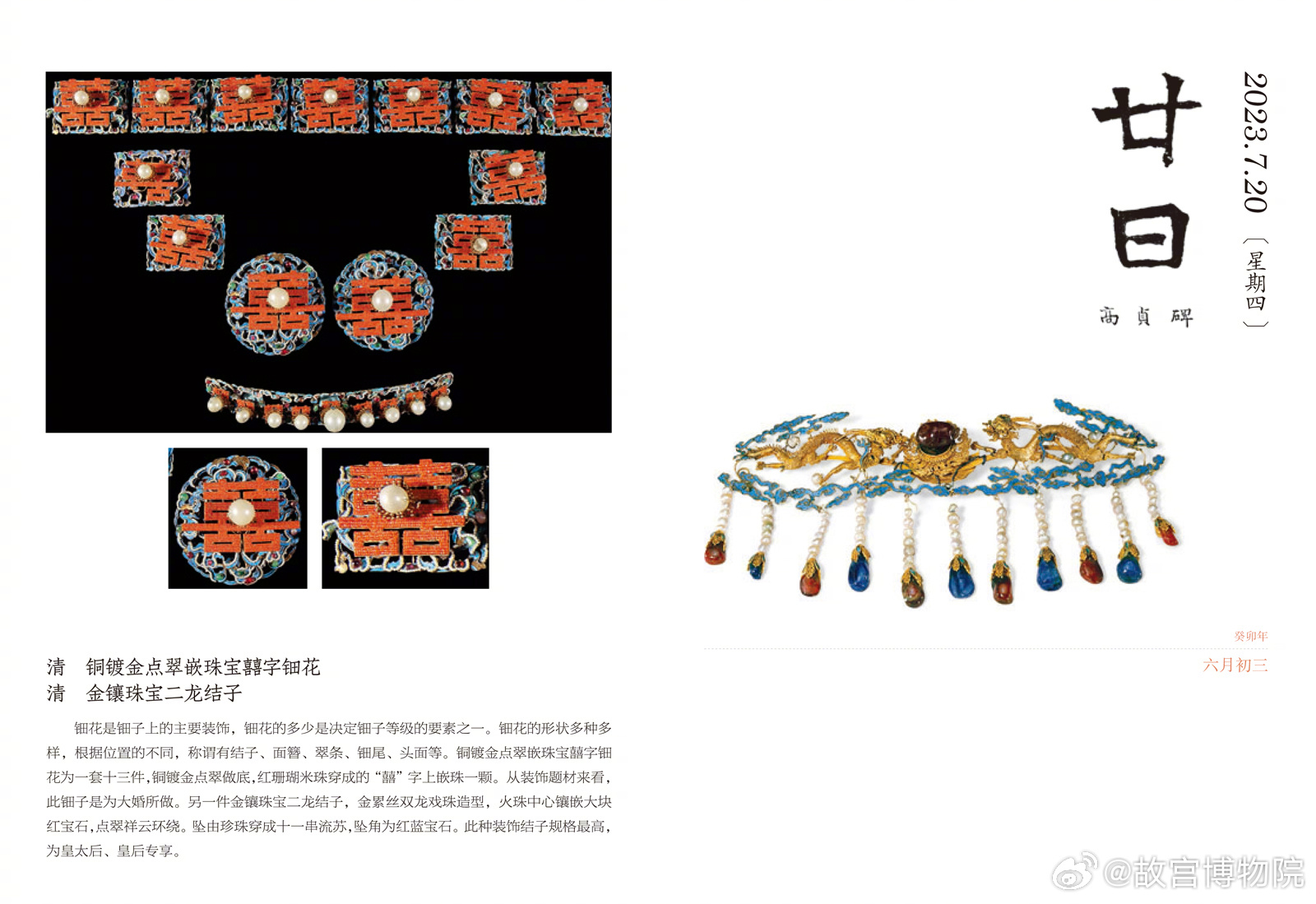
In the Qing Dynasty, gold-plated copper dots emerald inlaid with jewelry and the word Tianhua; in Qing Dynasty, gold-plated jewelry with two dragon knots. Tin flowers are the main decoration on the tin, and the number of tin flowers is one of the factors that determine the grade of the tin. Tin flowers come in a variety of shapes, and depending on their location, they are called knots, face hairpins, green strips, tin tails, head faces, etc. Gold-plated copper dot emerald jewels inlaid with the word “囍” is a set of thirteen pieces, with gold-plated copper dot emerald as the base, and a bead embedded in the character “囍” made of red coral rice beads. Judging from the decorative theme, this tin is made for a big wedding. Another piece of gold inlaid jewelry is a two-dragon knot, in the shape of two dragons playing with gold silk. The center of the fire bead is inlaid with a large ruby, surrounded by green and auspicious clouds. The pendant is made of pearls threaded into eleven strings of tassels, and the corners of the pendant are red sapphires. This kind of decorative knot has the highest standard and is exclusively used by empress dowagers and empresses.

Qing Daoguang, silver-plated hairpin with gold-plated emerald dots inlaid with gemstones, and Tongzhi in Qing Dynasty, silver-plated hairpin with gold-plated gemstones and fake beads and phoenix pattern. In the jewelry of concubines, there are a large number of hairpins of various types, and although they have different themes, they all have auspicious meanings. The number of pearls and the types of gemstones on these jewelry reflect the rank and status of the jewelry owner. Three pieces of silver – plated emerald “囍” character hairpins, with pearls inlaid on the center “囍” character, “囍” character above and below…

In the Qing Dynasty, the golden chiseled word butterfly pattern is flat and square. Bianfang is a unique headdress for Manchu noblewomen in the Qing Dynasty, and it is also a bracket used for dressing up the “two heads”. It has a similar function to the long hairpin used by Han women. This flat square is made of gold, chiseled with sesame seeds as the ground, with a circle of flowers and grass patterns chiseled on the frame, six dancing butterflies and five “囍” characters chiseled inside the frame, and a bat chiseled on the head, implying the double arrival of happiness and happiness. It is a special decoration for the queen’s wedding…

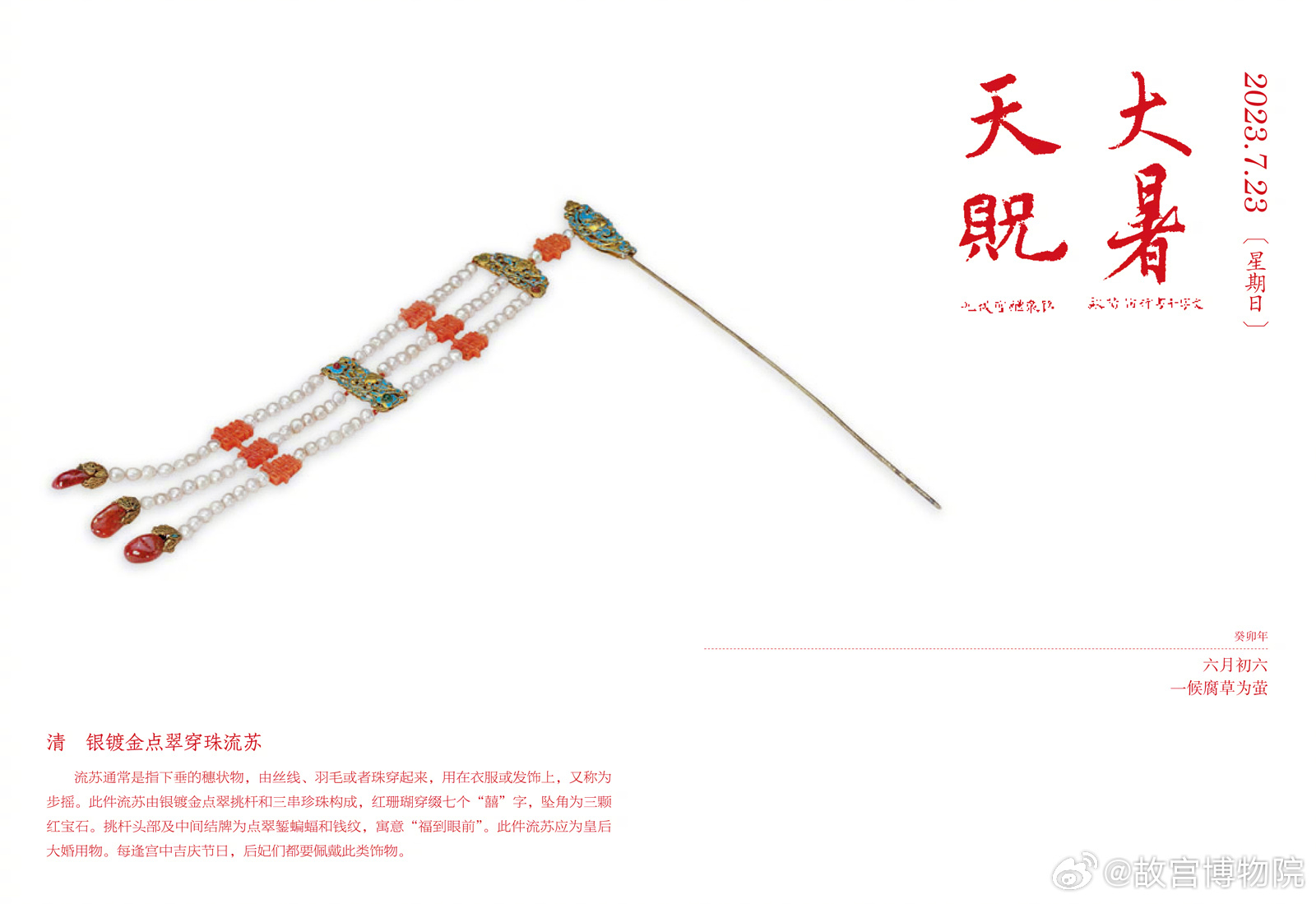
Clear, silver-plated dots emerald beads tassels. Tassels usually refer to drooping tassels, threaded by silk threads, feathers or beads, used on clothes or hair ornaments, also known as step shakes. This tassel is composed of silver-plated dot emerald poles and three strings of pearls. The red coral is embellished with seven “囍” characters, and the pendant corners are three rubies. The head of the pole and the knot in the middle are dotted emerald chiseled bats and money patterns, which means “blessings come to you”. This tassel should be used for the queen’s wedding. Every auspicious festival in the palace, concubines have to wear such ornaments.

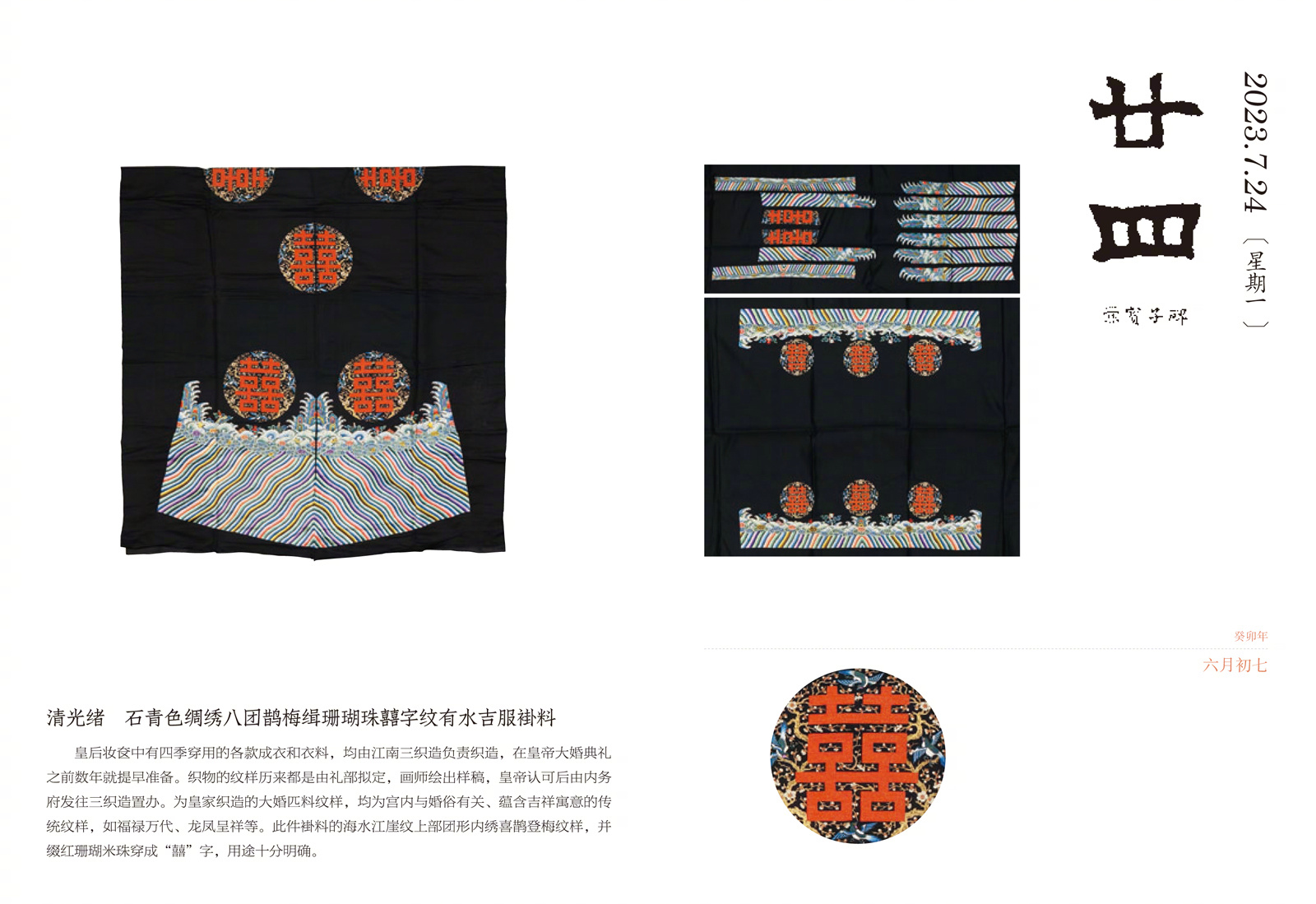
Qing Guangxu, stone blue silk embroidered with eight groups of magpies, plums, coral beads and Chinese characters, with water and auspicious clothing materials. The queen’s dowry includes all kinds of ready-made clothes and materials for the four seasons, all of which are woven by Jiangnan Sanzhi, which is prepared in advance several years before the emperor’s wedding ceremony. The pattern of the fabric has always been drawn up by the Ministry of Rites, and the artist draws a sample draft. After the emperor approves, the Ministry of Internal Affairs sends it to Sanzhizao for purchase. The wedding patterns woven for the royal family are all traditional patterns that are related to marriage customs in the palace and contain auspicious meanings, such as Fulu Bandai, Dragon and Phoenix Bringing Good Fortune, etc. The seawater river cliff pattern of this gown is embroidered with a magpie and a plum pattern on the upper part, and decorated with red coral and rice beads to form the character “囍”. The purpose is very clear.

Qing Guangxu, bright yellow silk embroidered with eight groups of magpies, plums, coral beads and 囍 characters, with Shui Jifu gowns. This gown is embroidered with bright yellow silk, with eight embroidered plum blossoms in full bloom, four magpies jumping on the branches, and red coral rice beads in the middle to form the character “囍”, with distinct layers and echoing up and down. Bright yellow is the imperial color exclusively used by the royal family. The magpie and plum blossoms imply happy brows, and the word “囍” pressed on the top implies happiness on top of happiness, highlighting the joy and peace of the emperor’s wedding. Plum blossoms have strong cold resistance, and they can brave the severe cold and bloom alone in the middle of winter when all the flowers are withered. Emperor Guangxu’s wedding coincided with the midwinter when plum blossoms were in full bloom, and such patterns added a festive atmosphere to the wedding..

Images and visuals are from – Forbidden City –Palace Museum Beijing- China –People’s Republic of China…..

#漢服 #HanFu #HanTraditionalClothing | #June2023 #正好遇见你 #HiProducer | Episode 10 to 13 – Chinese cultural Inheritance of an intangible cultural | The inheritance of Ru kiln porcelain in the past dynasties also classical dance restoration Han and Tang Dynasties…..

正好遇见你 #HiProducer  is an intangible cultural heritage urban drama directed by Gao Han , starring Guo Xiaodong , Zhang Nan , Li Xiaoran , Zhang Bo , Zheng Kai , Sun Yihan , Niu Zifan , Sheng Langxi , and Wu Qianyu  .

The series tells the story of a variety show team with literary director Yu Zazao and young cultural relics expert Tao Tang as the core, working together to launch a cultural TV program in order to show the beauty of Chinese civilization. The series covers 35 episodes in which is produce by Huanyu Film and Television in collaboration streaming with iQyi and Tencent Video ….. Majority of the Production is done in Suzhou for its modern setting among with the Chinese Cultural Traditional Heritages recreation is done at Hengdian, Subo studios…

Behind the Scenes of the production shooting process….  During the filming, the crew was allowed to enter the Suzhou Museum for on-site shooting, but in order to protect cultural relics, most of the cultural relics appearing in the play are imitation props. In the early stage of filming, the drama team found historians of relevant cultural relics, searched a large number of documents to repeatedly compare the status and details of real cultural relics, and invited professional relics masters to copy them, so as to achieve the effect of false ones. The biggest one is the filigree inlay technology, which represents the highest level of imperial crafts. When making the Jin Ou Yonggu Cup props in the filigree inlay unit, the drama crew carried out a one-to-one replica in strict accordance with historical data, which took a full two months…

Main Cast

Guo Xiao Dong as Liao Muyun

Zhang Nan as Yu Zaizao

Li Xiao Ran as Wang Xining

Jaco Zhang Bo as Tao Tang

Zheng Kai as Gu Shiyong

Annie Sun Yi Han as Yuan Jiaying

Niu Zi Fan as Xie Yao

Joy Sheng Lang Xi as Shu Rong

Karena Ng as Zhuang Yiyi

Li De Long as A Xun

Synopsis Gu Shiyong, CEO of Palace Culture Film and Television Production Company, is determined to create a new large-scale cultural variety show “Inheritance”. He strongly invites Tao Tang, a young cultural relic expert, Mu Zongyun, a well-known director, and Wang Xining, a senior host. However, just when the program was ready to start, the young female director Yu Zazao suddenly parachuted into the company and joined the program group, disrupting the overall plan of the program and being strongly rejected by everyone. Surprisingly, Yu Zazao is calm and witty, dares to break the rules, and has inexhaustible inspiration like a genius. With her help, the originally scattered production team became unprecedentedly cohesive. Everyone worked together, starting from the historical relics of the Forbidden City, devoted themselves to excavating the core memory of the nation, promoting historical and traditional culture, and solving the problem of non-genetic inheritance. In the end, “Inheritance” stood out from many homogeneous programs and became a great success. Yu Zazao also successfully healed his soul and gained a complete friendship and career..

Episode 10

Zazao decided to make museum porcelain for the fifth issue. Yuan Jiaying assisted Tao Tang to shoot the inheritance of porcelain in the past dynasties and the daily work of ancient porcelain restorers with the theme of Tang Sancai. Yu Zazao led Team B to the home of Yang Wan, a famous antique porcelain artist. Yang Wan was silent and immersed in her own art world. Her husband Xiao Hong took good care of his wife and knew every piece of his wife’s works like the back of his hand. Yu Zazao accidentally discovers a mysterious attic in the Yang family, but Xiao Hong stops him when he tries to open the door. Fortunately, Tao Tang shows up in time to explain to Yu Zazao, and Xiao Hong agrees to continue filming. Yu Zaizao pointed out that there is a huge difference in the style of Yang Wan’s works. Xiao Hong told Yu Zaizao that Yang Wan has a twin sister, Yang Xuan. Both sisters are very good at making porcelain, but their styles are very different. Ru kiln is shiny and pure, while the Jun kiln made by sister Yang Wan is luxurious and elegant. However, her younger sister Yang Xuan died unexpectedly, and Yang Wan suffered a very heavy blow. In order to commemorate her sister, Yang Wan turned to study Ru kiln.

Episode 11

On the other hand, Wen Zhou, the host invited by the program group, was intercepted, causing Yuan Jiaying, who was going to film Tang Sancai porcelain, to open the skylight. Yu Zaizao said that even if Wang Xining was injured, she could still shoot perfectly. Wang Xining was injured on her right face and leg, so she asked her to sit quietly, and told the story of Emperor Cheng Hua, Zhu Jianshen and the Chicken Crock Cup in one scene. The email of the restored photo was sent, and the photos of Hang Sharong were displayed inch by inch on the computer. Yu Zazao looked at the group photo of Hang Sharong and the sisters of the Yang family, and fell into deep thought. Yuan Jiaying thought that the latest issue of porcelain was well received, and proposed to make a sequel, which was opposed by everyone. Seeing the ancient murals and photos of pottery figurines brought by Tao Tang, Yu Zazao decided to overthrow Yuan’s idea and turn to classical dance restoration. Tao Tang introduced the Guofeng Song and Dance Troupe, which is working with Su Bo to restore the classical dance of the Han and Tang Dynasties, and Lu Feiyu, the chief dancer of the dance troupe, agreed to be interviewed. But when she saw the fish in the water, she suddenly changed her mind and told everyone that she would never cooperate with someone who had no sense of responsibility. At this time, everyone knew that Yu Zazao and Lu Feiyu had studied under the same famous dancer Feng Yunying.

Episode 12

Yu Zaizao suddenly disappeared, and everyone thought she was devastated. The show was in danger of being opened up, so Yuan Jiaying asked her to film it first. Just when the show was at an impasse, Feng Yunying, who was supposed to be gathering in Dunhuang, returned unexpectedly, and Lu Feiyu was both surprised and delighted. Feng Yunying told the truth to Lu Feiyu. It turned out that Lu Feiyu and Yu Zazao were the most important things to her back then. However, Yu Zazao’s insensitivity to the emotions around her affected her shaping of dance drama characters, and she would never be able to become a qualified dance artist. . In order to train Lu Feiyu wholeheartedly, and to allow Yu Zazao to open her heart and gain emotional experience, she encourages Yu Zazao to accept the “pursuit” of psychologist Ye Fujun. This move greatly stimulated Lu Feiyu, who also admired Dr. Ye, and caused the dance troupe to fall apart. In order to further make Lu Feiyu feel the pain, Feng Yunying gave corner A to Yu Zazao and asked Lu Feiyu to jump corner B. This incident was known to Fei Yu’s male partner Xie Hui. In order to teach Yu Zazao a lesson, he intentionally made an accident when throwing Yu Zazao high during training, causing Yu Zazao to fall directly to the ground and fracture his tail vertebrae. After the incident, Professor Feng felt deeply guilty, and Yu Wangqing took Yu Zazao away in a fit of anger. In order to protect Lu Feiyu, Feng Yunying concealed the truth of the incident, and only said that Yu Zazao gave up dancing after being injured. Lu Feiyu thought that Yu Zazao had broken her promise to learn dance all her life, and developed hatred for her.

Episode 13

Knowing the truth, Lu Feiyu felt regretful and heartbroken, and immediately agreed to participate in the filming of the variety show. During the filming of the program group, Lu Feiyu led the students to dance the Dunhuang dance that had been choreographed, which amazed everyone. However, Lu Feiyu fell to the ground due to severe lumbar muscle strain. Fortunately, Yu Zazao had already seen the clue and invited an acupuncture expert in advance. Lu Feiyu had to rest to ease the pain in her body, which meant no time for rehearsals for her solo performance. In addition, Yu Zazao also readjusted the ending of the dance. Gu Shiyong couldn’t help feeling worried, but Yu Zazao and Lu Feiyu were full of confidence. Lu Feiyu’s solo recording was very successful. Fang Quan, the producer of “Intangible Cultural Heritage” who was waiting for Lu Feiyu’s appearance, learned that his plan had failed. Zao’s victory doll, blood pressure soared. After the performance, Lu Feiyu reached out and hugged Yu Zazao. Feng Yunying formally apologizes to Yu Zazao, but Yu Zazao doesn’t understand why the teacher is crying.

Images and Visuals are from of their respectives …

#漢服 #HanFu #HanTraditionalClothing | #June2023 #正好遇见你 #HiProducer | Episode Six to Nine – Chinese cultural Inheritance of an intangible cultural- The Shanghai cheongsam Qipao with exquisite craftsmanship to evolution from Qing Dynasty to Modern- Today’s  Post Modern Qing Dynasty Qipao..

正好遇见你 #HiProducer  is an intangible cultural heritage urban drama directed by Gao Han , starring Guo Xiaodong , Zhang Nan , Li Xiaoran , Zhang Bo , Zheng Kai , Sun Yihan , Niu Zifan , Sheng Langxi , and Wu Qianyu  .

The series tells the story of a variety show team with literary director Yu Zazao and young cultural relics expert Tao Tang as the core, working together to launch a cultural TV program in order to show the beauty of Chinese civilization. The series covers 35 episodes in which is produce by Huanyu Film and Television in collaboration streaming with iQyi and Tencent Video ….. Majority of the Production is done in Suzhou for its modern setting among with the Chinese Cultural Traditional Heritages recreation is done at Hengdian, Subo studios…

Behind the Scenes of the production shooting process….  During the filming, the crew was allowed to enter the Suzhou Museum for on-site shooting, but in order to protect cultural relics, most of the cultural relics appearing in the play are imitation props. In the early stage of filming, the drama team found historians of relevant cultural relics, searched a large number of documents to repeatedly compare the status and details of real cultural relics, and invited professional relics masters to copy them, so as to achieve the effect of false ones. The biggest one is the filigree inlay technology, which represents the highest level of imperial crafts. When making the Jin Ou Yonggu Cup props in the filigree inlay unit, the drama crew carried out a one-to-one replica in strict accordance with historical data, which took a full two months…

Main Cast

Guo Xiao Dong as Liao Muyun

Zhang Nan as Yu Zaizao

Li Xiao Ran as Wang Xining

Jaco Zhang Bo as Tao Tang

Zheng Kai as Gu Shiyong

Annie Sun Yi Han as Yuan Jiaying

Niu Zi Fan as Xie Yao

Joy Sheng Lang Xi as Shu Rong

Karena Ng as Zhuang Yiyi

Li De Long as A Xun

Synopsis Gu Shiyong, CEO of Palace Culture Film and Television Production Company, is determined to create a new large-scale cultural variety show “Inheritance”. He strongly invites Tao Tang, a young cultural relic expert, Mu Zongyun, a well-known director, and Wang Xining, a senior host. However, just when the program was ready to start, the young female director Yu Zazao suddenly parachuted into the company and joined the program group, disrupting the overall plan of the program and being strongly rejected by everyone. Surprisingly, Yu Zazao is calm and witty, dares to break the rules, and has inexhaustible inspiration like a genius. With her help, the originally scattered production team became unprecedentedly cohesive. Everyone worked together, starting from the historical relics of the Forbidden City, devoted themselves to excavating the core memory of the nation, promoting historical and traditional culture, and solving the problem of non-genetic inheritance. In the end, “Inheritance” stood out from many homogeneous programs and became a great success. Yu Zazao also successfully healed his soul and gained a complete friendship and career..

Episode 6

Yu Zaizao tried to propose to the company to make Qing Dynasty court women’s clothing, but Yuan Jiaying took the lead unexpectedly. Under the recommendation of Wang Xining, Yuan Jiaying found a master chef of Shanghai cheongsam with exquisite craftsmanship, and made a series of perfect arrangements from the evolution of qipao to cheongsam. In the museum, Tao Tang and Yuan Jiaying had a conflict of ideas. Tao Tang found that the exhibits in the exhibition hall were not only Qing Dynasty costumes. He proposed to make a special edition of Ming and Qing costumes to let the audience understand Chinese women’s costumes more comprehensively. Yuan Jiaying thought that The gowns of concubines of the Qing Dynasty are the most well-known to the public and are more conducive to overseas distribution. It is difficult for the two to agree. On the other side of the shooting scene of Group B, the cheongsam master Liu Shifu was not good at speaking, and the shooting was once deadlocked. Unable to dig out valuable stories from him, Yu Zazao ran into difficulties for the first time. In order to ensure the hit rate, Yuan Jiaying made up a shooting plan and prepared to fabricate a dramatic story to create highlights, but Yu Zazao flatly rejected it. After Yu Zaizao refused to shoot, Yuan Jiaying took the lead alone and took charge of directing two groups of shoots at the same time. But Master Liu was unwilling to tell the fabricated story according to Yuan Jiaying’s script.

Episode 7

Yuan Jiaying turned to seek Wang Xining’s help. After hard work, the two finally discovered the emotional story behind Master Liu. Yu Zazao was about to lose, but he had a flash of inspiration under Tao Tang’s deliberate suggestion. Gu Shiyong saw the magnificent stage prepared by Yu Zazao, but he didn’t know what kind of medicine she was selling in her gourd. He was afraid of investing in bamboo baskets to fetch water, so he became anxious for a while. Yu Zaizao decided to ask Shu Rong to help, with the theme of Chinese women’s clothing, to reproduce the evolution of Chinese women’s makeup and clothing in the past dynasties. The women in costumes of different dynasties are graceful and charming, with elegant steps, as if they have stepped out of ancient paintings. With the help of Tao Tang, the mighty Zhonghua Yiguanxiu surpassed the sensational emotional story in one fell swoop, winning applause from all the halls and making Yuan Jiaying lose face. At the cheongsam display scene, Yu Zazao put on a cheongsam and looked more and more graceful. This scene deeply moved Gu Shiyong. Yuan Jiaying had the idea of ​​resigning because of her loss to Yu Zazao, Gu Shiyong persuaded her to stay, and Yuan Jiaying stayed for the sake of the overall situation. A program called “Intangible Cultural Relics” was born out of nowhere. The location and content of the program were very similar to “Inheritance”. Everyone couldn’t help worrying about the fate of “Inheritance”.

Episode 8

Hearing that Master Li declined the interview, everyone was extremely annoyed. Yu Zaizao proposed a replacement plan and interviewed another jade carving master, but Wang Xining refused. The two disagreed, and Wang Xining was not happy. Gu Shiyong was very dissatisfied with Yu Zazao’s behavior of offending Wang Xining, but Yu Zazao didn’t care about Gu’s preaching at all, and went to Wang Xining to reconcile with a smile on his face. Wang Xining was ridiculed by the popular host Wan Sihua and the opposite producer Fang Quan, but he still kept his expression unchanged and insisted on staying for the filming. In the middle of the night, the entire film crew worked overtime to discuss, and Yuan Jiaying, who got the news, came to help. Yuan Jiaying arranged an interview plan for another jade carving master, Master Wang, and asked everyone to go to the studio to shoot the next morning, and she herself will go directly to Yunnan to find Master Wang who is on a business trip to complete the personal interview part. Yu Zaizao bluntly said that such a shooting plan could not win, Yuan Jiaying chased Yu Zaizao, and the two accidentally saw Wang Xining silently meeting with her biological son in the corridor. Seeing this scene, Yuan Jiaying reminded Yu Zazao to keep a safe distance from his colleagues, and Yu Zazao didn’t take it seriously at all.

Episode 9

Yu Zaoli invites Tao Tang to act in a play, although Tao Tang is reluctant but still bites the bullet and makes a guest appearance. The tense Tao Tang forgot his words one after another, and the atmosphere at the scene was tense. With the encouragement of the director and the support of Yu Zaozao, Tao Tang is getting better. In the end, Yu Zaizao successfully reproduced the legend of Baoyu in the Ming and Qing dynasties, which surprised Gu Shiyong, and Tao Tang’s acting skills also won unanimous praise from everyone. The new issue of “Inheritance” was successfully launched and received great acclaim. Fang Quan, the producer of “Intangible Cultural Heritage”, vowed to make Gu Shiyong’s team look good. Tao Tang took the opportunity to teach Yu Zaizao that he should respect the hard work and hard work of every ordinary person in the crew, and live in harmony with Yuan Jiaying. Wang Xining was almost involved in a traffic accident, and his face and legs were injured to varying degrees. Everyone from the program team came to the hospital to visit, but found a familiar figure from behind, which turned out to be Mu Zongyun holding flowers. Director Mu was embarrassed and refused to admit himself Worrying about Wang Xining was clear to everyone and couldn’t help laughing. Everyone thought Wang Xining’s car accident was an accident, only Yu Zazao firmly believed that it was related to the divorce case.

QIPAO 旗袍 Cheongsam …. In which from historically Shenyang is the birth place of the Qing Dynasty 1636-1912plus ….  In which Qipao is termed for Qing Dynasty Clothing that the Manchu ethnic adoptively wore…… in which the Shenyang Palace Museum was an imperial palace towards two Qing Dynasty emperors. Previously two years ago During the event it which was an eight day forums, with exhibitions also related workshops illustrating the birth place of the Old Capital of Cheongsam where the Qing Dynasty- Qipao was inspired from..  

Before that Shanghai 1930’s Qipao-Cheongsam revolution, the Manchurian Cheongsam was the fashion of choice of the Qing Dynasty (1636-1912)   throughout as it standardised that style during the dynasty… Replacing the previous clothing standard Han Fu – Han Dynasty clothing style, in which also is form fitting towards the women’s silhouette but with a higher degree of freedom of flare of personal, individual style… 

Qipao-Cheongsam is uniquely hand crafted tailored Chinese dress to the customer’s various measurements… in which you can still have them brought of the rack in which is accustomed to the standard measurements… in which you can tell which is western influenced with the back zipped in which the Eastern traditional Chinese Tailors would have the side zipped of the Qipao dress due it interrupts the flow of the pattern work at the back of the dress..  Also it creates a continuous seamless back look…  after as the measurements are translated drafted onto the silk or the customer desired accustomed fabric of choice, from the measurements book with the associated look of the design elements with additional accessories the sexiness of Qipao lies subtlety.. Measuring, patterning, cutting, and button making are crucial, in where passion and art comes together in tailoring

 In which traditionally Qipao- Cheongsam dresses are worn for from straight forwardly every day towards after work evening wear in without having to change to another set of wardrobe dressing only to accessories for the required occasion… … in which the Qipao dress pattern silhouette is design for the lady’s figure in which accentuating the silhouette without giving away too much of what’s underneath in retaining…. its timeless classic silhouettes in which are designed to be worn every day, from work, evening,  casually  towards to the weekend… with sleek simple, elegant, sexy intelligent sophistication in which are easy to be accessorised with any pieces of clothing in your current or upcoming wardrobe…

Images and Visuals are from of their respectives …