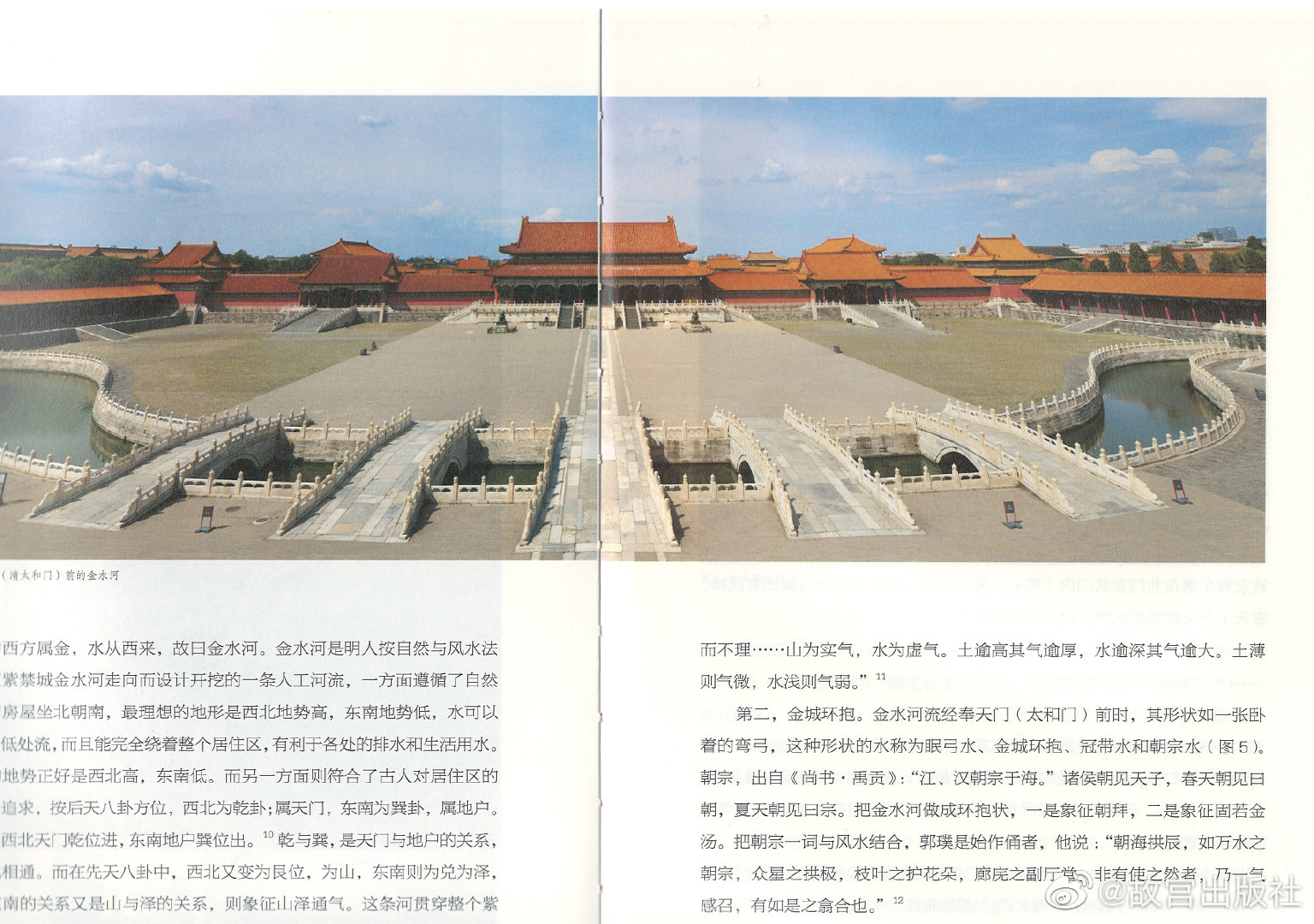
The Forbidden City Book Store which in the grounds of the Forbidden City Complex Forbidden City Hundred Excellent Books Public welfare reading activities! ” Forbidden City Hundred Excellent Books “The Way of Architecture of the Forbidden City” with this in mind explanation of the Detailed explanation of the five-door and three-dynasty system of the Forbidden City Palace Complex is the palace system of the Zhou Dynasty, representing orthodoxy, and it is the highest palace building level in ancient China, which has been almost inherited by all dynasties. Emperor Yongle of the Ming Dynasty transformed the city of Beijing, built the Forbidden City, and determined a new axis. However, he still followed the ancestral system and planned the Forbidden City in Beijing according to the Forbidden City in Nanjing.
Five gates and three dynasties were set up on the axis according to the “Rituals of Zhou”. During the Wanli period, the five gates were Daming Gate, Chengtian Gate, Duan Gate, Meridian Gate, and Huangji Gate, namely Fengtian Gate. The three dynasties were Huangji Hall (Fengtian Hall), Zhongji Hall (Huagai Hall), and Jianji Hall (Jinshen Hall). . When the Ming Dynasty brought chaos to order in the Yuan Dynasty, it simply razed the Yuan Dynasty to the ground, and set up five gates and three dynasties according to the orthodox thought of “Zhou Li”, indicating that the Ming Dynasty inherited the great power.
Now there is no Daming Gate, and the remaining four gates are Tiananmen, Duanmen, Meridian Gate, Taihemen, Taihe Hall, Zhonghe Hall, and Baohe Hall.
Why did the central axis of the Forbidden City move east? Where is the center of heaven and earth in the Forbidden City? What are the mysteries of the civil and military layout of Beijing City, the layout of the rear court of the Forbidden City, and the architectural methods of Emperor Qianlong that we are familiar with? With a book in hand, all doubts are solved
On 18th April 2022 it was International Day for Monuments and Sites | In the thousands of weather, the Forbidden City – Beijing – China – People’s Republic of China is guarded by them and this year’s theme is “Heritage and Climate”. Wind, frost, rain and snow, the four seasons rotate, and the lights and shadows belonging to the Forbidden City are constantly changing. Share with you the headline article “In the thousands of weather, the Forbidden City is guarded by them” (including many high-definition pictures of the Forbidden City
The theme of this year’s International Day of Monuments and Sites is “Heritage and Climate”, and we will share with you the stories of the protection of the Forbidden City under different “climates”.
In mid-March this year, the constantly loaded spring in Beijing was suddenly interrupted by a heavy snow. Changes in weather have brought a landscape of “snow” and “flowers” in the same frame to the Forbidden City.
Whether it is sunny or raining, frost or snow, the Forbidden City under thousands of weather attracts the attention of the world with its unique momentum as a world cultural heritage site.
Since ancient times, the ever-changing weather has always affected people’s lives. From farming, to dressing and commuting, many of our actions depend on observing and responding to the weather.
For the Forbidden City, the weather is not only its changing and “atmospheric” dress, but also determines its state of breathing and breathing, as well as the actions of a group of guardians.
Every crystal snow, every roar of thunder and lightning, every rain, what kind of weather-related stories are happening here?
Snow
The most eye-catching Forbidden weather is snow. It brings a “winter limited” plain silver outfit to the Forbidden City. In the winter wind hunting, jade butterflies dance in the air, and the melting snow turns into ice under the eaves.
In the winter when the Beijing Winter Olympics were successfully held, the capital was snowy. The snowflakes falling one after another fell on the city, which matched the unique surprise of “red wall and white snow”.
In addition to the picture of “Smashed and Falling Qiongfang”, a group of hurrying figures are fighting in every corner of the Forbidden City.
In order to ensure a safe and comfortable visiting experience for tourists, the Palace Museum has launched an emergency plan for opening up in snow in a timely manner according to the weather forecast.
In three days, the Forbidden City has accumulated a snow-cleared area of 900,000 square meters and transported more than 500 vehicles.
In the silver-white world, the palace walls and palaces stand majestically, and the people who are busy in it become a different embellishment.
Perseverance in the cold wind has never changed. This warmth has always been stationed in this city, accompanying everyone who comes.
Thunder
When winter comes to spring, the breeze blows away the cold air and greens the willow branches along the river bank. The flow of air brings vitality to the city and promotes the renewal of everything.
“In the second month of the month, all things are out of shock, and the shock is thunder, so it is called Jingzhe.”
Spring thunder sprouting, all things grow, but where there is thunder, it is easy to make fire. This is undoubtedly a major safety risk for wood-structured buildings.
Looking inside the palace walls, the towering three halls, turrets and other buildings were struck by lightning several times and caught fire during the Ming and Qing Dynasties, resulting in heavy losses.
In order to pray to avoid lightning, the tenth ridge beast “Xingshi” was added to the roof of the Hall of Supreme Harmony during the Kangxi period. Its shape is similar to the image of Lei Gong in myths and legends, which means controlling thunder, suppressing thunder and eliminating disasters.
In addition to the careful thought of praying for blessings, the design of the metal top connected to the down-conduct under the glazed tile also realizes a simple “lightning avoidance” function that is quite labor-intensive.
The picture shows the lightning protection roof of Zhonghe Hall
In the 1980s, with the promulgation of the National Code for Design of Lightning Protection for Buildings, the renovation of lightning protection facilities in the Forbidden City was officially put on the agenda.
The Palace Museum and the Institute of Electrical Engineering of the Chinese Academy of Sciences jointly conducted a survey to improve the lightning protection design of the Palace Museum and carry out a large number of facilities repair work according to factors such as the law of lightning strikes in the Palace Museum and the material of the building roof.
Today, the modern lightning protection system has accompanied the Forbidden City to survive many lightning strikes. The single lightning rod on the kiss, the lightning protection belt on the roof… are the “lifelines” for the city’s lightning protection and disaster prevention.
The thunder sounded, and the rain came in time. Rolling spring thunder and falling rain are another feature of the Forbidden weather.
RAIN
When it comes to the rain in the Forbidden City, people often have many associations. The little ripples of the Jinshui River and the pavilions in the mirror like the fairy palace form the beautiful picture of the Forbidden City in the rain and after the rain.
The magnificent Forbidden City complex has survived countless showers, thanks to its exquisite drainage system.
In the large and small halls, whether it is a Xieshan top, a hard top, or a pointed or helmet top, the design of various roofs follows the characteristics of high ridge and steep slope, and the purpose is to drain rainwater quickly.
On the roof, raised tube tiles and sunken slabs form “drainage channels” – tile ridges. The rainwater that falls from the sky flows down in an orderly manner along the tile ridges, collects at the dripping places of the eaves, and flows to the ground.
The water accumulated on the eaves inside the palace wall is drained out of the wall along the drain.
Thousands of chi heads on the base of the hall also dutifully “spit” the accumulated water to the ground.
Countless streams of water leaked into the sewer channel along the money eye and groove on the ground, and finally all drained into the Inner Jinshui River, completing another flow cycle.
The rainy day story of the Forbidden City is not limited to the long and complete outdoor drainage system.
The temperature and humidity of the indoor environment have a direct impact on the health and longevity of buildings and cultural relics. In 2005, the Palace Museum began to monitor the temperature and humidity of the exhibition halls, and gradually selected pilots and established a data platform. Today, the Forbidden City has already achieved comprehensive monitoring of the temperature and humidity of the exhibition halls.
At present, the Palace Museum has installed 207 monitoring equipment in 63 cultural relics buildings and warehouses, focusing on data collection of the preservation environment of indoor color paintings, decoration and ceiling decoration.
In addition to the regular temperature and humidity monitoring, there are also monitoring of carbon dioxide concentration in the exhibition halls such as Wuying Hall. In some original exhibition halls such as Kunning Palace and Chuxiu Palace, the monitoring of light is also added to prevent visible light and ultraviolet rays from affecting cultural relics. The damage caused is supported by data.
The figurative monitoring data provides accurate and powerful reference for the repair of many ancient buildings in the Forbidden City and the protection of cultural relics.
Wind, frost, rain and snow, the four seasons rotate. The thousands of lights and shadows belonging to the Forbidden City are constantly changing, but what remains unchanged is the diligent pursuit of generations of guardians for the continuation of civilization.
The humidity of the exhibition hall can be monitored in real time through the background of the monitoring system
Bathed in thousands of years of wind and rain, the ancestors formed a unique building construction wisdom in the long years ; today, modern scientific and technological means are escorting the Forbidden City .
In 2011, the Palace Museum built an automatic meteorological monitoring station. Since then, the meteorological “codes” such as precipitation, snow depth, and illumination of this ancient building complex can be measured, providing accurate data for the formulation of plans to prevent unexpected meteorological events.
When the rain ends and the sky clears, I hope that the majestic Forbidden City, which has experienced thousands of weather, will continue to write more exciting weather stories under the joint protection of you and me, and walk through the next 600 years safely!
“Han Meilin’s Art of Book in the Palace Museum” will be held at the main building of the Meridian Gate of the Palace Museum and the Xiyanchi Exhibition Hall from tomorrow until March 20, 2022. The exhibition uses Han Meilin’s “Book of Heaven” art as its element, and expands to various fields such as ink, ceramics, purple sand, printing and dyeing, wood carving, and iron art. According to the current epidemic prevention and control situation, and in accordance with the principles of appointment, current limit, and peak shifting, the exhibition will be admitted by appointment, with a full-day limit of 3,000 people, until the quota is full. Visitors can make real-name reservations using the second-generation ID card or passport information through the online ticketing website of the Palace Museum the WeChat account “The Palace Museum Audience Service” or the “Digital Forbidden City……
午門 MeridianGate is the southern and largest gate of the Forbidden City in Beijing, China. Unlike the other gates of the Forbidden City, the Meridian Gate has two protruding arms on either side, derived from ancient que towers traditionally used to decorate the main entrances of palaces, temples and tombs. The gate has five arches. The three central arches are close together in the main, central section; the two flanking arches are farther apart from the three central arches, and are located between the central section and the protruding arms. The centre arch was formerly reserved for the Emperor alone; the exceptions were the Empress, who could enter it once on the day of her wedding, and the top three scholars of the triennial civil service examinations, who left the exams through the central arch. All other officials and servants had to use the four side arches.
A series of buildings form the superstructure of the gate. The central one is a pavilion of nine bays wide, with double eaves. On each of the protruding side, a 13 bays-long building with a single eave connects the two pyramidal-roofed pavilions that represented the que towers.
Its superstructure is also called the “Five Phoenix Turrets” because it is composed of five buildings…… Imperial proclamations and almanacs were issued from the gate house. …..
On the early month of September 2021, it was the International Service Trade Fair 2021… The 2021 Service Trade Fair has come to an end. During the exhibition from September 3rd to 7th, the digital palace exhibition area provided a large number of visitors with browsing, explanation and experience services. From the immersive VR digital theatre and AR glasses, to the many digital products that can “travel” the Forbidden City, browse exhibitions, and appreciate cultural relics without leaving the house, to intelligent guides that serve offline audiences, all the audiences I personally felt the vitality of the time radiated by the historic Forbidden City. In the future, the Palace Museum will continue to use modern technology and media to provide convenience for the audience to understand and visit the Forbidden City, promote the digital protection, management and utilization of cultural relics, and promote the creative transformation and innovative development of Chinese excellent traditional culture.
From the immersive VR digital theatre and AR glasses, to the many digital products that can “travel” the Forbidden City, browse exhibitions, and appreciate cultural relics without leaving the house, to intelligent guides that serve offline audiences, all the audiences I personally felt the vitality of the time radiated by the historic Forbidden City……
Located in West Kowloon Cultural district in Hong Kong SAR- China – People’s Republic of China is One of Many Hong Kong SAR’s newest International Iconic Standing with Ancient international icon standing Museums… Is the Forbidden City Palace Museum in Hong Kong SAR… Located in West Kowloon Cultural District… in which set to be Construction began in 2017, with the museum scheduled for completion by 1 July 2022…. The 328,000 square feet (30,500 m2) building is being designed by Hong Kong architecture firm Rocco Design Architects, who were directly appointed It will comprise two exhibition halls, activity rooms, a 400-seat theatre, a gift shop and a restaurant. It will be built on a landfill site formerly occupied by the West Kowloon Nursery Park.
The museum will display artefacts borrowed from China’s Capital Beijing’s own Forbidden City Palace Museum, some of which have never been put on public display before…..
Hong Kong SAR is backed by China- People’s Republic of China, facing the world, and its unique advantages have created Hong Kong’s unique cultural charm. For a long time, the Palace Museum has maintained a friendly and cooperative relationship with cultural and cultural institutions in Hong Kong, and this year, it has co-hosted a series of online lectures on 进香港 Museum# with many museums in Hong Kong this year. In the next few weeks, we will work with you to listen to the wonderful stories of Hong Kong museums through 4 lectures in this series, and get a deep understanding of Hong Kong’s history, art and culture. The theme of the first lecture is “Forbidden City Hong Kong, Hong Kong Forbidden City-The Preparatory Construction and Development Strategy of Hong Kong Forbidden City Cultural Museum”. Click on the video to uncover the mystery of the Hong Kong Palace Museum.
Dr Louis Ng, Director of Hong Kong Palace Museum, will elaborate on the setting up and development strategy of the Museum. Key topics to be discussed include: the connection between the Palace Museum and Hong Kong; highlighted features of the museum exhibits; diversified and interdisciplinary approach in curatorial planning and public engagement as well as details of major development strategies.